Parapsychology
eBook - ePub

Parapsychology

  1. 224 pages
  2. English
  3. ePUB (mobile friendly)
  4. Available on iOS & Android
eBook - ePub

Parapsychology

About this book

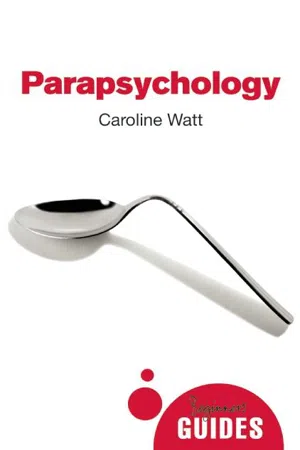
From premonitions to apparitions, spoon-bending to mind-reading, the paranormal has bemused and mystified humans for millennia.In this Beginner's Guide, renowned author and scientist Dr Caroline Watt explores the evidence behind such phenomena. In the last one hundred years, parapsychologists have tried to determine whether it is possible to examine paranormal activity using scientific methods. Packed full of interesting characters, surprising incidents and novel experiments, this book takes the reader on a journey through this fascinating research. Parapsychology: A Beginner's Guide traces the history and evolution of parapsychology as a science, and provides a thorough and critical analysis of the research and evidence in the field today.
Frequently asked questions

Yes, you can cancel anytime from the Subscription tab in your account settings on the Perlego website. Your subscription will stay active until the end of your current billing period. Learn how to cancel your subscription.
No, books cannot be downloaded as external files, such as PDFs, for use outside of Perlego. However, you can download books within the Perlego app for offline reading on mobile or tablet. Learn more here.
Perlego offers two plans: Essential and Complete
  • Essential is ideal for learners and professionals who enjoy exploring a wide range of subjects. Access the Essential Library with 800,000+ trusted titles and best-sellers across business, personal growth, and the humanities. Includes unlimited reading time and Standard Read Aloud voice.
  • Complete: Perfect for advanced learners and researchers needing full, unrestricted access. Unlock 1.4M+ books across hundreds of subjects, including academic and specialized titles. The Complete Plan also includes advanced features like Premium Read Aloud and Research Assistant.
Both plans are available with monthly, semester, or annual billing cycles.
We are an online textbook subscription service, where you can get access to an entire online library for less than the price of a single book per month. With over 1 million books across 1000+ topics, we’ve got you covered! Learn more here.
Look out for the read-aloud symbol on your next book to see if you can listen to it. The read-aloud tool reads text aloud for you, highlighting the text as it is being read. You can pause it, speed it up and slow it down. Learn more here.
Yes! You can use the Perlego app on both iOS or Android devices to read anytime, anywhere — even offline. Perfect for commutes or when you’re on the go.
Please note we cannot support devices running on iOS 13 and Android 7 or earlier. Learn more about using the app.
Yes, you can access Parapsychology by Caroline Watt in PDF and/or ePUB format, as well as other popular books in Psychology & History & Theory in Psychology. We have over one million books available in our catalogue for you to explore.
1
Introduction: The roots of parapsychology
Surveys suggest that around 50% of those in both America and Britain believe in the existence of the paranormal, and about 30% of people claim to have had a psychic experience. This statistic means that, if you have not had a paranormal experience yourself, you probably know someone who has. This book describes the research that has been conducted in an attempt to understand these unusual, but surprisingly common, experiences.
The study of such experiences, parapsychology, can be traced back to some strange events in the mid-nineteenth century in Hydesville, New York, which seemed to suggest that some individuals could communicate with the deceased. Pioneering researchers grappled with the challenge of testing claims of afterlife communication. In the process they developed the three main approaches that are now employed in parapsychological research. But before we find out more about how parapsychology came to be what it is today, let’s briefly consider what parapsychology is not.
Misconceptions about parapsychology
When I am sitting on an aeroplane and the stranger in the seat next to me asks what I do, I sometimes hesitate to answer. Yes, I am a researcher looking at quite a fascinating and sometimes controversial topic. But before I tell my fellow traveller what my job entails, I often have to dispel some myths that exist about parapsychology. For example, quite understandably, many people associate parapsychology with popular films such as Ghostbusters. In fact, parapsychologists do not run around in boiler suits, hunting down marauding ghosts with proton packs. Instead, like other scientists, parapsychologists often carry out well-controlled studies and publish their findings in both mainstream and specialist academic journals.
Furthermore, parapsychologists typically have little interest in UFOs, astrology, occult beings, Bigfoot, or the Loch Ness Monster. Their principal interest is in the capabilities and experiences of living human beings – hence the ‘psychology’ part of the discipline’s name. But ‘para’ means ‘beyond’, which signifies that parapsychologists are particularly interested in exceptional or anomalous human capabilities and experiences. So, they are interested in seemingly paranormal phenomena such as telepathy, clairvoyance, precognition, psychokinesis, out-of-body experiences, reincarnation, apparitions, hauntings, and spirit communication. The University of Edinburgh’s Koestler Parapsychology Unit (KPU), of which I am a founder member, has studied many of these phenomena since its inception in 1985. Over these three decades, many members of the public have contacted us to report their unusual experiences. Throughout this book, I will delve into the KPU archives to illustrate some of these experiences (to protect privacy, some details have been changed and pseudonyms are used).
Finally, being a parapsychologist does not necessarily mean that one believes in the existence of such phenomena. Although many researchers find the evidence for psychic abilities convincing, others are less certain and some are even very sceptical. I tend to take the middle position. I consider that there is sufficient evidence to justify further work, but not enough to conclude that paranormal abilities exist. Throughout this book, I will refer to paranormal phenomena and abilities. For fluency of expression, I will avoid repeatedly using terms such as ‘alleged’, ‘purported’, and ‘claimed’, although this is not meant to imply that I think such phenomena are genuine.
It’s now time to go back to the roots of parapsychology. The story begins with an age-old question: is there life after death?
The Fox sisters
For centuries paranormal phenomena were discussed and debated, but rarely subjected to systematic investigation. Then, in the mid-nineteenth century, two young girls set in motion a series of events that eventually led to the birth of modern-day parapsychology.
In March 1847, teenage sisters Kate and Margaret Fox from Hydesville in New York claimed to be able to talk to the dead. These strange conversations involved the sisters asking simple questions out loud and the ‘spirits’ apparently replying with a series of raps. The popularity of the sisters’ demonstrations encouraged others to claim that they could also communicate with the dead. Early demonstrations often involved what became known as ‘physical mediumship’, wherein the spirits would make their presence known by rapping, moving objects, writing on slates, and even materializing limbs and figures. Over time other demonstrations involved so-called ‘mental mediumship’, wherein people would appear to enter a trance in order to channel messages from the dead, either directly from the deceased or with the supposed help of a spirit control.
Within a few years, hundreds of thousands of people became convinced that these demonstrations provided compelling evidence of life after death.
Although the majority of Victorian scientists were fiercely sceptical about the existence of paranormal phenomena, some researchers adopted a more open-minded approach towards the topic. Often driven by either a discomfort with the materialistic worldview or by personal bereavement, some of these academics invested considerable amounts of time and energy carrying out lengthy and intricate investigations.
A medium under the microscope
Several well-known Victorian scientists examined the existence of psychic ability, with one of the most important and influential studies being Sir William Crookes’s investigation of Daniel Dunglas Home (pronounced ‘Hume’). Crookes was a British chemist, a Fellow of the Royal Society, and a pioneer of the vacuum tube. In contrast, Home was a Scottish-born medium who claimed to be able to produce a range of psychic phenomena, including the ability to move heavy objects with the power of his mind and handle hot coals without burning himself.
In the early 1870s, Crookes carried out a series of studies into Home’s claims, and eventually declared that Home could indeed demonstrate paranormal phenomena under controlled conditions. When Crookes published the results of this work in a well-respected scientific journal, many of his colleagues turned against him and argued that his investigations were deeply flawed. This criticism proved damaging to Crookes’s career, with some academics even suggesting that his Fellowship of the Royal Society be revoked. Subsequently, Crookes became more cautious about publicizing his work with mediums, and only returned to openly publishing on the topic once he felt his position within academia was secure.
Worried that such career-damaging episodes would deter academics from investigating spirit communication, Spiritualist and writer Edmund Rogers proposed forming an organization that would place the scientific investigation of mediums on a more respectable footing. Rogers contacted several academics who were known to be positively predisposed to the paranormal, and suggested that they create a formal society. Rogers’s work eventually led to the formation of the Society for Psychical Research in 1882.
Exact and unimpassioned enquiry
The Society for Psychical Research (SPR) was the world’s first organization devoted to the scientific study of paranormal phenomena. Created by Rogers and a small group of highly eminent scholars, the SPR aimed to investigate ‘that large body of debatable phenomena designated by such terms as mesmeric, psychical and “spiritualistic” 
 in the same spirit of exact and unimpassioned enquiry which has enabled Science to solve so many problems’.
The SPR’s first president was a respected moral philosopher from Cambridge University, Henry Sidgwick. Sidgwick’s co-founders included classicist and poet Frederic Myers, psychologist Edmund Gurney, and mathematician (and Sidgwick’s wife) Eleanor. Eleanor Sidgwick had been born into arguably the most influential political dynasty in nineteenth-century Britain, and her brothers – politician Gerald Balfour and future British Prime Minister Arthur Balfour – also played key roles in forming the Society. This inner circle of scholars and politicians was soon joined by an illustrious group of scientists, including Sir William Crookes, physicist Sir William Barrett, Nobel laureate physicist Sir Joseph John Thomson, and physicist Sir Oliver Lodge.
Many of the SPR’s founding fathers were drawn to the organ-ization out of intellectual curiosity, while others were eager to have science confirm their religious beliefs. Sir Oliver Lodge, for instance, was a committed Christian who believed that the human spirit survived physical death, and William Barrett was a strong Spiritualist. However, despite their differing motivations and beliefs, all of the founders were prepared to align themselves with the SPR’s stated goal, namely to examine: ‘without prejudice or prepossession and in a scientific spirit those faculties of man, real or supposed, which appear to be inexplicable on any generally recognized hypothesis’.
Membership of the SPR soon swelled, and its researchers started to work with scientists on the European Continent, including French physiologist and future Nobel Prize-winner Charles Richet. In 1885, Harvard philosopher William James helped psychical researchers on either side of the Atlantic to collaborate by forming the American Society for Psychical Research (ASPR).
Initial work
Much of the early SPR research focused on one of the three strands of work central to modern-day parapsychology, namely testing those claiming strong mediumistic and psychic powers. Unfortunately for those wanting to believe in evidence of an afterlife, many of those producing demonstrations of physical mediumship were caught dressing up and impersonating spirits, employing accomplices, and using magic tricks to create séance phenomena. As a result, many SPR researchers started to turn their attention away from spirit raps and manifestations, and towards demonstrations of mental mediumship. This work entailed psychical researchers documenting the messages that allegedly came from the dead and then trying to ascertain the accuracy of those messages. The investigations proved time-consuming and controversial, with sceptics arguing, for example, that the mediums may have discovered the information through normal means, or that the messages were vague and therefore open to interpretation.
Lengthy reports describing investigations into physical and mental mediumship were published in the SPR’s Journal and Proceedings. Proponents of the paranormal believed that this large body of work proved the existence of mediumistic and psychic powers, while sceptics argued that the research had only yielded evidence of self-deception and trickery.
THE CREERY SISTERS
Whereas mediums claim to be able to communicate with the dead, psychics claim that they possess the ability to read minds, see into the future, or reveal concealed information. Some SPR research involved examining those claiming psychic powers. In 1882, for example, the respected physicist Sir William Barrett investigated the telepathic abilities of the Creery family from Derbyshire in the UK. The Reverend A.M. Creery (‘a clergyman of unblemished character’) had contacted the SPR and described a series of informal experiments that he had conducted with his daughters. During these experiments, Creery’s daughters appeared able to read his mind, and the Reverend invited the SPR to stage a more formal investigation. Intrigued, the SPR researchers travelled to the Creerys’ house and carried out a series of studies with the family over a six-year period. During Barrett’s experiments, one of Creery’s daughters would first leave the room. Those remaining in the room would then randomly select an object, or playing card, and the absent daughter would then return to the room and attempt to psychically identify the object or card. The researchers reporte...

Table of contents

  1. Cover
  2. Half title
  3. Series page
  4. Title page
  5. Copyright page
  6. Dedication
  7. Contents
  8. Acknowledgements
  9. Terminology and phenomena
  10. List of illustrations
  11. Epigraph
  12. 1. Introduction: The roots of parapsychology
  13. Section 1: Testing psychic claimants
  14. 2. Macro-PK
  15. 3. Psychic reading, remote viewing, and telepathic animals: ESP outside the lab
  16. 4. Mediumship and survival
  17. Section 2: Anomalous experiences
  18. 5. Out-of-body experiences
  19. 6. Near-death experiences
  20. 7. Hauntings and apparitions
  21. 8. The psychology of psychic experiences
  22. Section 3: Laboratory research
  23. 9. Telepathy and clairvoyance in the laboratory
  24. 10. Precognition in the laboratory
  25. 11. Mental influence in the laboratory: Physical and biological
  26. 12. Conclusion: Parapsychology’s value
  27. Appendix: How to test for ESP and PK ability
  28. Further reading
  29. Glossary