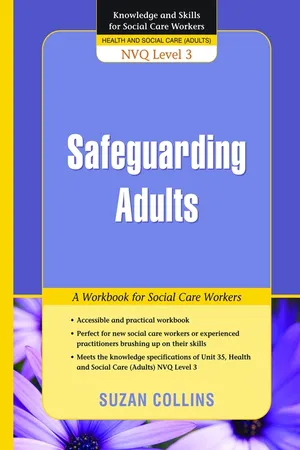
Safeguarding Adults
eBook - ePub

Safeguarding Adults

A Workbook for Social Care Workers

  1. 80 pages
  2. English
  3. ePUB (mobile friendly)
  4. Available on iOS & Android
eBook - ePub

Safeguarding Adults

A Workbook for Social Care Workers

About this book

Working in residential or domiciliary settings involves a responsibility to safeguard adults from harm and abuse. This workbook will provide staff and relatives with the ability to make sensible choices concerning prevention and protection, as well as responding to and reporting concerns.

Safeguarding Adults examines the different forms of abuse, where abuse can take place and how and where to report the suspected abuse. The workbook meets the requirements of care standards and promotes best practice by enabling staff to feel confident contributing to keeping the people they support safe from harm and abuse.

Designed to meet the requirements of Health and Social Care (Adults) NVQ Level 3, Unit 35, this workbook is also a valuable source of guidance for any social care worker wanting or needing to improve their practice in relation to safeguarding adults from harm and abuse.

Frequently asked questions

Yes, you can cancel anytime from the Subscription tab in your account settings on the Perlego website. Your subscription will stay active until the end of your current billing period. Learn how to cancel your subscription.
No, books cannot be downloaded as external files, such as PDFs, for use outside of Perlego. However, you can download books within the Perlego app for offline reading on mobile or tablet. Learn more here.
Perlego offers two plans: Essential and Complete
  • Essential is ideal for learners and professionals who enjoy exploring a wide range of subjects. Access the Essential Library with 800,000+ trusted titles and best-sellers across business, personal growth, and the humanities. Includes unlimited reading time and Standard Read Aloud voice.
  • Complete: Perfect for advanced learners and researchers needing full, unrestricted access. Unlock 1.4M+ books across hundreds of subjects, including academic and specialized titles. The Complete Plan also includes advanced features like Premium Read Aloud and Research Assistant.
Both plans are available with monthly, semester, or annual billing cycles.
We are an online textbook subscription service, where you can get access to an entire online library for less than the price of a single book per month. With over 1 million books across 1000+ topics, we’ve got you covered! Learn more here.
Look out for the read-aloud symbol on your next book to see if you can listen to it. The read-aloud tool reads text aloud for you, highlighting the text as it is being read. You can pause it, speed it up and slow it down. Learn more here.
Yes! You can use the Perlego app on both iOS or Android devices to read anytime, anywhere — even offline. Perfect for commutes or when you’re on the go.
Please note we cannot support devices running on iOS 13 and Android 7 or earlier. Learn more about using the app.
Yes, you can access Safeguarding Adults by Suzan Collins in PDF and/or ePUB format, as well as other popular books in Social Sciences & Social Work. We have over one million books available in our catalogue for you to explore.
Different Types of Abuse
In this section, you will be reading about different types of abuses and the possible signs and symptoms that can be present. Please be aware that these are possible signs and symptoms of abuse, but they can also be signs and symptoms of something else, e.g. a person you are supporting may have bruises on her hip because she keeps tripping over the carpet. You will need to record everything that concerns you.
This section describes signs and symptoms of the service user. However, be aware that the abuser could also show signs, such as always wanting to be with the service user, or not allowing visitors or telephone calls.
Types of abuse:
physical
financial or material
sexual
psychological and emotional
neglect and acts of omission
self-neglect
discriminatory
institutional.
PHYSICAL ABUSE
Physical abuse can include the following:
punching
pinching
slapping
shaking
hitting
sedating
pushing
restraining
scratching
kicking
rough handling.
Physical abuse in medication can take the form of undermedicating, overmedicating or withholding medication, and also inappropriately altering medication labels and/or records.
Signs and symptoms of physical abuse can include the following:
loss of hair in one area and sore scalp
anxiety or fear
unexplained injuries
self-harm
marks resulting from a slap
fractures
sprains
unexplained burns (e.g. on back of hands)
drowsiness
flinching and cowering
many bruises inconsistent with an explanation (e.g. knocked self, had a fall)
the service user needs medical advice but will not go to see the GP or frequently changes GPs.
You should not use control and restraint unless there is an agreed procedure in place and you have received appropriate training.
Control and restraint should be used only as a last resort. Each time this is used, a control and restraint form must be completed.
image
Is control and restraint happening in your workplace?
Yes/No
If you have answered ‘Yes’, is there an agreed procedure in place?
Yes/No
Have staff received appropriate training?
Yes/No
If control and restraint is happening in your workplace and there is not an agreed procedure in place and/or staff have not received training you must report this immediately.
You can report it to:
management
CQC.
image
A service user tells you that she has bruises on her arms and that the staff did it because she would not do the washing up. What do you do?
FINANCIAL OR MATERIAL ABUSE
Financial or material abuse can include the following:
taking things that belong to the service user
taking money
misusing money
being pressurized to give mo...

Table of contents

  1. Cover Page
  2. Title Page
  3. Copyright
  4. Acknowledgements
  5. Contents
  6. Introduction
  7. Prevention and Protection
  8. Needs and Preferences
  9. The Principles of Care
  10. Who is a Vulnerable Adult?
  11. What is Abuse?
  12. Notifiable Incidents
  13. Factors that May Make Abuse More Likely to Occur
  14. Different Types of Abuse
  15. Power
  16. Circumstances Where Abuse Can Occur
  17. Providing Opportunities to Share Concerns
  18. Reporting and Responding to Concerns
  19. Barriers to Reporting Concerns
  20. Self-harm
  21. Questions to Test your Knowledge
  22. True and False Exercises
  23. Self-Assessment Tool
  24. Certificate
  25. Knowledge Specification Chart
  26. Legislation and Useful Websites
  27. References
  28. Back Page