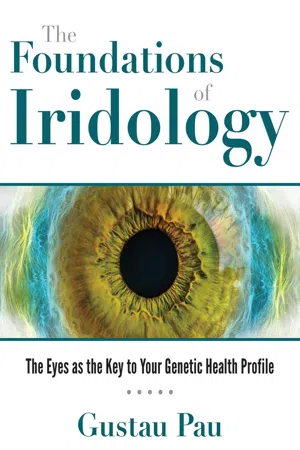
The Foundations of Iridology
eBook - ePub

The Foundations of Iridology

The Eyes as the Key to Your Genetic Health Profile

  1. 160 pages
  2. English
  3. ePUB (mobile friendly)
  4. Available on iOS & Android
eBook - ePub

The Foundations of Iridology

The Eyes as the Key to Your Genetic Health Profile

About this book

A complete guide to decoding the iris to reveal health predispositions for prevention and early treatment • Details the fundamental reflex signs of iridology and how to identify constitutional strengths and weaknesses in the stroma, pigments, and capillaries of the eyes as well as read energy patterns in pupil tone • Explores the history and development of iridology from the 18th century to today • Includes analysis of real case studies with full-color photos and illustrations The iris of your eye is a personal and unique identifier that expresses much more about us than we can imagine. Through detailed observation of the irises' stroma, pigments, and capillaries, you can determine a person's constitutional strengths and weaknesses and gain insight into their genetic predisposition to certain illnesses as well as preventive and treatment options that would be most effective. By reading the iris, practitioners of natural medicine can interpret the signs that reveal a client's lifestyle choices and use this knowledge to make enlightened decisions regarding the client's health plan and how to help them realize their full potential. In this full-color guide, Gustau Pau, an iridologist with more than 35 years of experience, details the chromatic scale and signs expressed in the eyes and how to use them to identify organs and their function as well as susceptibility to specific ailments. He explores the history and development of iridology from Hildegard von Bingen's work on healing to 18th-century European scientists, including Ignaz von Peczely, the father of modern iridology. He reveals recent iridology developments on identifying genetically inherited physical traits, explaining how individuals can use this insight to make nutritional and lifestyle choices that will offset inherited weaknesses and bolster strengths. Focusing on the digestive system, he shows how the pupillary zone can reveal digestive function and demonstrates how diet is responsible for causing many diseases. The author also explores miasmas in the eyes, includes methods for reading energy patterns in pupil tone, and offers the scientific explanation for the old contention that the "eyes are the windows of the soul." Illustrating the fundamental signs that iridologists use for reference, Pau provides sample iridographies and real case studies with photos and diagrams. Explaining how scientific research on the eye has not yet caught up with the innovations of iridology, he shows how the eyes reveal both our internal state and future health and have a much broader role in the body that we are only now just discovering.
Frequently asked questions

Yes, you can cancel anytime from the Subscription tab in your account settings on the Perlego website. Your subscription will stay active until the end of your current billing period. Learn how to cancel your subscription.
No, books cannot be downloaded as external files, such as PDFs, for use outside of Perlego. However, you can download books within the Perlego app for offline reading on mobile or tablet. Learn more here.
Perlego offers two plans: Essential and Complete
  • Essential is ideal for learners and professionals who enjoy exploring a wide range of subjects. Access the Essential Library with 800,000+ trusted titles and best-sellers across business, personal growth, and the humanities. Includes unlimited reading time and Standard Read Aloud voice.
  • Complete: Perfect for advanced learners and researchers needing full, unrestricted access. Unlock 1.4M+ books across hundreds of subjects, including academic and specialized titles. The Complete Plan also includes advanced features like Premium Read Aloud and Research Assistant.
Both plans are available with monthly, semester, or annual billing cycles.
We are an online textbook subscription service, where you can get access to an entire online library for less than the price of a single book per month. With over 1 million books across 1000+ topics, we’ve got you covered! Learn more here.
Look out for the read-aloud symbol on your next book to see if you can listen to it. The read-aloud tool reads text aloud for you, highlighting the text as it is being read. You can pause it, speed it up and slow it down. Learn more here.
Yes! You can use the Perlego app on both iOS or Android devices to read anytime, anywhere — even offline. Perfect for commutes or when you’re on the go.
Please note we cannot support devices running on iOS 13 and Android 7 or earlier. Learn more about using the app.
Yes, you can access The Foundations of Iridology by Gustau Pau in PDF and/or ePUB format, as well as other popular books in Medicine & Alternative & Complementary Medicine. We have over one million books available in our catalogue for you to explore.
1
Anatomy and Physiology of the Eye
image
As embryos we have two hearts, which later fuse to form one, what a pity; and we have one single eye, which later splits in two, how lucky.
FRANCISCO ORTS LLORCA
OCULAR ANATOMY
The eyeball has a spherical shape that is slightly flattened in relation to its vertical axis. The cornea, which is transparent, is located in the front part of the eye, forming a protuberance on the surface. The eyeball is made up of membrane formations (enveloping membranes) called the sclera, choroid, and retina, as well as transparent, refractive liquid and solid elements (the cornea, aqueous and vitreous humor, and lens).
The iris is the front part of the choroid, and its movement inspired the diaphragmsused on photographic cameras. The iris has a delicate consistency; it is twelve to thirteen millimeters in diameter and averages just three-tenths of a millimeter in thickness. It has two surfaces (anterior and posterior) and two circumferences (major and minor).
From the anterior to the posterior, the iris is composed of the endothelium, the stroma, and a posterior pigmented layer.
image
Endothelium
This layer of flattened polygonal cells forms a continuum in contact with the aqueous humor (the liquid found in the anterior chamber of the eye).
Stroma
The stroma is the tissue of the iris, formed by connective tissue, chromatophore cells, muscle fibers, neurofilaments, blood and lymphatic vessels, and a basement membrane. It has a deep layer with a one-millimeter-wide annular ring of muscle fibers (sphincter) whose contraction decreases the size of the pupil.
image
Posterior Pigmented Layer
At the rear of the iris are two rows of dark purple-colored retinal epithelial cells. They protrude from the minor circumference of the iris, surrounding the pupil.
INNERVATION
The iris is innervated by the autonomic nervous system, with thoracolumbar sympathetic branches and craniosacral parasympathetic branches.
The annular muscle fibers and ciliary muscle are innervated by the short ciliary nerve branch of the oculomotor nerve (cranial nerve III), which originates in the midbrain.
The fibers of the dilator muscle are innervated by the long ciliary nerves, which are connected to the sympathetic cervical ganglion.
These nerves reach the iris through the choroid layer of the eyeball, forming the iridian plexus, from where they are distributed to the muscle fibers and other structures of the iris. Some neurofilaments form a network or mesh on the subendothelial surface. This sensitive mesh is made up of triangular units having concentric circumferences and vertices pointing toward the pupil; the triangles located at the periphery of the iris have larger bases. The sides of these triangular units coincide with tiny vessels and neurofilaments. Furthermore, there is another deep nerve network with a motor component.
In terms of motor units, the iris is the most sensitive in the body. As comparison, a leg muscle might allocate 120 muscle fibers per motor unit. The iris muscles require the impressive number of one to eight fibers per motor unit—that is, enormous specificity for such a small anatomic space.
Nerve Connections
The direct connection of the neurofilaments on the superficial layers of the iris with the cervical ganglion of the sympathetic system and the ciliary ganglion of the parasympathetic system explains how the impressions of the whole organism can be sent to the iris and lets us understand how the tissue of the iris receives nerve signals and blood with energetic and biochemical information from other parts of the body. This information generates iridology signs on the surface of the iris. We know that each part of the organism (form and function) is represented on a certain part of the iris. In regards to this relationship, one of the hardest tasks in iridology, which is also without a doubt the most delicate one, is to accurately determine the areas that correspond to each organ, function, and body part, a task that has not yet been concluded.
By daily observation of this small and delicate part of our anatomy, we believe that we can establish a series of postulates that clearly summarize the possibilities of iridology and its reflexive function, moving away from unsupported definitions like the ones we find in the Pschyrembel clinical dictionary, which states: ā€œIridology: method to recognize diseases in the rest of the body through observation, which is scientifically inadmissible.ā€
(Evidently, if you fall into the trap of thinking that the iris can be used to identify diseases, i.e., pathologies, you will simply have to change your thinking because it is completely wrong.)
Principles of Iridology
In synthesis, we believe that to use iridology effectively, you must adhere to the following points and principles:
  • Time does not modify the structure of the iris, but it modifies its appearance.
  • The absence of signs does not necessarily mean good health.
  • Iridology does not diagnose diseases.
  • Treatments do not modify the structure of the iris, although at times they can modify its appearance.
USES OF IRIDOLOGY
  • To gauge a person’s disposition toward illness
  • To identify the origins of a disease
  • To identify causal relationships for illness
  • To identify the most appropriate healing orientation
  • To provide an overview of a person’s health
  • To assess the relationship between parts
  • To identify the most effective preventive health-care measures
ASSESSMENTS THROUGH THE IRIS
  • Vital tone
  • Ability to recuperate
  • Life expectancy
  • Nutritional status
  • Tissue regeneration capacity
  • Unreactive zones (zones that do not respond to stimuli)
  • Connective muscle tone
  • Nerve strength
  • Suppressions
  • Libido
  • Iatrogenesis indicators
  • Predisposition to cardiovascular symptoms
  • Recovery indicators
  • Irritation points
  • Catarrhal sectors
  • Endocrine lability (i.e., endocrine vulnerability)
CONDITIONS REFLECTED IN SIGNS ON THE IRIS
  • Time
  • Intensity
  • Absence of blockage
  • Affinity or temperament
  • Genetics
  • Trauma
HERING’S LAW
Iridology, which since its creation has coexisted with homeopathy, lets us give a more practical meaning to the axiom proposed by Constantine Hering, an early pioneer in homeopathy. We are talking of the renowned Hering’s law,*1 which we can use in conjunction with iridological observation to look for the path to healing, the path to well-being, and the path of disease, or, with more audacity, the causal identification of disease. It has been our experience that iridology consultations identify some type of chronic disorder in seven out of ten people who say they feel fine. This fact should motivate us to aspire to above-average health in comparison to the general population.
Iridologist Henry Lindlahr contributed to this matter by stating that the path to disease was due mainly to three typically human behaviors: ignorance, convenience, and negligence. An incorrect diet, the wrong job, erroneous thoughts, and inadequate personal relationships are consequences of these behaviors and can be causal factors leading us to ailments.
Modern society has adopted the philosophy of relief (ā€œgetting byā€), where people take drugs that are often unnecessary and that potentiate or stimulate antiphysiological habits, in addition to causing unwanted effects. With medication to prop us up, we go forward in our lives having made very few fundamental changes or none at all, letting day-to-day inertia carry us, and forgetting that nature is always changing. Following this line of thought, a curios aphorism by Hippocrates states that change is good when we want to train ourselves to face fortuitous changes: ā€œThose things which one has been accustomed to for a long time, although worse than things which one is not accustomed to, usually give less disturbance; but a change must sometimes be made to things one is not accustomed to.ā€*2
image
Based on the reflections of health and physiological tendencies that it reveals to us, the iris shows us which changes we must undertake, how to retrace a wrong path, and how to distance ourselves from our ā€œenemies.ā€ Getting rid of a bad habit little by little rarely works; if you are certain of the path, you must be strict and relentless and completely dive in. The first task is to change our way of thinking (from top to bottom and from the inside out, as Hering would say), throw away the obsolete and the burdensome, and assimilate the new. In others words, we must act differently than the average and separate ourselves from social inertia and the latest fads.
Some people, despite the obvious anatomical relationship between the iris and the person as a whole, doubt these fundamentals and, thus, the reliability of their reading. Well, for those who still harbor doubts, there are some very interesting physiological relationships that are not usually argued but may shed light on the matter. To begin, it is important for these people to reflect on the embryological origin of the nervous system and in particular the iris, which, though it has muscular structures, is derived not from the myotome (the embryonic structure from which...

Table of contents

  1. Cover Image
  2. Title Page
  3. Dedication
  4. Acknowledgments
  5. Table of Contents
  6. Foreword by Dr. Pedro Silva Jaramillo
  7. Introduction to Iridology
  8. Chapter 1: Anatomy and Physiology of the Eye
  9. Chapter 2: Causae et Curae
  10. Chapter 3: Iridology Charts
  11. Chapter 4: Crisis, Constitution, and Disposition in the Iris
  12. Chapter 5: Fundamental Signs of Iridology, Part 1
  13. Chapter 6: Fundamental Signs of Iridology, Part 2
  14. Chapter 7: The Pupil, Window to the Soul
  15. Chapter 8: Vessels in the Sclera
  16. Chapter 9: Clinical Practice
  17. Chapter 10: Iridology and the Miasms of Homeopathy
  18. Chapter 11: The Influence of Nutrition and Acid Intoxication
  19. Chapter 12: Iridology from Infancy through Old Age
  20. Chapter 13: Iridology Consultations and the ā€œImportance of Everythingā€
  21. appendix 1: Sample Iridographies
  22. Appendix 2: Laboratory Tests That Inform Iridology
  23. Footnotes
  24. Bibliography
  25. About the Author
  26. About Inner Traditions • Bear & Company
  27. Books of Related Interest
  28. Copyright & Permissions
  29. Index