An  Illustrated History of the Mandala
eBook - ePub

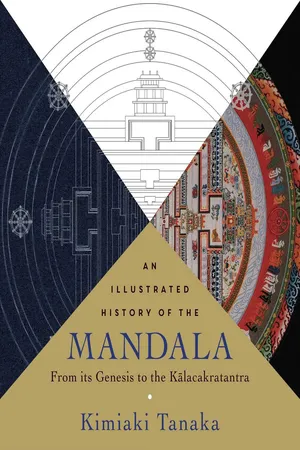
An Illustrated History of the Mandala

From Its Genesis to the Kalacakratantra

  1. 344 pages
  2. English
  3. ePUB (mobile friendly)
  4. Available on iOS & Android
eBook - ePub

An Illustrated History of the Mandala

From Its Genesis to the Kalacakratantra

About this book

Everyone's heard of mandalas; now we have a uniquely rich history and explanation of their history and meaning. This book is a history of the genesis and development of the mandala from the fifth and sixth centuries, when the mandala first appeared in India, to the eleventh century, when the Kalacakratantra appeared just before the disappearance of Buddhism in India. The 600 years of Indian esoteric Buddhism that concluded the 1, 700-year history of Indian Buddhism could be said to have been the history of the development of the mandala. (The Kalacakratantra integrated earlier mandala theories into a single system and established a monumental system unprecedented in the history of esoteric Buddhism. It was thus the culmination of the development of Indian Buddhism over a period of 1, 700 years.) The analysis is at the micro level and includes numerous illustrations and charts. Particular attention is paid to proper names, mudras, and mantras that have been overlooked by scholars in philosophy and doctrine, and the author tackles issues that cannot be explained solely from a historical viewpoint, such as geometric patterns, the arrangement of deities, the colors, and their meaning in Buddhist doctrine.
Frequently asked questions

Yes, you can cancel anytime from the Subscription tab in your account settings on the Perlego website. Your subscription will stay active until the end of your current billing period. Learn how to cancel your subscription.
No, books cannot be downloaded as external files, such as PDFs, for use outside of Perlego. However, you can download books within the Perlego app for offline reading on mobile or tablet. Learn more here.
Perlego offers two plans: Essential and Complete
  • Essential is ideal for learners and professionals who enjoy exploring a wide range of subjects. Access the Essential Library with 800,000+ trusted titles and best-sellers across business, personal growth, and the humanities. Includes unlimited reading time and Standard Read Aloud voice.
  • Complete: Perfect for advanced learners and researchers needing full, unrestricted access. Unlock 1.4M+ books across hundreds of subjects, including academic and specialized titles. The Complete Plan also includes advanced features like Premium Read Aloud and Research Assistant.
Both plans are available with monthly, semester, or annual billing cycles.
We are an online textbook subscription service, where you can get access to an entire online library for less than the price of a single book per month. With over 1 million books across 1000+ topics, we’ve got you covered! Learn more here.
Look out for the read-aloud symbol on your next book to see if you can listen to it. The read-aloud tool reads text aloud for you, highlighting the text as it is being read. You can pause it, speed it up and slow it down. Learn more here.
Yes! You can use the Perlego app on both iOS or Android devices to read anytime, anywhere — even offline. Perfect for commutes or when you’re on the go.
Please note we cannot support devices running on iOS 13 and Android 7 or earlier. Learn more about using the app.
Yes, you can access An Illustrated History of the Mandala by Kimiaki Tanaka in PDF and/or ePUB format, as well as other popular books in Historia & Arte general. We have over one million books available in our catalogue for you to explore.

Information

eBook ISBN
9781614292920
Subtopic
Arte general

1. The Genesis of the Maṇḍala


1. Triads as Objects of Worship
IN ORDER TO ELUCIDATE the historical development of the maṇḍala from its genesis in India to its final stage, the Kālacakratantra, we need to know something about the history of Buddhist art in India. This chapter surveys the history of Indian Buddhist art from its origins to the appearance of the primitive form of the maṇḍala.
Buddhism has a long history of approximately 2,500 years, starting from the time of the Buddha Śākyamuni. The oldest extant examples of Buddhist art were produced in the second century BCE at Sanchi and Barhut, although initially images of the Buddha were not objects of worship.
The question of whether buddha images originated in Gandhāra, in modern-day Pakistan, or in Mathurā, in the modern Indian state of Uttar Pradesh, has been the subject of much debate among scholars. However, iconographically speaking, the influence of Gandharan iconography can be seen in early Mathuran sculpture,17 and so it would seem natural to assume that Gandharan images slightly pre-dated those of Mathurā.
Image
FIG. 1.1. BUDDHA TRIAD FROM AHICHATRA (NATIONAL MUSEUM, NEW DELHI)
In Gandharan art, the triad was adopted as an object of worship from the earliest stage. On the lid of the well-known and controversial Kaniṣka Casket, the Buddha is flanked and worshiped by Brahmā and Indra. This combination is based on the legend of the Buddha’s descent from Trayastrimśa Heaven, attended by Brahmā and Indra, after having preached to his deceased mother. It symbolizes the ascendancy of Buddhism over Brahmanism, which worships Hindu gods.
There are also frequent examples of a triad with two bodhisattvas. In many examples of Gandharan art, we cannot identify the attendant bodhisattvas because there is no inscription. However, many scholars identify the figures in this type of Gandharan triad as Śākyamuni, Maitreya (the future Buddha of this world), and Avalokiteśvara (the bodhisattva of compassion), a triad that continued to be reproduced until the Pāla dynasty (eighth to twelfth centuries), especially in eastern India. The reason seems to have been that this type of triad was the main image at the site of the Buddha’s enlightenment, known as Vajrāsana and corresponding to present-day Mahābodhi Temple.18
A Buddha triad, dated to the twenty-third year of Kaniṣka’s reign, has been unearthed at Ahichatra, the ancient capital of the kingdom of Northern Panchala in central India, that has a bodhisattva holding the buds of a lotus on the right side and Vajrapāṇi, a protective deity, on the left (fig. 1.1). It is debatable whether or not the bodhisattva holding lotus buds represents Avalokiteśvara, but since Avalokiteśvara appears as an important figure in early Mahāyāna sūtras from the second century, it is possible that it is Avalokiteśvara.
Image
FIG. 1.2. BUDDHA TRIAD (CHAPEL 3, NASIK CAVE 23)
In early Buddha triads, the iconography of the left and right attendants sometimes presents a contrast. For example, in the Gandharan triads mentioned above, Maitreya is generally rendered as a young Brahmin and Avalokiteśvara as a young warrior-king (kṣatriya). This is based on the prophecy that Maitreya, the future Buddha, will be born the son of a Brahmin when he appears on earth. In Mathuran triads, on the other hand, Avalokiteśvara is shown as a nobleman holding lotus buds and Vajrapāṇi as a yakṣa bodyguard with a snake around his neck.
In terms of philosophical ideas, when Avalokiteśvara appears flanking Amitābha in the Amitābha triad, he is said to represent Amitābha’s compassion, while Mahāsthāmaprāpta represents his wisdom. In the triad consisting of Śākyamuni, Mañjuśrī, and Samantabhadra,19 Mañjuśrī is said to represent Śākyamuni’s wisdom, while Samantabhadra represents his practice (caryā) and vows (praṇidhāna), as these are the respective domains of these two bodhisattvas. It was thus customary to contrast attributes of the main deity by means of the iconography of the attendants.
In the post-Gupta period (500–750 CE), many triads with attendants who can be clearly identified iconographically as Avalokiteśvara and Vajrapāṇi were created in cave temples in western India. However, a Japanese scholar has presented a new interpretation of the most renowned example, Padmapāṇi and Vajrapāṇi in the wall painting of Cave 1 at Ajantā, suggesting that they are not bodhisattvas but gatekeepers.20 There is a possibility that several examples, particularly triads in which the main deity forms the dharma-wheel mudrā (dharmacakra[pravartana]-mudrā) with both hands, represent Amitābha, Avalokiteśvara, and Mahāsthāmaprāpta, since in Tibet and Nepal Mahāsthāmaprāpta in the Amitābha triad is often depicted in the likeness of Vajrapāṇi.21
Nevertheless, it is an established fact that the triad consisting of a main deity, Avalokiteśvara, and Vajrapāṇi is very common in cave temples throughout western India. Furthermore, the position of the two attendants is fixed, with Avalokiteśvara on the right and Vajrapāṇi on the left (fig. 1.2). In triads of this type, Vajrapāṇi is depicted not as a yakṣa but as a bodhisattva. This fact reminds us that Vajrapāṇi once received a prophecy, recorded in the Āryatathāgatācintyaguhyanirdeśa of the Ratnakūṭa cycle, that he would be reborn in Abhirati—the realm of Akṣobhya in the east—after having protected one thousand buddhas of the Auspicious Eon (Bhadrakalpa) and would then become a buddha.22 Thus by being promised enlightenment in the future by the Buddha, Vajrapāṇi rose in status from bodyguard to bodhisattva and eventually became the main deity of esoteric Buddhism. Moreover, the triad of Śākyamuni, Avalokiteśvara, and Vajrapāṇi developed into the Buddha, Lotus, and Vajra families of the Garbha-maṇḍala.
2. Depictions of the Buddha’s Sermons
The triad emerged in India as an object of worship not long after the appearance of buddha images and developed, over time, into more complex figures. Scholars differ in their views about the meaning of such groups of figures. For instance, there is a well-known Gandharan stele unearthed at Mohammed Nari (second to third century, Central Museum, Lahore) that shows the Buddha displaying the dharma-wheel mudrā and preaching with many buddhas and bodhisattvas arranged around him. This stele had been interpreted as a depiction of the miracle of Śrāvastī, since one thousand buddhas who had emerged from the body of the Buddha are depicted in both corners at the top and there is a lotus pond at the bottom.
More recently, however, it has been suggested that it represents Amitābha’s paradise, Sukhāvatī, or the Buddha preaching a Mahāyāna sūtra.23 In depictions of eight scenes from the Buddha’s life, which became established from the post-Gupta period through to the Pāla dynasty, the Buddha invariably displays the dharma-wheel mudrā in depictions of the appearance of one thousand buddhas, or the miracle of Śrāvastī. Before the establishment of the meditation mudrā (dhyāna-mudrā) in esoteric Buddhism, though, Amitābha was frequently depicted with the dharma-wheel mudrā.24 Moreover, scenes arranged around the Buddha are difficult to identify, except for the appearance of one thousand buddhas, which is also seen in other examples from Gandhāra, and so one should be cautious about the identification of this stele. Generally speaking, it is only natural to interpret a group of bodhisattvas and deities centered on the Buddha displaying the dharma-wheel mudrā as a depiction of a sermon by the Buddha.
Textually speaking, the production of painted scrolls called paṭa started in India around the third century CE,25 and the method of producing a paṭa is explained in early esoteric Buddhist scriptures that appeared from the sixth to seventh centuries. Typical examples include the Mahāmaṇivipulavimānaviśvasupratiṣṭhitaguhyaparamarahasyakalparāja (hereafter Mahāmaṇivipulavimānakalparāja), Mañjuśrīmūlakalpa, Wenshushili fabaozang tuoluoni jing, and Dafangguang Manshushili jing (aka Guanzizai pusa shouji jing).
Among these texts, the Mañjuśrīmūlakalpa explains the methods (paṭavidhāna) for four types of paṭa: upper, middling, lower, and fourth.26 Through my own research, I have confirmed the existence of a tradition of paṭa (or thangka) based on the Mañjuśrīmūlakalpa that has continued down to modern times.
Image
FIG. 1.3. MTHONG BA DON LDAN (HAHN CULTURAL FOUNDATION)
The Hahn Cultural Foundation in Korea possesses a unique thangka called “Mthong ba don ldan.”27 This thangka depicts a buddha forming the dharma-wheel mudrā with both hands and seated on a lotus throne sup...

Table of contents

  1. Cover
  2. List of Figures
  3. Foreword by Robert A. F. Thurman
  4. Introduction: What Is the Maṇḍala?
  5. 1. The Genesis of the Maṇḍala
  6. 2. The Emergence of the Garbha-maṇḍala
  7. 3. Maṇḍalas of the Prajñāpāramitānayasūtra
  8. 4. The Emergence of the Vajradhātu-maṇḍala
  9. 5. The Emergence of the Guhyasamāja-maṇḍala
  10. 6. Maṇḍalas of the Mother Tantras
  11. 7. The Maṇḍala of the Kālacakratantra
  12. 8. The Development of the Maṇḍala and Its Philosophical Meaning
  13. Postscript
  14. List of Tibetan Terms
  15. List of Chinese, Japanese, and Korean Terms
  16. About the Author
  17. Notes
  18. Bibliography
  19. Index
  20. Copyright