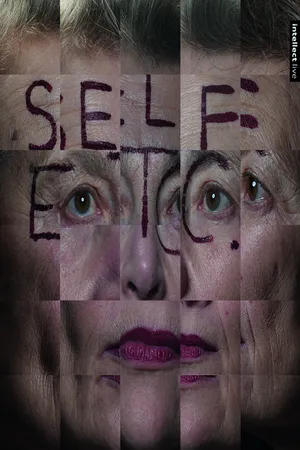
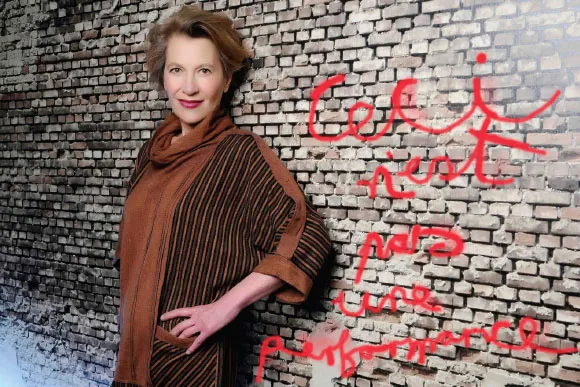
Anne Bean: Self Etc. is the first major monograph about the performance work of artist Anne Bean, a noted international figure who has been working actively since the 1960s. Part of the Intellect Live series, co-published with the Live Art Development Agency, this book includes extensive visual documentation of Bean's performances, critical essays by leading scholars of art and performance and a series of new visual essays by the artist. Additional contributions include documentation of collaborations with influential artists, such as Bean's Drawn Conversations, made at Franklin Furnace, New York, in collaboration with Harry Kipper, Karen Finley, Kim Jones and Fiona Templeton; and TAPS: Improvisations with Paul Burwell, involving numerous artists, including Paul McCarthy, Steven Berkoff, Evan Parker, Brian Catling, Carlyle Reedy, Rose English, David Toop, Lol Coxhill, Jacky Lansley and Maggie Nicols.
Lavishly illustrated and including previously unseen images, Anne Bean explores and expands the nature, form and contexts that artistic collaboration can take.
Frequently asked questions
Yes, you can cancel anytime from the Subscription tab in your account settings on the Perlego website. Your subscription will stay active until the end of your current billing period. Learn how to cancel your subscription.
At the moment all of our mobile-responsive ePub books are available to download via the app. Most of our PDFs are also available to download and we're working on making the final remaining ones downloadable now. Learn more here.
Perlego offers two plans: Essential and Complete
Essential is ideal for learners and professionals who enjoy exploring a wide range of subjects. Access the Essential Library with 800,000+ trusted titles and best-sellers across business, personal growth, and the humanities. Includes unlimited reading time and Standard Read Aloud voice.
Complete: Perfect for advanced learners and researchers needing full, unrestricted access. Unlock 1.4M+ books across hundreds of subjects, including academic and specialized titles. The Complete Plan also includes advanced features like Premium Read Aloud and Research Assistant.
Both plans are available with monthly, semester, or annual billing cycles.
We are an online textbook subscription service, where you can get access to an entire online library for less than the price of a single book per month. With over 1 million books across 1000+ topics, we’ve got you covered! Learn more here.
Look out for the read-aloud symbol on your next book to see if you can listen to it. The read-aloud tool reads text aloud for you, highlighting the text as it is being read. You can pause it, speed it up and slow it down. Learn more here.
Yes! You can use the Perlego app on both iOS or Android devices to read anytime, anywhere — even offline. Perfect for commutes or when you’re on the go. Please note we cannot support devices running on iOS 13 and Android 7 or earlier. Learn more about using the app.
Yes, you can access Anne Bean by Rob La Frenais in PDF and/or ePUB format, as well as other popular books in Media & Performing Arts & Artist Monographs. We have over one million books available in our catalogue for you to explore.
IS POSSESSED: THE ARTIST, THE CRITIC, THE PIRATE AND THE MESSENGER
ROB LA FRENAIS
These are some stories written from memory.
First memory
A strange, quiet, elegant lady of a certain age was hovering at the edge of a large, well-attended funeral of a well-known artist in Brighton. Slim, vigilant, watchful yet remote, her sculpted facial features bore the resemblance of an old friend of the Critic, who we can call the Artist, who had disappeared from the face of the earth for nearly two years. Nobody was really approaching her, a certain disquiet seem to accompany her presence. If one was an anthropologist you might describe the atmosphere emanating from the person, well-dressed but with a disturbing sense of being there but not quite there, as being an example of what is called the ‘uncanny valley’. With some trepidation, the Critic verified that this strange lady was indeed the Artist, transformed into another self.
Second memory
In a crowded performance venue in Liverpool three years earlier an unusual process was taking place. To all intents and purposes this was a reunion of a relatively well-known performance art grouping using fire, pyrotechnics and sound, minus a fiery, colourful, some say self-destructive deceased, male character, the Pirate. Without anyone knowing, a professional psychic medium, the Messenger, was in the audience, who had been previously asked to contact the dead artist. In the event, the Messenger declined, saying the energy of that person was ‘too dark’, but he sat, unannounced, in the audience, near the Critic. At the end, while clearing up, one of the two remaining participants, the Artist, an old friend, who bore a resemblance to the well-dressed lady he met later at the funeral, her face smeared with ash and smoke from the performance, was asked a simple question by the Critic. Immediately her face contorted and from inside the depths of her body, a familiar male voice snarled aggressively at him, as if in the film The Exorcist: “You gonna be scared forever!” She seemed momentarily to be possessed by the Pirate.
Third memory
The Artist had asked the Critic to take part in a performance 30 years earlier. In a Victorian museum in the North of England, in a room full of Pre-Raphaelite paintings, the Artist would make a live work. The Critic had to review it on the spot, in real time, with a clattering, manual typewriter. The Artist made ten paintings, each on a blank paper or canvas within an ornate gold frame. A vast range of ways of working was utilised and references were made to other painters such as Goya and Blake. Each of the actions touched on the kinds of ‘conversation’ one has whilst painting and with a painting. The Critic was, in the Artist’s words, ‘both the voice of the audience, a collective pheromone that one is often finely tuned into during performance, as well as the voice of the critic, overly sanctioned and unduly powerful’. The Critic was the editor of a small magazine so didn’t feel very unduly powerful, but he had agreed to do it, tapping out the noise ‘ting ting’ on the typewriter, trying to capture the essence of the live work unfolding before him. Surrounded by the drama and exaggeration of overwhelming exotic and figurative historical works such as Waterhouse’s The Slave, the Critic felt the keyboard start tapping with a life of its own as the words tumbled out, as if possessed.
Fourth memory
Shortly after the Artist returned from her 16-month transformation into the consciousness of another self, in another place, she asked the Critic to recreate this performance work 30 years later in a tiny former council flat in London, unusually crammed with contemporary artworks. This time the artist reversed the process, erasing all the paintings, except one, which the owner of the flat had implored her to save. The Critic, this time, not possessed of a manual typewriter but instead a laptop, decided to use a real time text-to-voice programme and again critiqued the work at the same time as taking part in it. His thoughts were amplified into an artificial, slightly sinister whisper. Again his thoughts accelerated, and the programme took on a life of its own, rather like an emerging artificial intelligence, repeating key phrases and somehow, though a process of feedback, and began to get inexplicably angry, as if possessed.
Chana Dubinski, Newark-on-Trent, 2012. Photo: Cara Lemans
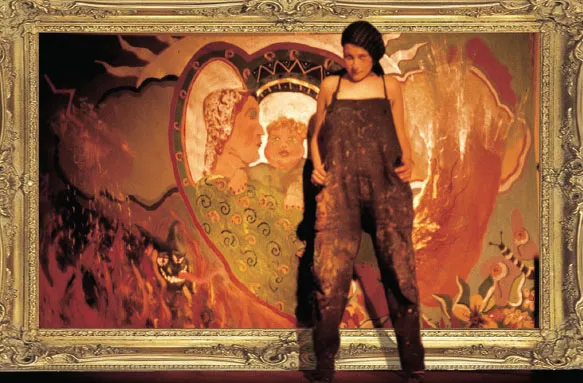
Anne Bean, oil painting Poor Little Jewish Boy, Leap, Eire, 1975. Photo: Mary Whooley
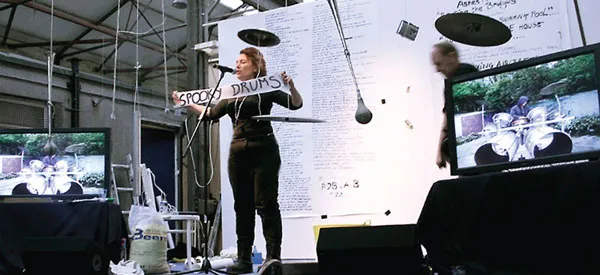
Anne Bean and Richard Wilson with Phil the Messenger , Adventures in the House of Memory (aka Dark Haloes, Spooky Drums), Liverpool Biennial, 2008. Photo: Liverpool Biennial
Fifth memory
The Critic began to find himself recalling a voice he had heard once before, back in Liverpool. He remembered the Pirate, the other artist, young and old shouting Dylan Thomas’s famous words about not going gently into that good night. He had also been a writer for the Critic’s small magazine. The Critic often had to sit in his studio waiting for the Pirate to finish his articles, to be whisked straight off to the printers that day. He remembered the ancient Pirate in his decline, poisoning himself to death with rum and whisky, walking, slightly staggering, with an elegant stick and floppy hat. The Artist was carefully looking after him, knowing that in the end she could not protect him from his demons. She had her own.
Sixth memory
Sometime in the 1980s, the Artist and the Pirate had invited an already well-known North American performance and installation artist to make a semi-private performance together in a derelict house in East London. The Critic was there with a number of other people, wandering around the rooms. Suddenly the already rickety and dangerous house started to resonate with banging, sawing, bangs and shrieks. Above the Critic’s head a foot smashed its way through the floorboards. The audience slowly realised it was in the equivalent of a war zone as the three artists systematically began destroying the environment they stood in. The audience inevitably were caught up in the mayhem, running for cover, not knowing which way to go, what to see, what floor would give way, what glass would fly, what staircase was safe. The Pirate suddenly smashed his head through a window, beating a drum, blood streaming down his face, yelling as if he didn’t care. The Critic suddenly felt that in order to survive, he had to have his wits honed and alert, like the artists. As debris rained down the audience felt it necessary to vacate the premises, but the Critic remained, dodging and diving, in the dust and chaos, taking notes frantically. This was what real art was about, he thought. Real danger. No health and safety.
Seventh memory
Do we give names and faces to these characters and situations or shall we let them be anonymous for a while longer? Maybe we should just try to imagine a few more scenes in the life of the Artist, one of her many selves. She is open to any turn of fate ‘living in the open air’ as another writer puts it, following her destiny, still quite young. She walks randomly into the high street information centre of a well-known cult with another artist and they take the test they pose to lure the innocent in. She does not go home but instead joins up spontaneously, changes her name. Over the next year she rises up through the organisation of the cult, doing exactly what she is instructed. She soon, with her combination of total engagement and charisma, ascends the echelons of the cult until she becomes one who is as perfected by their process. She issues instructions t...
Table of contents
Cover Page
Title Page
Copyright
Contents
Introduction
Impossible Things: The Life Art of Anne Bean in the 1970s
Memento Mori: Secret Conversations We Didn’t Know We Were Having
Is Possessed: The Artist, the Critic, the Pirate and the Messenger
The Audience As Battery: Interview with Anne Bean
TAPS: A Visual Essay
Within Living Memory: Shadow Deeds
Today’s The Day: A Visual Essay
Unask the Question: A Visual Essay
Erasing Distances: Forging PAVES
Disbelief Systems: Interview with Bow Gamelan Ensemble
Disbelief Systems: An Afterword – The Threshold
The Entangled Self: The Art of Life in the Open Air