eBook - ePub
Available until 23 Dec |Learn more
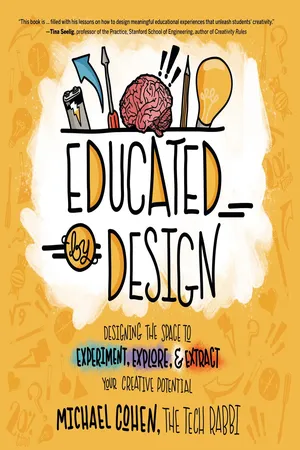
Educated by Design
Designing the Space to Experiment, Explore, and Extract Your Creative Potential
This book is available to read until 23rd December, 2025
- English
- ePUB (mobile friendly)
- Available on iOS & Android
eBook - ePub
Available until 23 Dec |Learn more
Educated by Design
Designing the Space to Experiment, Explore, and Extract Your Creative Potential
About this book
No one expects to run—much less win—a marathon without preparation. Such endeavors require training and practice. Lots of practice and even some slips and falls along the way. In Educated by Design, Michael Cohen (aka The Tech Rabbi) explains that creativity is no different. When creativity is clearly defined and intentionally practiced, all educators can improve the design they bring to their students' learning experiences.
Tools to learn more effectively

Saving Books

Keyword Search

Annotating Text

Listen to it instead
Information
Topic
EducationSubtopic
Education GeneralChapter 1

CREATIVITY IS A MINDSET, NOT A TALENT
Our mission on earth is to recognize the void—inside and outside of us—and fill it.
—The Lubavitcher Rebbe
Once in a while you get shown the light in the strangest of places if you look at it right.
—Grateful Dead
What is creativity?
When I ask people that question, their answers tend to associate the creative process with a talent, usually something artistic or musical. But true creativity isn’t limited to the arts. Creativity can fuel countless talents and skills and gifts because it comes from within an individual. It’s the spark, the catalyst, the drive to view a problem—or perhaps even life itself—in a new and unexpected way. Creativity is found in the way talented people use their talents. It’s found in their thinking, wondering, exploring, and their embrace of the unknown. It’s the mindset that allows their talents to thrive.
What about those folks who aren’t artistic or musical? What about those of us who can’t dance or sing or draw or sculpt or craft or act? What does creativity look like for us? I believe it must take a different form—one not focused on creating something from nothing but on creating something into something more. Today, creativity demands something more from our minds, our souls, and how we look at the world around us.

Growing up in school, I was told that creativity is not a job. Today I make it my job to be creative and help others develop the same thinking and strategy to achieve above and beyond their goals and expectations.
I have learned that not everything you need to know in life is learned in school, and that it is never too late to learn something or become something. If Sidney Frank can create a business around Grey Goose Vodka in his seventies, none of us have an excuse. Sidney, who was already a successful businessman, could have continued with the status quo. What he showed the world is that it is never too late to create something new and great, and creativity might be lying in plain sight, and just eight years after creating the new Vodka, he sold it to Bacardi for $2 billion.
That fear to leap is what keeps so many of us stuck in the status quo and fearful of the potential of failure. In 2016, I attended the SXSWEdu conference. With a messenger bag slung around my shoulder and the tired look of travel on my face, I checked into my room at a hotel in downtown Austin. My concierge smiled and asked me what brought me to Austin, and I told him I was speaking at the conference about how to develop a creative mindset to better identify problems and develop solutions for challenges we face. He smirked, like so many before him, as he said something like, “I wish I was more creative” or “I’m not creative.” Either way, something had convinced that guy he wasn’t creative even as he was getting a master’s degree in film production while working nights as a concierge at a posh Austin hotel. What is it? Is it our schooling? Could twelve years of solving linear problems explain our tendency to view life’s challenges through the lens of a standardized exam? Perhaps. The good news is that while our current education system might not be designed for creative thinking, it is still possible to develop a creative mindset.
Somewhere around age six, the current education model begins to purge students of creativity, curiosity, and wonder. The purge is so extreme that pedagogical models such as inquiry-based learning can not only exist but also be considered revolutionary.
Has any revolutionary invention, process, or approach been achieved without inquiry?

Step back for a moment and think about that. Our education system, a system meant to prepare young people for a future of success, is designed in a way that a model of learning based around posing questions, problems, and scenarios and seeking to solve can be considered innovative. Now don’t get me wrong; I think that inquiry-based learning is an amazing concept, but its birth stems from a system of standardized learning that is linear and multiple choice. So how do we re-infuse education with that creativity and curiosity that is purged so soon? How do we incorporate it into our teacher practice, our classroom learning, and into the culture of our schools and institutions? The first step is to shatter the myth that creativity is a talent and the stereotype that equates creativity to being artistic, musical, or skilled in some other expressive process.
When we finally understand that creativity is a way of thinking that blends our imagination with the world around us, true innovation can exist, and it doesn’t need to be at the level where lightbulbs are invented. Innovation for a first grader might not be groundbreaking for a ninth grader, but it is important to remember that value is subjective when analyzing the creative process for different age groups. Creativity is a mindset, not an art set.

As I said before, creativity isn’t something you get; it’s something you reveal. It’s about divergent thinking, a term coined by psychologist J.P. Guilford to describe the process of creating ideas by generating as many solutions as possible. The divergent-thinking approach to problem solving stands in stark contrast to today’s educational system, which is built on convergent thinking, a method of discovering a singular “correct” answer.

I believe both divergent and convergent thinking have a role in life, but innovative practice and process are more likely to thrive when we create new ideas and solutions. We often associate creativity with originality. While a factor, it is not always required, and many times, it is the improvement of something that already exists that results in an innovation.
How Developed is Your Creative Thinking?
In the toolkit in the back of the book, you’ll find a link to a sample Torrance Test of Creative Thinking (TTCT). Testing yourself and giving your students an opportunity to take it can open up a window into how developed our creative thinking is. Similar to assessing yourself during marathon training, it helps to know what you are capable of doing now as well as the growth you hope to achieve.

The Obstacle of Functional Fixedness
If we’re open to shifting our thinking, what is the next step? I believe it’s found in the words of Steve Jobs, who shared in the 1994 interview that “Creativity is connecting things.” Our ability to connect people, places, and ideas is rooted in how we view the world, and in turn, that worldview determines how easily we are able to overcome one of the greatest obstacles to creativity—functional fixedness.
What is functional fixedness? It is a cognitive bias that results in an inability to use a known object in a new way. In plain English, this means that a box is used to hold one thing, a shoelace is for tying shoes, and a toothpick is useless if you have nothing stuck in your teeth. The research around functional fixedness began to take form in the mid-1940s, when gestalt psychologist Karl Duncker started to research the method in which we solve problems with limited yet familiar resources. His most famous activity, the “Candle Problem,” is one that might look familiar to you. I saw it first in Daniel Pink’s book Drive, yet for some reason, I couldn’t share that I had seen it before. Sure enough, I dusted off my educational psychology textbook from grad school, and there it was in chapter 8!

What is it about the problem that is so powerful? In workshops, I have seen some people solve it in less than five minutes while others struggle well past half an hour to reach a solution. The problem helps us understand the mental barriers preventing us from looking for novel and unconventional solutions to the challenges we face. One way to overcome this functional fixedness is to engage in diverse experiences and interact with individuals who have diverse backgrounds.

Before becoming a professional educator (I have always considered myself a teacher), I was by trade a designer, artist, strategic marketer (fancily referred to as a storyteller these days), and a businessman. I believe all of those experiences shaped my thinking and my approach to education. Don’t get me wrong—I am not telling teachers to get a second job, nor am I questioning the validity of teacher programs, credentials, and advanced degrees. (I have a master’s in education, after all.) I am, however, challenging everyone reading this book to diversify their resources and connections when looking to hone their educational craft. The true first step of developing a creative mindset is to identify and learn from creative people in a wide variety of industries.
-plgo-compressed.webp)
Here is my shortlist of those who have influenced me, inspired me to shift my thinking, and helped me succeed. They are talented, creative, resilient, and most importantly, patient—a characteristic that easily deserves its own book. These individuals are leaders in core areas that I feel are critical for learning what a creative mindset looks like:
ENTREPRENEURS
Gary Vaynerchuk is a serial entrepreneur, media marketing master, author, and social media extraordinaire. He also curses like a sailor, which makes it slightly awkward for a rabbi to endorse him. At the end of the day, his message that anyone can make it if they are patient, stick with it, and put in the work is tried and true for me.
- Twitter: https://twitter.com/garyvee
- Site: http://www.garyvee.com
- Content: https://youtu.be/1ClbiB7_YYg
Seth Godin is an entrepreneur, author, and speaker. He has published eighteen bestselling books, many of which have significantly impacted me and my work, including Linchpin and What To Do When It’s Your Turn (and it’s always your turn). His insights into how we communicate ideas, build confidence around the value we can provide others, and the need to just “Ship It” and get thing out into the world are not just inspiring, but actionable directives to helping prepare our students for tomorrow.
- Twitter: https://twitter.com/ThisIsSethsBlog
- Site: https://www.sethgodin.com
- Content: https://youtu.be/xBIVlM435Zg
DESIGNERS
John Maeda is a designer, technologist, and creative driver in education and business. As a former president of Rhode Island School of Design (RISD), professor at the MIT Media Lab, and consultant to startups, he has mastered the way in which design and creative thinking can influence business to succeed.
- Twitter: https://twitter.com/johnmaeda
- Site: https://www.maedastudio.com
- Content: https://www.designintech.report
David Kelly is an entrepreneur, designer, engineer, and teacher. He is a founder of the design firm IDEO and a professor at Stanford University. His work has had a huge impact on me since I first saw his team at IDEO featured on an episode of Nightline in 2012. I have come to think of him as a distant mentor as my own design thinking continues to grow and evolve.
- Twitter: https://twitter.com/kelleybros
- Site: https://www.creativeconfidence.com
- Content: https://youtu.be/M66ZU2PCIcM
ENGINEERS
Tina Seelig is the head of Stanford University’s Technology Ventures Program and an author of many titles, including What I Wish I Knew ...
Table of contents
- Foreword by Don Wettrick
- Introduction
- Chapter 1
- Chapter 2
- Chapter 3
- Chapter 4
- Chapter 5
- Chapter 6
- Chapter 7
- Chapter 8
- Chapter 9
- Chapter 10
- Chapter 11
- Bibliography
- Acknowledgments
- Bring Michael Cohen to Your School or Event
- More From Dave Burgess Consulting, Inc.
- About the Author
Frequently asked questions
Yes, you can cancel anytime from the Subscription tab in your account settings on the Perlego website. Your subscription will stay active until the end of your current billing period. Learn how to cancel your subscription
No, books cannot be downloaded as external files, such as PDFs, for use outside of Perlego. However, you can download books within the Perlego app for offline reading on mobile or tablet. Learn how to download books offline
Perlego offers two plans: Essential and Complete
- Essential is ideal for learners and professionals who enjoy exploring a wide range of subjects. Access the Essential Library with 800,000+ trusted titles and best-sellers across business, personal growth, and the humanities. Includes unlimited reading time and Standard Read Aloud voice.
- Complete: Perfect for advanced learners and researchers needing full, unrestricted access. Unlock 1.4M+ books across hundreds of subjects, including academic and specialized titles. The Complete Plan also includes advanced features like Premium Read Aloud and Research Assistant.
We are an online textbook subscription service, where you can get access to an entire online library for less than the price of a single book per month. With over 1 million books across 990+ topics, we’ve got you covered! Learn about our mission
Look out for the read-aloud symbol on your next book to see if you can listen to it. The read-aloud tool reads text aloud for you, highlighting the text as it is being read. You can pause it, speed it up and slow it down. Learn more about Read Aloud
Yes! You can use the Perlego app on both iOS and Android devices to read anytime, anywhere — even offline. Perfect for commutes or when you’re on the go.
Please note we cannot support devices running on iOS 13 and Android 7 or earlier. Learn more about using the app
Please note we cannot support devices running on iOS 13 and Android 7 or earlier. Learn more about using the app
Yes, you can access Educated by Design by Michael Cohen in PDF and/or ePUB format, as well as other popular books in Education & Education General. We have over one million books available in our catalogue for you to explore.