eBook - ePub
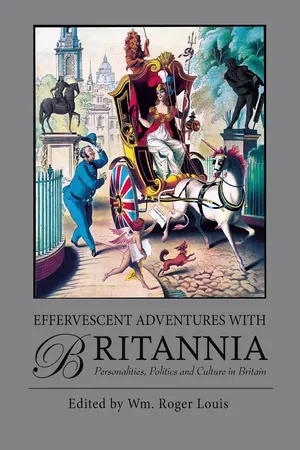
Effervescent Adventures with Britannia
Personalities, Politics and Culture in Britain
- 400 pages
- English
- ePUB (mobile friendly)
- Available on iOS & Android
eBook - ePub
About this book
Effervescent Adventures with Britannia is the latest addition to Wm Roger Louis's stimulating and acclaimed series, Adventures with Britannia. It draws upon a distinguished array of writers and scholars - historians, political scientists, journalists, novelists, biographers and English literature specialists - to guide the reader through a fascinating labyrinth of British culture, history and politics. Together, they provide a unique insight into the pivotal themes - political, literary and cultural - which have shaped British state and society. The subjects covered include a new analysis of Jack the Ripper by Richard Davenport-Hines, a new appraisal of Harold Nicholson and Royal Biography by Jane Ridley and a new account of Evelyn Waugh in North America by Martin Stannard. In literature, Patrick French writes on V.S. Naipul; in history Andrew Lownie offers new perspectives on Guy Burgess and in politics Kenneth O. Morgan considers what will become of Britain after Brexit. Collectively, the chapters combine a rich mix of original ideas, historical and literary allusion, personality and anecdote, to provide an intellectual adventure into the mainsprings of modern British and international society.
Trusted by 375,005 students
Access to over 1 million titles for a fair monthly price.
Study more efficiently using our study tools.
Information
1
Jack the Ripper
RICHARD DAVENPORT-HINES
London’s most infamous serial killer was known as the “White-chapel murderer” or “Leather Apron” until on 27 September 1888 the Central News Agency received a red-inked, defiant, semiliterate letter signed “Jack the Ripper.” This letter was probably a hoax concocted by news agency staff. It is suitable that he is known by a name devised in a journalistic stunt, for he was the first criminal to become a figure of international mythology through the medium of global communications. The indivisibility of his crimes from the reporting of them is shown in a few words of a Cabinet minister, Lord Cranbrook, who on 2 October noted: “More murders at Whitechapel, strange and horrible. The newspapers reek with blood.”1
The Ripper was almost certainly male, probably right-handed, unmarried, employed, and possessed of either some anatomical training or enough education to study surgical textbooks. He was perhaps a foreigner. Although all his victims (possibly barring one) were destitute and drunken prostitutes, he did not rape or penetrate them; nevertheless, there was a sexual element to his homicidal excitement. He was daring, energetic, hate ridden, cruel, and perhaps obsessed with wombs. Evidence for his age and appearance from those who claimed to have seen him is inconclusive and contradictory. Nothing is certain of his life except for a few violent hours during the summer and autumn of 1888.
There was much routine violence against women in Whitechapel, an area of the East End. Early on the morning of Tuesday, 3 April 1888, following the Easter bank holiday on Monday, Emma Elizabeth Smith, age forty-five, was attacked in Osborn Street. A blunt instrument, possibly a stick, was thrust into her. She died in the London Hospital the next day. Her death is sometimes reckoned as the first in the series of crimes perpetrated by the Whitechapel murderer, but was probably an unrelated street robbery and rape by several ruffians.
Between 1:50 and 3:30 a.m. on Tuesday, 7 August 1888 (again after a Monday bank holiday) Martha Tabram (b. 1849), alias Turner, who was also known as Emma, was stabbed thirty-nine times on the first-floor landing of the communal stairs of the George Yard Buildings, a block of model dwellings off Whitechapel High Street. Her clothes were disarrayed, and her lower body was exposed. Police investigations focused on an unidentified private in a guards regiment with whom Tabram had reportedly gone to George Yard shortly before midnight on 6 August. Some criminologists insist that Tabram’s killer was an unidentified soldier; others identify this crime as the first of the series attributed to Jack the Ripper.
There is no controversy that at about three in the morning on Friday, 31 August 1888, the Whitechapel murderer killed Mary Ann (Polly) Nichols (b. 1845) in the entrance to a stable yard in a narrow cobbled alley called Buck’s Row, off Whitechapel Road. As with Tabram, her skirts were raised almost to her stomach. Her abdomen was savagely ripped open, and her throat cut; her private parts were twice stabbed. She had, however, probably been throttled before the stabbing and mutilation. After her murder, suspicions focused on Jack Pizer (c.1850–1897), a Jewish slipper maker who for some time had been bullying prostitutes and was known as “Leather Apron”; he was eventually detained and eliminated from the inquiry.
The next victim was Annie Chapman, alias Annie Siffey (b. 1841). She was murdered (probably at 5:30 a.m.) on Saturday, 8 September 1888, in the backyard of 29 Hanbury Street, Spitalfields, an area near Whitechapel. This was the only one of the serial killings committed in daylight. An eyewitness who saw the killer picking up his victim described him vaguely as shabby-genteel, foreign looking, and about forty years old; a neighbor apparently heard him stifling her cries and throttling her to insensibility or death. Chapman’s throat was severed, and her body mutilated. Some of her organs were removed from the scene, and her rings were wrenched off. The perpetrator seemingly had some knowledge of anatomical or pathological examinations; a small amputating knife or a thin, sharpened butcher’s knife was probably used.
Police street patrols of Whitechapel and Spitalfields had been increased after the Tabram murder and were soon intensified until the district was almost saturated with police at nighttime. After Nichols’s murder, when journalists raised the specter of a homicidal lunatic stalking his victims through Whitechapel, Inspector Frederick Abberline of Scotland Yard, who had an extensive knowledge of the area, was sent there to coordinate the divisional detectives investigating the prostitute murders. Generally, the police were reasonably efficient, though bewildered. The press sensation following Chapman’s murder, however, raised bitter recriminations against the Metropolitan Police. Some of these attacks were intended to injure politically the Home Secretary, Henry Matthews, or to retaliate against the stern police treatment of Irish nationalists, socialists, and the East End unemployed. The situation was exacerbated by Sir Howard Vincent’s guidelines for the Criminal Investigation Department, which required secretiveness on the part of police officials in unsolved cases. Resentful of this policy, journalists resorted to ploys and dodges that impeded police investigations. There was a popular outcry for a large government reward to be offered for information on the killer, but the Home Office was set against this practice, which it knew could draw false information or induce the framing of innocent parties. The police nevertheless were showered with information from the public about lunatics, misfits, and unpopular neighbors. Chapman’s death raised suspicions of Jewish ritual murder, and crowds assembled in Whitechapel streets and threatened Jews. This resulted in Samuel Montagu, MP for Whitechapel and a pious Orthodox Jew who was fearful that wild rumors could be a pretext for anti-Semitic outbreaks, offering a reward of £100 for the murderer’s capture, and in the formation (largely by Jewish tradesmen) of the Mile End Vigilance Committee. Larger rewards were later offered.
Probably between 12:40 and 1 a.m. on Sunday, 30 September, in Dutfield’s Yard, flanking the socialist (and mainly Jewish) International Working Men’s Educational Club, at 40 Berner Street, Elizabeth Stride (b. 1843), a Swede, prone to drink but not a habitual prostitute, was murdered. A meeting of 100 members had recently ended in the club, where those who had not dispersed were singing. Stride’s throat was cut, but her clothing was undisturbed. Her expression was peaceful, and she still clutched in her left hand a packet of aromatic breath sweeteners wrapped in tissue paper. Some Ripperologists discount Stride as one of the serial killings because the corpse was not extensively slashed or mutilated, but it is more likely that the killer was disturbed before completing his work. A passerby gave evidence suggesting that there were two men involved in this killing. Another witness, who saw a member of the socialist club carrying a small black bag while leaving the yard, started the legend of Jack the Ripper carrying a doctor’s bag.
After murdering Stride, the killer went three-quarters of a mile eastward (twelve minutes’ walk) to Mitre Square, off Aldgate, within the eastern boundary of the City of London. In the southeast corner of this square, near a warehouse yard and some derelict or empty houses (the darkest corner of the square, favored by prostitutes and their clients), between 1:30 and 1:44 a.m. on that same morning, he murdered Catherine Eddowes (b. 1842), alias Kate Conway or Kelly. She had been discharged from the Bishopsgate Street police station (where she had been held for drunkenness) only forty-five minutes before her corpse was discovered. She was found lying on her back with her clothes disarranged. Her throat was cut and her stomach opened. Further terrible mutilations were made, and again the murderer took organs away. He showed ruthless efficiency on this occasion, for he had only a quarter of an hour between two police patrols to inveigle his victim into the square, kill and mutilate her, and escape. The police reacted swiftly to the discovery in Mitre Square, but the killer fled eastward, apparently stopping to leave a piece of Eddowes’s bloody and fecal-stained apron at a stairwell entry at 108–19 Wentworth Model Dwellings, Goulston Street, where he chalked a message:
The Juwes are
The men That
Will not
be Blamed
for nothing.
The chairman of the Mile End Vigilance Committee received a parcel (16 October) putatively containing a portion of Eddowes’s kidney, together with an unsigned letter headed “From Hell,” purportedly from the murderer.
From the night of the double murder, the police investigation became even more conditioned by public unrest and reactive to the press. The police were demoralized by false leads and failure. Relations became strained between Matthews and the commissioner of the Metropolitan Police, Sir Charles Warren, who reported to the Home Office on 17 October, “I look upon this series of murders as unique in the history of our country”;2 Warren resigned a few weeks later. The press agitation reached its shrillest pitch during October 1888, when there were no Whitechapel prostitute murders: the pseudonym Jack the Ripper of the probably inauthentic letter publicized by the Central News Agency achieved worldwide notoriety in the early days of that month. This name represented a state of mind rather than an individual: that mentality being a paroxysm of horror, fear, and fascinated disgust.

Fig. 1.1. “Finding the Mutilated Body in Mitre Square,” Illustrated Police News, 6 October 1888.
In the aftermath of the Chapman murder, a German hairdresser named Charles Ludwig was apprehended (18 September), and the evidence against him seemed powerful until the double murder was committed, while Ludwig was in police custody. Other suspects at this time included Jacob Isenschmid, an insane Swiss pork butcher; Oswald Puckridge (1838–1900), a trained apothecary who had recently been released from the Hoxton House Lunatic Asylum and had threatened to rip people up with a long knife; and three medical students, including John Sanders (1862–1901), who had attended London Hospital but had become insane. It was speculated whether the killer was a member of a barbaric sect, a mad Freemason, a black magician, a dipsomaniac, a notoriety craver, a jewel thief, a midwife or abortionist, a person or persons intent on inciting anti-Semitism (many details of the Stride and Eddowes murders could be construed as intended to incriminate Jews), or a religious monomaniac. Sir George Savage (who suspected “post-mortem room and anatomy room porters”) hypothesized that “imitative action may have come into play,” and that the murders were maniacal acts of emulation by more than one killer, including someone bent on “world regeneration.”3 A looser speculation is that the killer was a social reformer such as Thomas Barnardo (who met Stride on 26 September) hoping to shock the national conscience about slum conditions. Certainly, Whitechapel became the cynosure of 1888. The Church of England clergyman Lord Sydney Godolphin Osborne, in a description typical of the time, characterized its inhabitants as living in “godless brutality, a species of human sewage, the very drainage of the vilest productions of human vice” and called for a concentrated philanthropic effort.4
On Friday, 9 November 1888, (perhaps between one and four in the morning) the Whitechapel murderer killed Mary Jane Kelly (b. 1862) in her room at a common lodging house, Miller’s Court, off Dorset Street, Spitalfields. Her body was found almost naked on her bed, her throat cut. Since the murderer was secure in her room, without fear of interruption, he had time to cut her to pieces by the light from her fireplace. The mutilations were horrific, apparently undertaken in an atrocious frenzy.
Kelly is usually treated as the last victim of the Whitechapel murderer. His death, incarceration in an asylum, or emigration may have terminated the crimes. (The deaths of Alice McKenzie, whose throat was cut between 12:25 and 12:50 a.m. in Castle Alley, off Whitechapel High Street, on 16 July 1889, and of Frances Cole, whose throat was cut under a railway arch in Swallow Gardens at 2:15 a.m. on 13 February 1891, have been tentatively attributed to the Whitechapel murderer.)
Over 130 suspects are listed in The Jack the Ripper A to Z (1991). Sir Melville Macnaghten of the Criminal Investigation Department believed in the guilt of Montague Druitt (1857–1888), a barrister and schoolmaster who drowned himself in the Thames after the Kelly killing. Another police official, Sir Robert Anderson, suspected Aaron Kosminski (c. 1864–1919), a Polish Jew working in Whitechapel as a hairdresser, who was confined in Colney Hatch Asylum in 1891. Inspector Frederick Abberline of Scotland Yard, the most impressive detective involved in the investigation, suspected Severin Klosowski (1865–1903), a Pole who had studied surgery and immigrated to England in 1887. Klosowski (who originally...
Table of contents
- Cover
- Title Page
- Contents
- List of Authors
- Introduction
- 1. Jack the Ripper
- 2. George Bernard Shaw and Physical Culture
- 3. Evelyn Waugh in North America
- 4. V. S. Naipaul and the British Tradition of Biography
- 5. Where Shall We Adventure? Hayao Miyazaki Meets Robert Louis Stevenson
- 6. Newer Images of Women and Men in the Interwar Decades
- 7. Encyclopaedia Britannica
- 8. Current American and British Newspapers
- 9. The Anglo-American Special Relationship in Intelligence
- 10. The Quest for Stalin's Englishman: Guy Burgess
- 11. John Banville's The Untouchable
- 12. All Souls College
- 13. Guglielmo Marconi and England
- 14. Harold Nicolson and Royal Biography
- 15. Keeping an Eye on the Present: Whig History of Science
- 16. Re-illustrating the History of the British Empire
- 17. Britain Is Your Friend: Propaganda during the Second World War
- 18. Ernest Bevin and Palestine: Bevingrads and Demonologies
- 19. Britain's Egyptian Allies and the Suez Crisis
- 20. Limitless Violence in Palestine
- 21. Rudyard Kipling and Mrs. Ewing
- 22. The British Empire: Ramshackle or Rampaging?
- 23. The Falklands Conflict: A Worm's-Eye View
- 24. How to "Fix" a War: Tony Blair and Iraq
- 25. Seeking a Role: Britain after Brexit
- 26. British Studies at the University of Texas, 1975–2017
- eCopyright
Frequently asked questions
Yes, you can cancel anytime from the Subscription tab in your account settings on the Perlego website. Your subscription will stay active until the end of your current billing period. Learn how to cancel your subscription
No, books cannot be downloaded as external files, such as PDFs, for use outside of Perlego. However, you can download books within the Perlego app for offline reading on mobile or tablet. Learn how to download books offline
Perlego offers two plans: Essential and Complete
- Essential is ideal for learners and professionals who enjoy exploring a wide range of subjects. Access the Essential Library with 800,000+ trusted titles and best-sellers across business, personal growth, and the humanities. Includes unlimited reading time and Standard Read Aloud voice.
- Complete: Perfect for advanced learners and researchers needing full, unrestricted access. Unlock 1.4M+ books across hundreds of subjects, including academic and specialized titles. The Complete Plan also includes advanced features like Premium Read Aloud and Research Assistant.
We are an online textbook subscription service, where you can get access to an entire online library for less than the price of a single book per month. With over 1 million books across 990+ topics, we’ve got you covered! Learn about our mission
Look out for the read-aloud symbol on your next book to see if you can listen to it. The read-aloud tool reads text aloud for you, highlighting the text as it is being read. You can pause it, speed it up and slow it down. Learn more about Read Aloud
Yes! You can use the Perlego app on both iOS and Android devices to read anytime, anywhere — even offline. Perfect for commutes or when you’re on the go.
Please note we cannot support devices running on iOS 13 and Android 7 or earlier. Learn more about using the app
Please note we cannot support devices running on iOS 13 and Android 7 or earlier. Learn more about using the app
Yes, you can access Effervescent Adventures with Britannia by Roger Louis in PDF and/or ePUB format, as well as other popular books in History & British History. We have over one million books available in our catalogue for you to explore.