- 160 pages
- English
- ePUB (mobile friendly)
- Available on iOS & Android
eBook - ePub
About this book
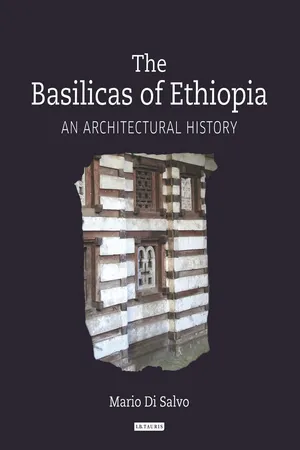
The basilica is symbolic of the history of Christianity in Ethiopia. Aizan, the first Christian king of the Aksumite empire was responsible for the creation of the large, five-aisled church of M?ry?m ??yon, sadly destroyed in 1535, and since then many hundreds of basilicas have been built in Ethiopia, many, including the UNESCO World Heritage site of Lalibela, literally 'hewn from the rock'. In this book, architectural historian and architect Mario di Salvo considers the unique architectural features of Ethiopia's basilicas and explains how they developed over time. Featuring almost 200 colour illustrations, this book is an attractive and comprehensive guide to some of Ethiopia's most inspiring religious buildings.
Trusted by 375,005 students
Access to over 1 million titles for a fair monthly price.
Study more efficiently using our study tools.
Information
PART I
The Ruins of the Aksumite Basilicas
(Fourth–Seventh Century)
Map I
Location of the ancient Aksumite basilicas (fourth–seventh century). Brown lines indicate the main watershed ridges; red lines indicate minor watershed ridges.


Figure I-1. Adulis. Excavation of a basilica during the British expedition of 1867–68 (from The Illustrated London News, 5 September 1868, p. 224)
The basilica, with its evolutionary characteristics and as a rigorously predetermined expression of an organic whole in the correspondence of spaces and functions, arrived in Aksum following the introduction of Christianity there in the first half of the fourth century (c.335) by Frumentius, a devoutly religious Syrian who had been ordained bishop by Athanasius, the patriarch of Alexandria.1
Caught up by the current fascination with recent archaeological discoveries, in the early 1900s teams of archaeologists from different nations engaged in simple, at times rapid surveys, or extensive campaigns of excavation to locate and reveal the remains of the ancient Aksumite basilicas, which had long been in a state of ruin and disrepair (Figures I-1, I-2).2

Figure I-2. View of the ruins of the basilica of Agulā Endā Qirqos (from The Illustrated London News, 11 April 1868, p. 374)
Ensconced in a tradition whose roots extend back to the Aksumite era, the remains of these ancient basilicas became the object of renewed interest, as did the existence of craftsmen who for centuries had conserved and passed down the time-honoured traditions and legacy of knowledge originating in the ancient guilds. In effect, these craftsmen became ‘Ethiopian’ through conscious choice, and adopted features which articulated the structural elements and decorative motifs closely based on what had been inherited from the past.
An investigation that addresses the issue of the evolutionary process of the basilica as manifested in Aksumite Ethiopia must involve extensive study of individual sites, including detailed documentation of typological elements, styles and forms. The first basilicas built in the Aksumite era immediately reflected a series of variations on the basic basilica typology generally found in the Mediterranean area. In particular, the variant with a five-aisled hall, which added one more aisle on each side of the usual three-aisled arrangement, was the model for the construction of the basilica of Māryām Şĕyon at Aksum3 – considered the mother of all Ethiopian churches – and dating back to the fourth century, though certain evidence would seem to point to significant interventions from the early sixth century, under the rule of the neguś Kālēb, and beyond (Figure I-3).4
Information is provided in various documents including the unique and invaluable report of Francisco Alvarez, Jesuit chaplain of a Portuguese mission in Ethiopia, who visited and described the basilica in 1520. He reported the condition in which he found it more than one millennium after its construction, and shortly before it was razed to the ground in 1535 by the incursions of the dreaded Muslim warlord, Ahmad ibn Ibrahīm al-Ghazī (Grañ):
This church is very large, with five very wide and very long vaulted naves. The area above is terraced, and under the vaults and in the walls there are paintings. The church is lined with very beautiful bare stones assembled together. It has seven chapels, which are all placed with their backs towards the east, and their altars are well adorned […] This church is surrounded by a grand open-air walled circuit faced with large blocks of bare stone […] This circuit, in turn, has many large walls around it, and is without a roof.5

Figure I-3. Reconstruction of the plan of the basilica Māryām Şĕyon at Aksum (from Buxton & Matthews, fig. 20)
The excavations and information regarding the remains of this basilica remain insufficient to permit anything more than an inductive reconstruction.
Different hypothetical reconstructions of the plan do, however, exist (Figure I-3).6 Nor has this prevented certain scholars from attempting a reconstruction of the elevation of the cathedral, based on what is described in the Liber Aksumae7 and by Alvarez, corroborated by the example offered by the Aksumite stelai and by structural characteristics that are found in monuments of much later eras.8
A typological evolution of the basilica structure outside Ethiopia was introduced in the large basilica built by the Aksumites at Zafar (today Sana’a), when their king, neguś Kālēb invaded and settled in Yemen in 523–25 with the backing of the Byzantine emperor Justin I, both to defend Christianity and as a reprisal following the cruel persecution of the Himyarite Christians.
In the basilica of Sana’a (for which the emperor of Constantinople also sent workmen and materials) the typical axial/...
Table of contents
- Cover
- Title Page
- Dedication
- Acknowledgements
- Contents
- Foreword
- Author’s Note
- Preface – The Structural Characteristics of Christian Basilicas
- Part I: The Ruins of the Ancient Aksumite Basilicas (Fourth–Seventh Century)
- Part II: The Architecture of the Late-Aksumite and Post-Aksumite Basilicas of Tigray (Eighth–Twelfth Century)
- Part III: The Architecture of the Medieval Basilicas of Ethiopia (The Twelfth-Century Zagwe Kingdom and the Restoration of the Solomonic Dynasty)
- Glossary
- Bibliography
- eCopyright
Frequently asked questions
Yes, you can cancel anytime from the Subscription tab in your account settings on the Perlego website. Your subscription will stay active until the end of your current billing period. Learn how to cancel your subscription
No, books cannot be downloaded as external files, such as PDFs, for use outside of Perlego. However, you can download books within the Perlego app for offline reading on mobile or tablet. Learn how to download books offline
Perlego offers two plans: Essential and Complete
- Essential is ideal for learners and professionals who enjoy exploring a wide range of subjects. Access the Essential Library with 800,000+ trusted titles and best-sellers across business, personal growth, and the humanities. Includes unlimited reading time and Standard Read Aloud voice.
- Complete: Perfect for advanced learners and researchers needing full, unrestricted access. Unlock 1.4M+ books across hundreds of subjects, including academic and specialized titles. The Complete Plan also includes advanced features like Premium Read Aloud and Research Assistant.
We are an online textbook subscription service, where you can get access to an entire online library for less than the price of a single book per month. With over 1 million books across 990+ topics, we’ve got you covered! Learn about our mission
Look out for the read-aloud symbol on your next book to see if you can listen to it. The read-aloud tool reads text aloud for you, highlighting the text as it is being read. You can pause it, speed it up and slow it down. Learn more about Read Aloud
Yes! You can use the Perlego app on both iOS and Android devices to read anytime, anywhere — even offline. Perfect for commutes or when you’re on the go.
Please note we cannot support devices running on iOS 13 and Android 7 or earlier. Learn more about using the app
Please note we cannot support devices running on iOS 13 and Android 7 or earlier. Learn more about using the app
Yes, you can access The Basilicas of Ethiopia by Mario di Salvo in PDF and/or ePUB format, as well as other popular books in Architettura & Architettura religiosa. We have over one million books available in our catalogue for you to explore.