The way people persuade or influence others is about to change forever. This book moves away from the traditional hit-and-miss methods of persuasion, by applying real science to this fundamental business and life skill. From a business perspective, the very practical process described in this book allows anyone to rapidly create a truly persuasive message, that is very easy to understand, and highly influential. Because this proven methodology can be used to create very real business success, it will become essential reading for leaders, managers, marketeers and salesmen. Additionally, the techniques described in this book can be used for almost any endeavour. For instance, you can apply these easy-to- use techniques to develop a winning presentation for a multi-billion dollar contract, or you can use the same types of approach to communicate more effectively with your spouse. This is the power of the universal principles described in this book.
- 300 pages
- English
- ePUB (mobile friendly)
- Available on iOS & Android
eBook - ePub
About this book
Trusted by 375,005 students
Access to over 1.5 million titles for a fair monthly price.
Study more efficiently using our study tools.
Information
Subtopic
LeadershipIndex
Business
Part 1
Introduction
Chapter 1
Presenting for Success
Chapter 2
The Big Picture
I see that everywhere among the race of men, it is the tongue that wins and not the deed.
Sophocles (409 BC)
Chapter 1
Presenting for Success
| WHAT’S THE POINT?  | This Chapter: • explains why business presenting has been used as the vehicle for explaining these persuasive techniques; and • describes what this book gives you. |
It is one of life’s great truisms that the way we communicate with others ultimately determines the quality of our lives, and the lives of those around us. Good communication is particularly important in business, because in this environment it is often critical to change the thoughts and actions of your clients, managers, and colleagues.
In fact, according to research conducted in the United States by the top 10 executive search firms, 71% of male and 89% of female senior executives felt that communication skills were the key to their success(1).
The crucial element in this type of successful business communication is its ability to persuade others. For example, when communicating with a prospective client, you are typically trying to persuade them to buy your product or service. When you are speaking to subordinates, you are often trying to motivate them to behave in specific ways, or take certain actions. Alternatively, when you are communicating with your boss, you may be trying to get them to believe your information and adopt your recommendations (for example, you might be trying to convince them to promote you, because you are such a good communicator).
Persuasion / n / The act of getting a person to think in a particular way, so they believe your message, adopt specific behaviours, or take recommended actions.
A great deal of our day-to-day business communication therefore aims to transfer facts and opinions, so we can persuade other people. This includes informative communications, such as presenting a report. After delivering the report, you will not only want your audience to understand your information; you will also want them to believe your points, and use the information that you provide. In other words, you are trying to persuade them! Let’s face it; if you aren’t trying to get them to believe and use your information, you really have to wonder why you are giving it to them in the first place!
So why use a presentation?
There are of course many different ways to achieve persuasion. These range from the distribution of documents, right through to the use of well-prepared advertising campaigns. The selection of the method for persuasion is dependent on your situation. However, the cost of advertising normally limits this type of communication to circumstances in which you need to influence a very large number of people. The most commonly used methods of business persuasion are therefore generally limited to:

Although documents are still important, the emphasis has changed over the last few years, and the use of presentations has become much more common. This is because:

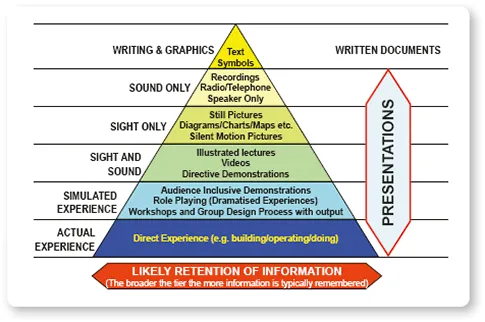
Figure 1.1:The Learning Pyramid Shows the amount a person typically remembers from different content
Table of contents
- Cover
- Title Page
- Dedication Page
- Copyright Page
- Contents
- Foreword
- Part One: Introduction
- Part Two: The Keys to Persuasion
- Part Three: Pulling the Presentation Together
- Part Four: Bounding the Presentation
- Part Five: Developing the Content
- Part Six: Scripting the Presentation
- Part Seven: Putting it all into Perspective
- Notes
- Index
Frequently asked questions
Yes, you can cancel anytime from the Subscription tab in your account settings on the Perlego website. Your subscription will stay active until the end of your current billing period. Learn how to cancel your subscription
No, books cannot be downloaded as external files, such as PDFs, for use outside of Perlego. However, you can download books within the Perlego app for offline reading on mobile or tablet. Learn how to download books offline
We are an online textbook subscription service, where you can get access to an entire online library for less than the price of a single book per month. With over 1.5 million books across 990+ topics, we’ve got you covered! Learn about our mission
Look out for the read-aloud symbol on your next book to see if you can listen to it. The read-aloud tool reads text aloud for you, highlighting the text as it is being read. You can pause it, speed it up and slow it down. Learn more about Read Aloud
Yes! You can use the Perlego app on both iOS and Android devices to read anytime, anywhere — even offline. Perfect for commutes or when you’re on the go.
Please note we cannot support devices running on iOS 13 and Android 7 or earlier. Learn more about using the app
Please note we cannot support devices running on iOS 13 and Android 7 or earlier. Learn more about using the app
Yes, you can access Persuasion & Influence by Bruce Hilliard in PDF and/or ePUB format, as well as other popular books in Business & Leadership. We have over 1.5 million books available in our catalogue for you to explore.