"A salient, measured, and illuminating study of history with reflections on what Britain's past means for its present and future, highly recommended." —
Midwest Book Review
John Grainger examines the long and erratic process by which the British Isles was gradually (and as it turns out, temporarily) unified over the course of eighteen centuries, and the subsequent beginnings of the process of disintegration, manifested in an independent Ireland and increasing devolution to, and nationalism in, Scotland and Wales. Taking the Roman (partial) conquest and forming of the province of Britannia as his starting point, he outlines the major stages by which unification was brought about, through invasions (or in reaction to the threat thereof) and the vagaries of dynastic succession. James I was the first monarch to reign simultaneously over the whole British Isles but full political union was not completed until the Act of Union that came into effect on 1 January 1801, against the backdrop of war with France. It was maintained for just 122 years before the Republic of Ireland gained independence in 1922. John Grainger sees the granting of their own parliaments to Wales and Scotland as further stages in the process of disintegration, which may be accelerated by "Brexit."
"The story of the United Kingdom is a mixture of myth, mystery and fact. This book provides a fact-based appraisal—Very Highly Recommended." —Firetrench
"This excellent treatise on how the United Kingdom became the UK following years of Dark Ages invasions and through the middle ages unification with Scotland makes for a very interesting read." —Books Monthly
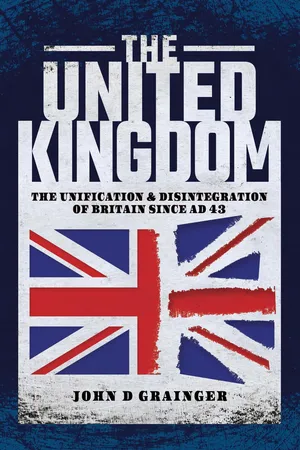
eBook - ePub
The United Kingdom
The Unification & Disintegration of Britain Since AD 43
- 319 pages
- English
- ePUB (mobile friendly)
- Available on iOS & Android
eBook - ePub
About this book
Information
Topic
HistoireSubtopic
Histoire de la Grande-BretagneChapter 1
The Roman Legacy
The first attempt to unite Britain and Ireland into a single state came with the Romans. This was, in the event, hardly a sustained attempt, and indeed no serious effort was ever made towards invading Ireland, though it was discussed. Yet the Roman presence in Britannia had a serious and lasting political legacy, which was never far from the minds of ambitious English - though not Scottish or Irish – politicians.
The Roman Empire extended its power, as is all too well known, as far north as the valley, between the mouth of the River Tyne and the Solway Firth, which separates the Pennine mountains of northern England and the Southern Uplands of Scotland. The boundary was marked by the wall ordered to be built by the Emperor Hadrian in AD 122 and garrisoned by Roman soldiers for almost the next three centuries. It was a structure which included a paved road south of the wall, providing a means of relatively rapid travel between east and west. This was originally for the soldiers, but it could easily be used by everybody else. There were also frequent gates incorporated in the wall for those travelling between north and south, so it is best interpreted as a boundary rather than a fortification, a customs barrier for regulating peacetime traffic and collecting duties; even fully garrisoned it could have been very easily crossed by an enemy force which concentrated by surprise on a single section. It actually has all the appearance of an imperial vanity project – Hadrian was liable to invent work for his soldiers – and it does not seem to be an effective military installation.
Occasional attempts were made to extend Roman dominion further to the north from the line of the wall. Even before it was, the Governor Cn. Iulius Agricola (AD 78–85) made a serious invasion of the north, reaching into the Highlands. His forts have been located as far north as the Moray Firth. He was unsuccessful despite winning a great battle; afterwards the troops were gradually withdrawn southwards, and the line of the wall became the occupation limit by about AD 100.
Then in the 140s, by order of the Emperor Antoninus Pius, at a moment when the wall of Hadrian was just about finished, a new and more permanent move northwards was made, which pushed the boundary forward to the Forth-Clyde line, and there another, slighter wall – a rampart-and-ditch construction with forts – was built. This frontier lasted about twenty years, and when the Emperor Septimius Severus mounted a personal campaign north of both walls in 209–11, he reached as far as Agricola had, according to the evidence of the temporary forts his army used, but this attempt at expansion also failed. It is not clear just what Severus’ aim was in this war. He was a proven conqueror in the East, where he had conquered and annexed Mesopotamia as far as the border with modern Iran, but in Scotland it looks more as if it was either a pre-emptive campaign or a punishment for earlier raids from the north, though a campaign lasting three years seems more serious than that. What stopped the war was not the local resistance, but Severus’ death. His quarrelling sons could agree that they were no longer interested in conquering the cold and wet Highlands, though on little else. Instead, Rome beckoned. The army withdrew to the line of Hadrian’s Wall once more, where it settled for the rest of the Roman occupation. A properly organized frontier system was now arranged, with the forts on the wall acting as the base for forward projections of Roman power in the form of alliances with some of the tribes to the north, several advanced forts to control the roads and travelling scouts to spy out possible threats. Perhaps on other occasions there were Roman invasions which we do not know about; certainly there were raids into the north, just as there were raids from the north into the richer south, but the permanent frontier lay along the wall.

None of these attempts at further conquest were successful in the long term. The withdrawals provided those living to the north of the wall – yet to be called Scots – with preliminary celebrations of independence, even if they had suffered casualties and a nasty ravaging, and the Roman Britons south of it now had the illusion of safety from invasion. Even though the Romans were generally victorious in the fighting during these expeditions, they had always failed to hold the ground they had apparently conquered in the north.
It is, in fact, not at all certain that these expeditions were really attempts to conquer the whole island. The knowledge that the Romans had seized only the southern two-thirds of Britannia probably stimulated Agricola to move further north, and his development of a legionary base at Inchtuthil in Perthshire would imply an intention to make a permanent occupation at least as far north as Fife, but the land further north was territory which was unproductive from a Roman point of view. Agricola’s forces were pulled back south to the line of the future Hadrian’s Wall once more serious problems developed elsewhere in the empire. Antoninus’ move north was still less an attempt at serious conquest, but probably more a gesture to the Roman expectation that an emperor, even so unmilitary a one as Antoninus, was expected to extend the bounds of the empire by conquest. Septimius’ expeditions were stopped when he died, so his long-term aim is unknown. Apart from Agricola’s failure, none of the Roman activities in the north seem to have been aimed at permanent conquest.
These campaigns, from Agricola to Severus, took place over a period of more than 130 years. The conquest of the retained province had been similarly intermittent. Again, the intended extent of the new province as projected by the imperial government when launching the invasion in AD 43 is not known, but several possible frontier lines have been suggested – along the line of the Fosse Way from the Wash to the Severn estuary, the Humber-Mersey line and perhaps the line between the River Tees and Morecambe Bay, and these seem to have marked the stages of the conquest of the southern part of the island. The conquest of Wales did not even begin until the 70s. So the province between 43 and 122 (when Hadrian’s Wall was built) repeatedly changed in size. The campaign into the lands north of the wall were thus continuations of that erratic process. The arrival of a new emperor on the throne in Rome several times started up the process again – Claudius’ original invasion, Nero’s reaction to Boudica’s rebellion, Vespasian in Wales, Domitian in the north, Hadrian and his wall and Antoninus with his advance to the Forth-Clyde line. It is almost as though the northern part of Britain was left unconquered so that an emperor could arrange a minor campaign, claim a conquest and a victory, and then sit back.
No serious attempt was ever made by the Romans to extend their power into Ireland, although Governor Agricola did claim that he could have conquered the island by using a single Roman legion (plus auxiliaries, of course – which would make the force around 10,000–12,000 men). The boast suggests that he knew little about the island, which, after all, is larger than England, and as damp as Scotland. Nevertheless, there was a good deal of Roman influence in Ireland, and occasional claims are made to have found evidence for a Roman military presence, though they are never verified. What evidence does exist is generally the result of trade between Ireland and the empire – coins and pottery are signs of the import of other goods and the export of Irish products – of booty acquired by Irish raiders into the larger island, or perhaps evidence of the accumulated wages and souvenirs of Irish mercenaries who served in the Roman army in Britain or perhaps further afield within the Roman Empire, and had then returned to their homeland.
The land which became Wales, of course, was conquered during the process of conquering what became England, a preliminary example of the close relations between the two future countries, but it is also noticeable that the two conquests were separated in time. There is no sign that the Romans recognized Wales as in any way different or separate. It was, of course, more mountainous than the eastern part of the island, and so less amenable to their policy of urbanization, and less productive in the goods they looked for. The two conquests went together as the conquerors moved from the south-east corner of Britannia towards the north-west and the wall they eventually built, so inevitably Wales was only dealt with once southern and central England had been secured; but then, in order to make that security certain Wales had to be conquered.
Britannia as a province was thus always in a sense incomplete, though the conquerors had seized control of the richest part of the archipelago, which they could exploit agriculturally, by quarrying its minerals – silver, lead, copper, coal – and by recruiting, or conscripting, thousands of young men into their army. But because of that incompletion it required a continuing Roman garrison out of all proportion to its importance or size. The size of that garrison may be in part the result of a sense that the province was under continual threat from outsiders, or that the British subjects were fundamentally hostile, or both of these considerations. The original conquest, after all, had not been easy, and it had taken forty years from the invasion until Agricola’s eventual failure and the withdrawal to the Tyne-Solway line, while the repeated invasions of the North had never succeeded. The combination and continuation of such difficulties clearly required that a large garrison be maintained.
This is a perfect example of an empire reaching the very limits of its capabilities and only learning of its inability to extend further when it had reached beyond those capabilities, then being unable to withdraw. Agricola’s boast about Ireland is belied by his own failure to conquer the North. Yet for two centuries the empire mounted expeditions which, if successful, would have ‘completed’ the conquest. It was also wholly unwilling to withdraw from a province which was becoming too expensive to hold; eventually, of course, the point was taken, though unwillingly, and from the 270s onwards, withdrawals of military forces from similarly unproductive and militarily expensive provinces took place with increasing frequency – Mauretania, Dacia, parts of Germany and eventually Britannia. Britannia was not ‘given’ its independence, but was just told to look to its own defence, with the implication that Roman imperial power would eventually return – a vague promise never to be honoured, though there is no reason to assume that the abandonment was intended to be permanent. Following those earlier withdrawals, the abandonment of Britannia should have surprised no one. By the time the abandonment was made official, the Roman army had mostly been withdrawn to deal with emergencies elsewhere.
The Roman imperial mindset insisted that any land which had been Roman remained Roman, even if it was no longer governed by an imperial official or defended by a Roman garrison. So Britannia, despite being told to look to its own defence, still remained a Roman province, subject to Roman laws. In the next generation more than one official, such as Bishop Germanus in 429, arrived to carry out official tasks. Further, any country which was ever subjected to Roman attentions, such as the lands north of Hadrian’s Wall, were also regarded as Roman. In the minds of bureaucrats in Rome or Constantinople, therefore, it followed that Britannia had been wholly taken into the empire, from Kent to Orkney (which had been visited more than once by Roman fleets). The alliances and agreements made with the tribes north of the wall – the Votadini of Lothian, the Nomantae and Damnonii of the south-west, even the Picts north of the Antonine Wall – were, by the fact of those agreements, Roman subjects. A Roman could argue that virtually all the island was really Roman, and remained so even after 410.
So, despite the essential and evident eventual failure of the physical conquest which began in AD 43, the Roman imprint on the land south of Hadrian’s Wall was deep and profound, if in the very long term only temporary, and the idea of the whole island as a single Roman province faded only slowly. On the other hand, an ‘occupation’ which lasted more than three-and-a-half centuries cannot be considered to be ‘temporary’, except at a very long time-distance. The population, starting with the wealthy, spoke Latin and lived as Roman subjects. Eventually this included most of the people of the whole island, for the population north of the wall (or walls) was very small.
A limit on Romanization may be seen in that the people of the province seem to have maintained their native languages all along, while, without the need to communicate to officials and army officers, the use of Latin soon dwindled to the educated and the Church after 410. A Roman way of life in towns and villas, with baths and mosaics, town councils and, eventually, Christian churches, took hold of the wealthiest classes. Thousands of British men were taken into, or voluntarily joined, the Roman Army and served throughout the empire, especially in the first decades after the conquest of the province, when the safety of the conquest required the removal of potentially hostile men who were capable of fighting.
This process of what historians and archaeologists call ‘Romanization’ was slow, partial and limited, but it did happen, though being only partial there was perhaps a good deal of passive resistance, not to mention a lack of any real Roman interest in pushing forward such a process. By contrast, Gaul and Hispania, which had both become Roman provinces a century or more earlier, were much more urbanized, and their populations largely abandoned their ‘native’ languages and spoke Latin. The wealthy classes in those lands also participated in the political life of the empire, providing administrators and emperors – but from Britannia we know of no officials, no army officers, and no senators.
Well before the fourth century, when it seems there was considerable wealth in the province, if in relatively few hands, the population probably regarded themselves as not only Romans, but also as citizens of their region, their civitas, very like other regions of the empire, and in that century increasing numbers of them also adopted the new Roman religion of Christianity when they were encouraged to do so by the Roman government. However, the enduring use of native languages implies a continuing resistance, even if it was passive, and even if the wealthy classes did take to villa and town life. The villas, though they are archaeologically occasionally spectacular, were not all that numerous, were concentrated in the south-eastern half of the province and cannot have housed more than 1,000–2,000 people in total.
Seen from Rome, this was only a marginal society and a distant province, expensive to protect and probably never paying its way. It always remained partly non-Roman, geographically, socially, linguistically and intellectually. One or two army officers used the army in Britannia as the base for attempting to usurp the empire, but only two were successful for more than a few years – the main exception being Constantine the Great, whose British base was inadvertent, not deliberate. The others came even later in the empire’s history: Magnentius in the 350s, Magnus Maximus in the 380s and finally Constantine III, who took the British army to the rescue of Gaul and Hispania; the army was not returned, and this led the Emperor Honorius to write his letter to the citizens calling on them to look to their own defence – a gesture in part aimed at cutting off Constantine’s logistical base. When the pressure of the empire became too great, the empire therefore abandoned Britain with scarcely a moment of regret, nor any apology.
So the legacy that Rome left behind after nearly four centuries of ruling half of the main British island as part of the empire, and pretending to control the rest, was first of all a memory of unity; second, some legends centred on usurpers and rebels; and third, the Christian religion, to which many Roman Britons were eventually converted during the fourth century. The religion spread to Ireland and north of the wall in the fifth century, when it was no longer an obvious instrument of Roman power in Britannia. Finally, and this was perhaps the most potent effect, there was a memory of the unity of the southern part of the island, a notion which was passed on to their non-Roman successors.
Such evidence as there is over the next couple of centuries does suggest an attempt was made to maintain the Roman system for a time by those who had been addressed by Honorius’ letter, but this broke down soon enough. The adoption of Christianity linked the Celtic inhabitants to the remaining, if diminishing, Roman world. Among the Welsh there remained the memory of their presence as Roman subjects, even if this was mere nostalgia, and the original resistance to Romanization was forgotten.
This was not in fact very much of a legacy, and the evidence – necessarily negative – is that any real memory of being Roman faded rapidly away into legend. The life of those Roman Britons who lived in their villas and reclined in their slave-fuelled hot baths vanished even from memory, though the hot baths at Bath remained in use for some time and became the subject of a notable and nostalgic Anglo-Saxon poem. The villas ceased to be inhabited when the complex economy, based in large part on the presence of a large military market, vanished. Their later inhabitants were no more than occasional squatters, whose fires and scattered remains are sometimes found. Christianity was driven from much of the former province by the arrival of unimpressed pagans from across the North Sea, and survived only amongst those whom these new arrivals dismissed as, ironically, Wealas (‘foreigners’), that is, Welsh.
Ultimately, almost the only political relic of the Roman period, during which the southern half of the main island had been united into a single polity, appears to have been the occasional use of a royal title, ‘Bretwalda’, which was a sort of decoration awarded to, or taken by, the pre-eminent Anglo-Saxon king at any particular time. He was usually one who had succeeded in dominating many of his neighbours, though only for a brief time, and it was never hereditary. Meaning ‘wielder of Britain’, it certainly had implications of the continuing concept of the unity of the old province, or an aspiration thereto, but no Anglo-Saxon king who gained that title could claim to have contributed much to the restoration of that unity beyond the brief conquest of weaker ...
Table of contents
- Cover
- Title
- Copyright
- Contents
- List of Maps
- Introduction
- Chapter 1 The Roman Legacy
- Part I Two Unifications; Two Failures
- Part II Attempts to Unify the British Islands
- Part III Separations
- Not Yet a Conclusion
- A Brexit Afterword
Trusted by 375,005 students
Access to over 1.5 million titles for a fair monthly price.
Study more efficiently using our study tools.
Frequently asked questions
Yes, you can cancel anytime from the Subscription tab in your account settings on the Perlego website. Your subscription will stay active until the end of your current billing period. Learn how to cancel your subscription
No, books cannot be downloaded as external files, such as PDFs, for use outside of Perlego. However, you can download books within the Perlego app for offline reading on mobile or tablet. Learn how to download books offline
We are an online textbook subscription service, where you can get access to an entire online library for less than the price of a single book per month. With over 1.5 million books across 990+ topics, we’ve got you covered! Learn about our mission
Look out for the read-aloud symbol on your next book to see if you can listen to it. The read-aloud tool reads text aloud for you, highlighting the text as it is being read. You can pause it, speed it up and slow it down. Learn more about Read Aloud
Yes! You can use the Perlego app on both iOS and Android devices to read anytime, anywhere — even offline. Perfect for commutes or when you’re on the go.
Please note we cannot support devices running on iOS 13 and Android 7 or earlier. Learn more about using the app
Please note we cannot support devices running on iOS 13 and Android 7 or earlier. Learn more about using the app
Yes, you can access The United Kingdom by John D. Grainger in PDF and/or ePUB format, as well as other popular books in Histoire & Histoire de la Grande-Bretagne. We have over 1.5 million books available in our catalogue for you to explore.