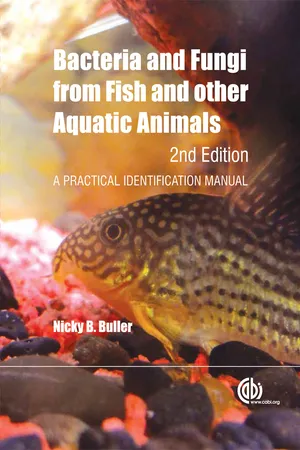
This practical book provides an updated resource for the identification of bacteria found in animals inhabiting the aquatic environment, illustrated with colour photos. It contains expanded biochemical identification tables to include newly identified pathogenic and saprophytic bacteria, molecular identification tests now available for a greater number of aquatic bacterial pathogens, more information on the pathogenesis and virulence of each organism and new coverage of traditional and molecular identification of fungal pathogens and quality assurance standards for laboratories.
eBook - ePub
Bacteria and Fungi from Fish and Other Aquatic Animals
A Practical Identification Manual
- English
- ePUB (mobile friendly)
- Available on iOS & Android
eBook - ePub
Bacteria and Fungi from Fish and Other Aquatic Animals
A Practical Identification Manual
About this book
Trusted by 375,005 students
Access to over 1.5 million titles for a fair monthly price.
Study more efficiently using our study tools.
Information
1
Aquatic Animal Species and Organism Relationship
1.1 Host Species, Bacteria and Disease
This chapter deals with the relationship between the host species and the bacterial flora that may be either part of the normal flora of that host, or are pathogenic for that host. This information is presented in two formats. Table 1.1 lists the aquatic animal hosts in alphabetical order under their Class, followed by Order then Family and then listed in alphabetical order according to their common name. The scientific name is in parentheses. For example, to look for bacteria found in prawns (shrimps) look under the Phylum Arthropoda, Order Decapoda. To search for fish, look under the Phylum Chordata, Class Actinopterygii (ray-finned fish). These are then arranged under Order and Family. For anemones, corals and jellyfish look under the Phylum Cnidaria, Class Anthozoa.
Names listed in journal articles were checked against names according to Fishbase (http://www.fishbase.org), World Register of Marine Species (WoRMS) (http://www.marinespecies.org/index.php) and algaebase (http://www.algaebase.org). The adjacent columns in the table list the bacteria that have been reported to be either pathogens of the host or are considered part of the normal flora, the tissue site of infection, or the pathology presented and the disease state. Some organisms are considered to be opportunistic pathogens, and in a healthy host may be part of the normal flora. In a stressed animal, these same bacteria may overcome host defence mechanisms and cause morbidity or infection in the animal. Some organisms have been identified and isolated from a host but the pathogenicity of the organism is unknown, as virulence studies were not carried out.
In the second format in Table 1.2, the information is presented by listing the bacteria in alphabetical order with adjacent columns listing the name of the disease, the tissue site where the organisms may be found, the aquatic animals where the organism has been reported and the geographical location of the disease.
Table 1.1 Host species and organism relationship.


1.2 Bacteria and Relationship to Host
Table 1.2 lists the bacteria that may be pathogens or saprophytes of fish and other aquatic animals. The information is presented in tabular form summarizing the information in the text. Not all bacterial species listed are presented in the text.
The bacteria are listed in alphabetical order. The ‘disease’ column indicates the status of the organism as saprophyte, environmental organism or a pathogen of fish and other aquatic animals. Under ‘disease signs’ clinical information is summarized or the site of bacterial infection is listed. Under the ‘aquatic species’ and ‘distribution’ headings is information regarding the aquatic animals and the country where the organism was isolated according to the references cited. The final column lists the reference number.
Table 1.2 Bacterial pathogens and saprophytes of fish and other aquatic animals.


1.3 Taxonomy and Identification of Bacteria
Taxonomy is the classification, identification and naming (nomenclature) of organisms and the placement into a Kingdom, Phylum, Class, Order, Family, Genus and Species based on morphological and phenotypic characteristics and DNA–DNA relatedness. A Type strain is designated to represent the species and to compare new species. Identification to species level using biochemical identification tests can be difficult due to phenotypic diversity within a species or because of phenotypic similarity to other species. However, for many years morphological and phenotypic characteristics were the only methods available to the diagnostic laboratory for the identification of bacteria isolated from samples. Biochemical identification is an important tool for the diagnostic laboratory and new technologies such as matrix assisted laser desorption ionization time of flight (MALDI-TOF) mass spectrometry available commercially from companies such as Bruker Daltonics and bioMérieux offer exciting advances for the diagnostic laboratory (Dekker and Branda, 2011; Neville et al., 2011). The technology is based on identifying bacteria and fungi by their protein profile. Biochemical methods rely on the fermentation, hydrolysis or carbon source utilization of a specific substrate, whereas protein profiling using mass spectrometry overcomes the shortcomings of traditional biochemical methods such as the length of time taken to complete the reaction, or false results due to incorrect growth conditions such as suboptimal NaCl concentration or growth temperature. Identification of a 24-h colony takes 45 s using the mass spectrometer. Current databases can identify more than 4000 species of bacteria and fungi including an extensive number of organisms commonly isolated in veterinary and aquatic microbiology laboratories. Unfortunately, at present the cost is inhibitory to the general diagnostic laboratory, however the technology allows the inoculum (1 µl from a bacterial colony mixed into matrix solution) to be prepared on specific cartridges off-site and sent through the post to a processing laboratory.
Molecular technologies such as polymerase chain reaction (PCR) and sequencing are more widely used now by diagnostic laboratories and are cheaper than a few years ago. PCR and sequencing can be used alone or in conjunction with biochemical methods to identify an organism.
Research laboratories are using phylogenetics, which examines the evolutionary relationship between organisms through molecular sequencing, and are applying this to relationships between species within a genus and attempting to improve upon biochemical identification. Even molecular identification is not straightforward and a PCR must be validated for specificity and sensitivity before it can be used in the diagnostic laboratory. Virulence genes and housekeeping genes may be present in a number of species within a genus and often these genes contain conserved and diverse regions. It is crucial that the optimum area of sequence is chosen for primer design. For interspecies identification, primers must be selected from a conserved region of the genome of the target species so as to detect and identify all strains within that target species, yet designed from a diverse region to allow differentiation from other species that harbour the same gene. For some genera the 16S rRNA gene is so similar between species that it offers little value for diagnostic identification unless used in conjunction with other identification methods. However, the 16S rRNA gene can assist or confirm biochemical identification results in placing an unknown bacterium into a genus and in some cases to species level and for a number of years has been used to assist taxonomy (Tindall et al., 2010).
Strains belonging to a species have ≥70% DNA–DNA hybridization (DDH) relatedness with 5°C or less change in melt temperature (∆Tm) (Wayne et al., 1987), a related G+C (guanine cytosine) content and >97% similarity in the 16S rRNA sequence (Stackebrandt et al., 2002). DDH measures hybridization efficiency between two sequences and not the sequence identity. A DDH of 70% corresponds to 95% average nucleotide identity (ANI); that is, the average nucleotide identity shared between two strains (Konstantinidis et al., 2006). An ANI between two strains corresponds to >97% sequence identity in the 16S rRNA gene (Goris et al., 2007).
Nomenclature of Bacteria
Certain rules govern the nomenclature of bacteria as stated in the International Code of Nomenclature of Bacteria (Lapage et al., 1992). The Code was updated to replace the word Bacteria with Prokaryote and to include certain amendments as published in Labeda (2000). The date of validation of a new bacterium is considered to be the date of publication in the International Journal of Systematic and Ev...
Table of contents
- Cover
- Half Title
- Title
- Copyright
- Contents
- List of Tables and Figures
- Acknowledgements
- Introduction
- Photographs of Culture and Microscopic Appearance of Organisms
- 1 Aquatic Animal Species and Organism Relationship
- 2 Bacteriological Culture Techniques: Microscopy, Culture and Identification
- 3 Biochemical Identification Tables
- 4 Technical Methods
- 5 Fungi, Yeasts and Oomycetes from Fish and Other Aquatic Organisms
- 6 Techniques for the Molecular Identification of Bacteria
- 7 Preparation of Media for Culture and Identification
- Further Reading and Other Information Sources
- Common Name and Scientific Name of Aquatic Animals
- Glossary of Terms
- References
- Index
- Color Plates
Frequently asked questions
Yes, you can cancel anytime from the Subscription tab in your account settings on the Perlego website. Your subscription will stay active until the end of your current billing period. Learn how to cancel your subscription
No, books cannot be downloaded as external files, such as PDFs, for use outside of Perlego. However, you can download books within the Perlego app for offline reading on mobile or tablet. Learn how to download books offline
Perlego offers two plans: Essential and Complete
- Essential is ideal for learners and professionals who enjoy exploring a wide range of subjects. Access the Essential Library with 800,000+ trusted titles and best-sellers across business, personal growth, and the humanities. Includes unlimited reading time and Standard Read Aloud voice.
- Complete: Perfect for advanced learners and researchers needing full, unrestricted access. Unlock 1.5M+ books across hundreds of subjects, including academic and specialized titles. The Complete Plan also includes advanced features like Premium Read Aloud and Research Assistant.
We are an online textbook subscription service, where you can get access to an entire online library for less than the price of a single book per month. With over 1.5 million books across 990+ topics, we’ve got you covered! Learn about our mission
Look out for the read-aloud symbol on your next book to see if you can listen to it. The read-aloud tool reads text aloud for you, highlighting the text as it is being read. You can pause it, speed it up and slow it down. Learn more about Read Aloud
Yes! You can use the Perlego app on both iOS and Android devices to read anytime, anywhere — even offline. Perfect for commutes or when you’re on the go.
Please note we cannot support devices running on iOS 13 and Android 7 or earlier. Learn more about using the app
Please note we cannot support devices running on iOS 13 and Android 7 or earlier. Learn more about using the app
Yes, you can access Bacteria and Fungi from Fish and Other Aquatic Animals by Nicky B Buller in PDF and/or ePUB format, as well as other popular books in Biological Sciences & Biology. We have over 1.5 million books available in our catalogue for you to explore.