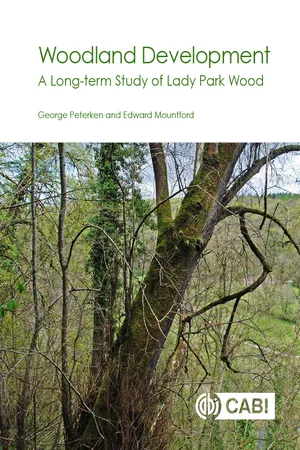
In 1944 Lady Park Wood (45 hectares of woodland in Gloucestershire and Monmouthshire, UK) was set aside indefinitely by the Forestry Commission so that ecologists could study how woodland develops naturally. Since then, in a unique long-term study, individual trees and shrubs have been recorded at intervals, accumulating a detailed record of more than 20, 000 individual beech, sessile oak, ash, wych elm, small-leaved lime, large-leaved lime, birch, hazel, yew and other species. In the seven decades since the study started, the wood has changed; trees grew, died and regenerated, and drought, disease and other events shaped its destiny. Each tree and shrub species reacted in its own way to changes in the wood as a whole and to changes in the fortunes of its neighbours. Meanwhile, the wild fauna, flora and fungi also responded, leaving the wood richer in some groups but poorer in others. In this landmark book, beautifully illustrated throughout, George Peterken and Edward Mountford, summarise the ongoing results of the Lady Park Wood study, highlighting its unique place in nature conservation and its significance to ecology in general. It also builds on experience at Lady Park Wood and elsewhere to discuss in particular: the role and maintenance of long-term ecological studies; the concept and form of natural woodland; the role of minimum-intervention policies in woodland nature conservation; near-to-nature forestry; and the desirability and practicalities of re-wilding woodlands.
eBook - ePub
Woodland Development
A Long-term Study of Lady Park Wood
- English
- ePUB (mobile friendly)
- Available on iOS & Android
eBook - ePub
About this book
Trusted by 375,005 students
Access to over 1.5 million titles for a fair monthly price.
Study more efficiently using our study tools.
Information
1 Understanding Woodland
To know fully even one field or one land is a lifetime’s experience. In the world of poetic experience it is depth that counts, not width. A gap in the hedge, a smooth rock surfacing a narrow lane, a view of a woody meadow, the stream at the junction of four fields – these are as much as a man can fully experience.
Patrick Kavanagh, Irish poet, quoted by Robert Macfarlane in Landmarks (2015: p. 63)
What (Nan Shepherd) learns – and what her book (The Living Mountain) taught me – is that the true mark of long acquaintance with a single place is a readiness to accept uncertainty: a contentment with the knowledge that you must not seek complete knowledge.
Robert Macfarlane (2015: p. 71)
Rewilding recognises that nature consists not just of a collection of species but also of their ever-shifting relationships with each other and with the physical environment. It understands that to keep an ecosystem in a state of arrested development . . . is to protect something which bears little relationship to the natural world. Rewilding has no end points, no view about what a ‘right’ ecosystem or a ‘right’ assemblage of species looks like. It lets nature decide.
George Monbiot (2013: pp. 8–10)
The woods we see around us reflect our past and our present. Swathes of the uplands are still covered by masses of conifers, uniform and geometrical, an arboreal analogue of the concrete, brutalist architecture that characterises many institutional buildings of the 1960s. The lowland farmlands are still studded with small, angular woods and belts planted for the fox hunters and country estate owners of the 18th and 19th centuries. Mixed with them we find numerous, less regular woods with oak, ash, hazel and other native trees that still clearly bear the marks of centuries of coppicing. And, in a few locations, park-like woodlands among heaths and pastures survive that would still, just about, be familiar to our medieval ancestors. In all these woods – their shape, pattern, composition and structure – much of the fascination lies in why people created them or allowed them to survive; how they used and misused them; what they meant to people; and how the fauna and flora managed to thrive in places that were usually not designed for their well-being.
But what happens when we take people out of the picture and allow woods to grow naturally? Do they take on different forms that might once have been familiar to our Mesolithic ancestors? Do trees grow, die and regenerate differently once they are freed from the moulding imposed on them by generations of woodmen and foresters? Will the woods degenerate? After all, foresters have long tried to improve them. Can they recover if they have been exploited? Does the wild fauna and flora prosper or languish once the habitats generated by people are no longer there? And if, as many people have found in recent years, the human element is so interesting, do they just become tedious and dull?
This book is about one attempt to answer questions such as these. Towards the end of the Second World War, a wood in the borderland between England and Wales, standing in the upper gorge of the lower Wye Valley (Fig. 1.1a and Fig. 1.1b: see pp. 1–2), was set aside by the Forestry Commission for study as a natural reserve (Fig. 1.2). While the war still raged in the East and Britain entered years of austerity and recovery, a small band of forestry students from Oxford University mapped and measured the trees and recorded the plants on the ground. By the end of 1945, Lady Parke – the ancient name for that part of the Highmeadow Woods – must already have been the best-recorded wood in Britain, at least as far as the trees were concerned. The records were stored at Oxford, and then 10 years later another group of forestry students sallied forth to record the wood again, and this exercise has been repeated at intervals ever since, often in the face of limited encouragement and negligible resources. Later, in 1980, adjacent woodland – also historically part of Lady Parke – was added, so that managed woodland could be compared with the untouched woodland originally set aside. Now, over 70 years later, long after those original forestry students have passed on, we have the individual histories of 20,000 or so trees and shrubs on record and can trace in detail how the wood and its inhabitants have performed when left to themselves.

Fig. 1.1a. The view downstream from the Seven Sisters rocks with Bloody cranesbill and Common rock-rose representing the rock-garden flora.

Fig. 1.1b. View upstream from the Seven Sisters rocks, featuring the Biblins campsite and, to the right, Lady Park Wood. Horseshoe vetch and Bloody cranesbill represent the rock-garden flora.

Fig. 1.2. This is the outcome so far of nearly 150 years of leaving a freshly cut coppice with standards woodland to grow naturally. This beech-dominated, old-growth stand in Lady Park Wood has received very little management since it was last coppiced in 1870.
Why did we bother? What have we learned? Was it worth the effort? And, is it worth continuing? One answer is entirely personal. GFP still remembers clearly the damascene moment when he first started re-recording the transects in 1980. Suddenly, with the charts and measurements from previous recordings in his hand, he could see the wood as a living, changing entity, not a statuesque, apparently unchanging collection of trees. Instead of the broad understanding of British woods that his survey and advisory work had given him, he realised that he could understand woods in depth, armed with both the detail of individual trees and an opportunity to understand their interactions across the long timescales over which they played out. EPM had much the same experience: once Lady Park had taught him how to recognise the marks of past events and the evidence of how stands were developing, this enabled him to recognise equivalent evidence in other woods.
The general answer requires some consideration of the context in which the study has taken place. After all, the assumptions, aims, concepts, knowledge and methods of research that form the foundation of ecology have changed a great deal since 1944, and so have the preoccupations and objectives of forestry. Although Alan Turing was simultaneously starting down the path that led to computers, the originators of the Lady Park recording could not possibly have envisaged the kinds of analysis that would become possible today. Equally, though the record may now have a role in, say, understanding climate change and the impact of Chalara ash disease, the originators could not have anticipated these at the outset. Back in Oxford, it must have seemed worthwhile in 1944 to initiate a study that could not have yielded results for many years, but in 2016 university ecologists have to publish quickly and in quantity to survive in their jobs.
The initiator of the study and leader of those recording expeditions in 1945 and 1955 was Dr Eustace Jones. Like Dr Alex Watt, one of the founders of British ecology, he was both a forester and an ecologist associated with Cambridge University. In the 1930s, he was recruited to the Oxford forestry department, where he taught various aspects of forestry to Masters graduates. He was also a keen bryologist, with prior knowledge of the lower Wye Valley, so there were mixed motives when he chose Highmeadow Woods for courses in field survey techniques and later selected Lady Park Wood for the study of natural woodland. Not for the first time, the chain of causation behind a scientific study was as much personal and subjective as it was objective.
Eustace Jones died in August 1992 (Obituary (1993) Forestry 66(2), 221–223), so what he started, others have necessarily continued. GFP became involved in the late 1970s, so he had opportunities to talk to him about the work and, late in his life, to take him back to the wood. Yet we have only a very general statement of his aims in starting the study. Today, we come up with a list of interest groups that have, or might benefit, ecologists, environmentalists, nature conservationists, foresters and the general public, not necessarily in that order of importance. In particular:
• Ecologists might test models, have them confirmed, or not, by long-term observation, or make observations that lead on to experimental and other kinds of fixed-term research (Figs. 3.4, 14.2).
• Nature conservationists can see what minimum intervention achieves and assess whether this is the right management for woodland nature reserves elsewhere.
• Environmentalists and land managers have a reference point of near-natural woodland against which to measure human impacts on managed woodland and other land.
• Foresters, in particular, can measure and demonstrate the effects of their management and gain inspiration for near-to-nature forestry (Fig. 16.2).
• The general public, and those managing land on their behalf, have a chance to witness a kind of ‘rewilding’ and assess whether this is desirable on a wider scale (Fig. 12.10). To quote Ward Cooper of CAB International after a site visit, Lady Park ‘makes you realise how managed other woods are’.
Lady Park is far from being the only place where we know how habitats have developed in the long term. The Park Grass fertiliser plots at Rothamsted were started in an ordinary meadow in 1856 and continue today without a break (Silvertown et al., 2006). Plots in the Boubínský Prales, a virgin forest in Bohemia (Czech Republic), were first recorded in 1847, then relocated and repeated and thereby became a long-term study (Řehák, 1968; Peterken, 1981: p. 229). Likewise, in Britain, a plot recorded in 1921 by R. Hansford Worth at the southern end of Wistman’s Wood, high on Dartmoor, was relocated and repeated (Mountford et al., 2001). The record at Lady Park is shorter than these, but more detailed. In fact, Jorg Brunet, who has continued the study of Dalby Söderskog in southern Sweden, which was started in 1909 (Brunet et al., 2014), tells us that it is one of the most comprehensive data sets in temperate Europe and North America, matched only by permanent plots at Bialowieza and a couple of sites in the USA.
Lady Park is now a National Nature Reserve. It occupies a spectacular position overlooking the Wye from above a 60 m Carboniferous Limestone cliff in one of the wildest landscapes in southern Britain. It is unusual in containing a substantial population of large-leaved lime, Britain’s rarest native major forest tree, and almost unique in being an ecological research reserve established by the Forestry Commission before official nature conservation came into being – and one that has actually been used for research ever since. It also offers a wide range of topography, composition and stand conditions for study.
But, attractive, invigorating, varied and well understood though it is, does Lady Park justify a whole book? After all, it is a sample of one and may be representative only of itself. Our response is that understanding a particular place can have general significance as part of a spectrum of various scales of understanding. At a large scale – regional, national or international – one can survey a large sample of woods and understand the full range of features encountered: how composition correlates with soils and geology; how relationships between species change over large distances; how climate controls composition; how management varies between regions. This is the kind of understanding achieved through the National Vegetation Classification (Rodwell, 1991). At a district scale, one can study all the woods within a limited area, including the small, apparently insignificant woods that tend to be ignored in large-scale studies, and recognise that each has its own history and individuality – analogous, perhaps, to understanding people through familiarity with a village community or small town, rather than a national survey. (An example would be our study of the flora of woods in central Lincolnshire (Peterken and Game, 1984).) At a single wood scale, one can study the detail, become familiar with all aspects over a long period and how different parts of a wood fit together and interact, much like understanding human relationships through a long marriage. One can spread such a study to several woods scattered over a district or region, but in practice one cannot match the detailed familiarity that can be achieved by concentrating on a single wood, nor familiarity over many years. This is, perhaps, analogous to the fabled ‘wife in every port’ lifestyle, which (we assume!) gives one a different understanding of human relationships. One can also study part of a single wood (or small samples of several woods), which is the scale at which experimentation and manipulation becomes practicable, and the kind of understanding achieved by studying pollen in deposits within small hollows within woods (e.g. Bradshaw, 1981).
Lady Park is also part of the spectrum of approaches to understanding woods. First, we can study how woods work, the processes operating and the patterns produced in stand structure, soil structure, nutrient flows, hydrology, energy exchanges, associations and interactions between species. Second, we can find out how they developed; that is, bring the time element into a study of processes. This brings in natural succession, natural disturbances, forestry, woodmanship and all other past usage, as well as the origins of the wood, and brings decidedly non-scientific historical sources into play. Third, we can enquire what woods mean to people as resources, play...
Table of contents
- Cover
- Half Title
- Title
- Copyright
- Contents
- Acknowledgements
- Summary
- Citations of Archived Documents
- 1 Understanding Woodland
- 2 Lady Park Wood and its History
- 3 The Ecological Reserve
- 4 Recording Trees and Expressing Change
- 5 The Changing Woodland
- 6 Ash: The Tree in the Spotlight
- 7 Beech and Oak, The Major Forest Trees
- 8 Limes and Wych Elm
- 9 Birch and other Short-lived Canopy Trees
- 10 Field Maple and Hazel, the other Coppice Species
- 11 Minor Trees and Shrubs
- 12 Habitats
- 13 Species
- 14 Long-term Ecological Studies
- 15 Natural Woodland in Theory and Practice
- 16 Near-to-Nature Forestry
- 17 Rewilding, Remoteness and Wilderness
- References
- Vascular Plant Species
- Index
- Back Cover
Frequently asked questions
Yes, you can cancel anytime from the Subscription tab in your account settings on the Perlego website. Your subscription will stay active until the end of your current billing period. Learn how to cancel your subscription
No, books cannot be downloaded as external files, such as PDFs, for use outside of Perlego. However, you can download books within the Perlego app for offline reading on mobile or tablet. Learn how to download books offline
Perlego offers two plans: Essential and Complete
- Essential is ideal for learners and professionals who enjoy exploring a wide range of subjects. Access the Essential Library with 800,000+ trusted titles and best-sellers across business, personal growth, and the humanities. Includes unlimited reading time and Standard Read Aloud voice.
- Complete: Perfect for advanced learners and researchers needing full, unrestricted access. Unlock 1.5M+ books across hundreds of subjects, including academic and specialized titles. The Complete Plan also includes advanced features like Premium Read Aloud and Research Assistant.
We are an online textbook subscription service, where you can get access to an entire online library for less than the price of a single book per month. With over 1.5 million books across 990+ topics, we’ve got you covered! Learn about our mission
Look out for the read-aloud symbol on your next book to see if you can listen to it. The read-aloud tool reads text aloud for you, highlighting the text as it is being read. You can pause it, speed it up and slow it down. Learn more about Read Aloud
Yes! You can use the Perlego app on both iOS and Android devices to read anytime, anywhere — even offline. Perfect for commutes or when you’re on the go.
Please note we cannot support devices running on iOS 13 and Android 7 or earlier. Learn more about using the app
Please note we cannot support devices running on iOS 13 and Android 7 or earlier. Learn more about using the app
Yes, you can access Woodland Development by George Peterken,Edward Mountford in PDF and/or ePUB format, as well as other popular books in Technology & Engineering & Forestry. We have over 1.5 million books available in our catalogue for you to explore.