- 144 pages
- English
- ePUB (mobile friendly)
- Available on iOS & Android
eBook - ePub
About this book
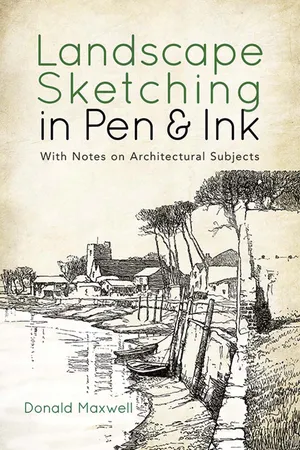
Although geared toward professional artists, this accessible approach to landscape sketching will also appeal to amateurs. English artist Donald Maxwell's entertaining and straightforward attitude begins with the basics: "We will draw a brick. Anybody can draw a brick."
Following introductions to perspective, light and shade, and composition, Maxwell proceeds to demonstrate how to direct a picture's focus, and he discusses the challenges of ink as a medium. His observations are complemented and enhanced with illustrative examples of boatyards, bridges, churches, and country farms from throughout Great Britain that date from the early twentieth century. A concluding gallery features a bonus collection of twenty-five images by Frank Brangwyn, Joseph Pennell, Otto Fischer, and other contemporary masters of pen-and-ink landscapes. Specially added for this edition is a new Foreword written by Sonja Rozman and Gašper Habjanič, two landscape architects with a passion for drawing.
Following introductions to perspective, light and shade, and composition, Maxwell proceeds to demonstrate how to direct a picture's focus, and he discusses the challenges of ink as a medium. His observations are complemented and enhanced with illustrative examples of boatyards, bridges, churches, and country farms from throughout Great Britain that date from the early twentieth century. A concluding gallery features a bonus collection of twenty-five images by Frank Brangwyn, Joseph Pennell, Otto Fischer, and other contemporary masters of pen-and-ink landscapes. Specially added for this edition is a new Foreword written by Sonja Rozman and Gašper Habjanič, two landscape architects with a passion for drawing.
Trusted by 375,005 students
Access to over 1 million titles for a fair monthly price.
Study more efficiently using our study tools.
Information
PART I
THE PROBLEM OF SKETCHING WITH PEN AND INK
THE pen is the one instrument of drawing in the use of which no instruction is needed. Any one who can write a postcard or put down a column of figures is perfectly well equipped technically to make a sketch in line.
Let us, therefore, start straight away and draw something without any further argument or any suspicion of what psychologists name the inferiority complex.
We will draw a brick.
Anybody can draw a brick.
On page 4, in the right hand bottom corner, is an outline of a brick marked B. It you don't like this brick go and find a better one. Take a foot rule and measure it. You will ascertain that it measures, as viewed in a wall, 8½ in. by 2½ in.
On page 5, this same outline, marked B, is filled in with a series of downward strokes. A line along the bottom will bind these together and a line at the end, a little thicker than the others, will denote that the brick goes no farther to the right. In fact, these bottom and end lines show the brick as lighted from the top left corner of the paper.
You will say, I know, that it is all very well drawing a brick, but what about perspective and art and technique and poetry— hang it all a man can't draw a picture if he hasn't got a gift.
You are quite right in some ways, but you do not argue that it is silly to attempt to write an account of a football match unless you can be Shakespeare, nor futile to be able to multiply by six if you are not Einstein.

FIG. 1
Bricks in a wall drawn in outline
In the Middle Ages most people of culture, the highest in the land, had to send for a priest if they wanted to write their names or read a simple message sent in writing from a neighbouring manor. King John, as a matter of cold fact, never signed Magna Carta, for all the assertions of the history books. He could not write his name, so he made a mark like a squashed frog and the Archbishop of Canterbury wrote it in for him.
This all seems very ridiculous to us, but it is not more ridiculous than the system of culture under which we live in the Merrie England of to-day, when we have to send for an artist if we want to draw a brick.
Now we have learnt to draw a brick for ourselves. And if we can draw a brick we can draw many bricks: we can draw a wall, a gate, a tower. In fact, we can draw, with due patience and a plumb line, anything that a man has made. If a man, not highly skilled as the fine arts go, can put brick on brick and thus build a wall, so can any one with a pen and a piece of paper put brick on brick and make a representation of a wall.
Here is a piece of wall. In Fig. 1 the bricks are drawn in pencil outline. In Fig. 2 that same piece of wall is shown in pen and ink. The various shapes have been filled in and the pencil lines rubbed out. Now note the different character in the bricks and the method of toning with lines to show that character. No. 1 is a new brick, a smooth plane of bright red. The general appearance of this brick in black and white is well expressed by the careful, almost parallel and firm lines that shade it. Brick No. 3, however, is an old one. It must be expressed with a less orderly and less parallel set of lines and these will give it a rough and battered appearance. Note that the mortar has come out and the join between this brick and the brick below it is hollowed out and therefore in shadow and expressible by black marks.

FIG. 2
Bricks in a wall toned to represent varying colour and age
At bricks 5 and 6, however, and the zone underneath them, there is a zone that has been whitewashed, though now rather dirty and going grey in the mortar between the bricks. Thus the simple outlining of the bricks and the slight toning with a few fine lines of the mortar, will give the appearance of a lime-washed wall or one made of very light coloured bricks.
If you will come with me only a few steps outside my studio, we will make a study of an old and rather tumble-down part of my house, a subject a little more advanced than this strip of brickwork. It is a bit of the Tudor fragment left when the house was rebuilt in the time of Queen Anne. In fact, it has at this date, I think, been rebuilt to some extent itself. The red bricks are not part of the original work, which would all have been in stone. It is the old bake-oven of the farmhouse, and the fact that it is in very bad repair is all the better for our purpose.
There is plenty of time, so we will fetch a chair and sit down to the job. A distance of about ten yards will suffice for scale, and we will avoid any perspective problems by taking up our position at right angles to the wall. We will measure each bit carefully. Let us begin by a definite statement that is well within our powers so far as we have advanced at present. Let us draw one brick as we did at B. We, therefore, set down our brick at X. In the pencil sketch in Fig. 3 we will mark this brick with an N to remind us when we come to detail and expression that it is a new brick and it must be shown as such if we are to express our piece of wall effectively.

FIG. 3
Pencil sketch of a piece of wall

FIG. 4
The same sketch carried on in pen and ink and the pencil work rubbed out
Then let us show the two bricks above it and the one just under the tiles. Then we will outline the two bricks below our brick N, and still farther below that, two more bricks, which are newer than most of the work. These we will also mark N to remind us.
Before we go any farther, let us get down this much in ink. Brick X we can shade with careful and evenly distributed straight vertical lines and we will treat the other two new bricks in the same way. Then we will put in the two bricks under X with rougher and darker lines, and so, brick for brick, expressing old or new, dark or light, until we have this little section of brickwork well nigh complete. From this definite and accurate statement we can add on and measure out other parts.
In the brick course, underneath the stonework, are two outlined bricks in Fig. 3, each marked O. This reminds us that they are old. They are darker and more crumbled than some. It is a good idea to put these letters N and O on different features in a wall because we may take your pencil sketch home and finish the pen work at leisure. Weather and other circumstances will often stop us being long before a subject, but an accurate pencil outline thus lettered will stand us in good stead.
Then, as in Fig. 3, we will complete our outline of the principal shapes of the various component parts of our wall, not forgetting to indicate in deep black those fissures in the masonry that give shadows.
When we come to tone this work and complete our statements about it, we shall have to devise some method of "colouring" the stones—some method of lining that will give them greyness a...
Table of contents
- Cover
- Title Page
- Copyright Page
- Foreword
- Preface
- Contents
- Part I: The Problem of Sketching With Pen and Ink
- Part II: Problems of Technique in Pen Line and The Planning Of a Picture
- Part III: Problems of the Design of Illustrations with a view to Successful Reproduction
- Part IV: Problems of Interpretation and of the Imaginative Treatment of Sketching in Pen and Ink
- Part V: A Gallery of Contemporary Pen and Ink Landscapes
Frequently asked questions
Yes, you can cancel anytime from the Subscription tab in your account settings on the Perlego website. Your subscription will stay active until the end of your current billing period. Learn how to cancel your subscription
No, books cannot be downloaded as external files, such as PDFs, for use outside of Perlego. However, you can download books within the Perlego app for offline reading on mobile or tablet. Learn how to download books offline
Perlego offers two plans: Essential and Complete
- Essential is ideal for learners and professionals who enjoy exploring a wide range of subjects. Access the Essential Library with 800,000+ trusted titles and best-sellers across business, personal growth, and the humanities. Includes unlimited reading time and Standard Read Aloud voice.
- Complete: Perfect for advanced learners and researchers needing full, unrestricted access. Unlock 1.4M+ books across hundreds of subjects, including academic and specialized titles. The Complete Plan also includes advanced features like Premium Read Aloud and Research Assistant.
We are an online textbook subscription service, where you can get access to an entire online library for less than the price of a single book per month. With over 1 million books across 990+ topics, we’ve got you covered! Learn about our mission
Look out for the read-aloud symbol on your next book to see if you can listen to it. The read-aloud tool reads text aloud for you, highlighting the text as it is being read. You can pause it, speed it up and slow it down. Learn more about Read Aloud
Yes! You can use the Perlego app on both iOS and Android devices to read anytime, anywhere — even offline. Perfect for commutes or when you’re on the go.
Please note we cannot support devices running on iOS 13 and Android 7 or earlier. Learn more about using the app
Please note we cannot support devices running on iOS 13 and Android 7 or earlier. Learn more about using the app
Yes, you can access Landscape Sketching in Pen and Ink by Donald Maxwell in PDF and/or ePUB format, as well as other popular books in Art & Art General. We have over one million books available in our catalogue for you to explore.