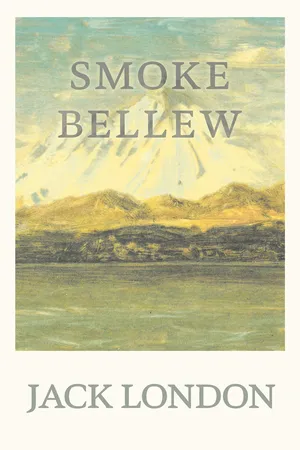
- 282 pages
- English
- ePUB (mobile friendly)
- Available on iOS & Android
eBook - ePub
Smoke Bellew
About this book
"Smoke Bellew" is a 1912 novel by Jack London. The story revolves around Christopher Bellew, a successful journalist in San Francisco who one day decides to swapping his monotonous and meaningless life for an entirely different one in nature. From clean-shaven pen-pusher to bearded mountain man, he adopts the name "Smoke" and learns to live in the wilds of the frontier. John Griffith London (1876 – 1916), commonly known as Jack London, was an American journalist, social activist, and novelist. He was an early pioneer of commercial magazine fiction, becoming one of the first globally-famous celebrity writers who were able to earn a large amount of money from their writing. Other notable works by this author include: "The Cruise of the Dazzler" (1902), "The Kempton-Wace Letters" (1903), and "The Call of the Wild" (1903). Many vintage books such as this are increasingly scarce and expensive. We are republishing this volume now in an affordable, modern, high-quality edition complete with a specially-commissioned new biography of the author.
Information
Print ISBN
9781528712316
Subtopic
ClassicsXII.
WONDER OF WOMAN
"Just the same, I notice you ain't tumbled over yourself to get married," Shorty remarked, continuing a conversation that had lapsed some few minutes before.
Smoke, sitting on the edge of the sleeping-robe and examining the feet of a dog he had rolled snarling on its back in the snow, did not answer. And Shorty, turning a steaming moccasin propped on a stick before the fire, studied his partner's face keenly.
"Cock your eye up at that there aurora borealis," Shorty went on. "Some frivolous, eh? Just like any shilly-shallyin', shirt-dancing woman. The best of them is frivolous, when they ain't foolish. And they's cats, all of 'em, the littlest an' the biggest, the nicest and the otherwise. They're sure devourin' lions an' roarin' hyenas when they get on the trail of a man they've cottoned to."
Again the monologue languished. Smoke cuffed the dog when it attempted to snap his hand, and went on examining its bruised and bleeding pads.
"Huh!" pursued Shorty. "Mebbe I couldn't 'a' married if I'd a mind to! An' mebbe I wouldn't 'a' been married without a mind to, if I hadn't hiked for tall timber. Smoke, d'you want to know what saved me? I'll tell you. My wind. I just kept a-runnin'. I'd like to see any skirt run me outa breath."
Smoke released the animal and turned his own steaming, stick-propped moccasins. "We've got to rest over to-morrow and make moccasins," he vouchsafed. "That little crust is playing the devil with their feet."
"We oughta keep goin' somehow," Shorty objected. "We ain't got grub enough to turn back with, and we gotta strike that run of caribou or them white Indians almighty soon or we'll be eatin' the dogs, sore feet an' all. Now who ever seen them white Indians anyway? Nothin' but hearsay. An' how can a Indian be white? A black white man'd be as natural. Smoke, we just oughta travel to-morrow. The country's plumb dead of game. We ain't seen even a rabbit-track in a week, you know that. An' we gotta get out of this dead streak into somewhere that meat's runnin'."
"They'll travel all the better with a day's rest for their feet and moccasins all around," Smoke counseled. "If you get a chance at any low divide, take a peep over at the country beyond. We're likely to strike open rolling country any time now. That's what La Perle told us to look for."
"Huh! By his own story, it was ten years ago that La Perle come through this section, an' he was that loco from hunger he couldn't know what he did see. Remember what he said of whoppin' big flags floatin' from the tops of the mountains? That shows how loco HE was. An' he said himself he never seen any white Indians—that was Anton's yarn. An', besides, Anton kicked the bucket two years before you an' me come to Alaska. But I'll take a look to-morrow. An' mebbe I might pick up a moose. What d' you say we turn in?"
Smoke spent the morning in camp, sewing dog-moccasins and repairing harnesses. At noon he cooked a meal for two, ate his share, and began to look for Shorty's return. An hour later he strapped on his snow-shoes and went out on his partner's trail. The way led up the bed of the stream, through a narrow gorge that widened suddenly into a moose-pasture. But no moose had been there since the first snow of the preceding fall. The tracks of Shorty's snow-shoes crossed the pasture and went up the easy slope of a low divide. At the crest Smoke halted. The tracks continued down the other slope. The first spruce-trees, in the creek bed, were a mile away, and it was evident that Shorty had passed through them and gone on. Smoke looked at his watch, remembered the oncoming darkness, the dogs, and the camp, and reluctantly decided against going farther. But before he retraced his steps he paused for a long look. All the eastern sky-line was saw-toothed by the snowy backbone of the Rockies. The whole mountain system, range upon range, seemed to trend to the northwest, cutting athwart the course to the open country reported by La Perle. The effect was as if the mountains conspired to thrust back the traveler toward the west and the Yukon. Smoke wondered how many men in the past, approaching as he had approached, had been turned aside by that forbidding aspect. La Perle had not been turned aside, but, then, La Perle had crossed over from the eastern slope of the Rockies.
Until midnight Smoke maintained a huge fire for the guidance of Shorty. And in the morning, waiting with camp broken and dogs harnessed for the first break of light, Smoke took up the pursuit. In the narrow pass of the canyon, his lead-dog pricked up its ears and whined. Then Smoke came upon the Indians, six of them, coming toward him. They were traveling light, without dogs, and on each man's back was the smallest of pack outfits. Surrounding Smoke, they immediately gave him several matters for surprise. That they were looking for him was clear. That they talked no Indian tongue of which he knew a word was also quickly made clear. They were not white Indians, though they were taller and heavier than the Indians of the Yukon basin. Five of them carried the old-fashioned, long-barreled Hudson Bay Company musket, and in the hands of the sixth was a Winchester rifle which Smoke knew to be Shorty's.
Nor did they waste time in making him a prisoner. Unarmed himself, Smoke could only submit. The contents of the sled were distributed among their own packs, and he was given a pack composed of his and Shorty's sleeping-furs. The dogs were unharnessed, and when Smoke protested, one of the Indians, by signs, indicated a trail too rough for sled-travel. Smoke bowed to the inevitable, cached the sled end-on in the snow on the bank above the stream, and trudged on with his captors. Over the divide to the north they went, down to the spruce-trees which Smoke had glimpsed the preceding afternoon. They followed the stream for a dozen miles, abandoning it when it trended to the west and heading directly eastward up a narrow tributary.
The first night was spent in a camp which had been occupied for several days. Here was cached a quantity of dried salmon and a sort of pemmican, which the Indians added to their packs. From this camp a trail of many snow-shoes led off—Shorty's captors, was Smoke's conclusion; and before darkness fell he succeeded in making out the tracks Shorty's narrower snow-shoes had left. On questioning the Indians by signs, they nodded affirmation and pointed to the north.
Always, in the days that followed, they pointed north; and always the trail, turning and twisting through a jumble of upstanding peaks, trended north. Everywhere, in this bleak snow-solitude, the way seemed barred, yet ever the trail curved and coiled, finding low divides and avoiding the higher and untraversable chains. The snow-fall was deeper than in the lower valleys, and every step of the way was snow-shoe work. Furthermore, Smoke's captors, all young men, traveled light and fast; and he could not forbear the prick of pride in the knowledge that he easily kept up with them. They were travel-hardened and trained to snow-shoes from infancy; yet such was his condition that the traverse bore no more of ordinary hardship to him than to them.
In six days they gained and crossed the central pass, low in comparison with the mountains it threaded, yet formidable in itself and not possible for loaded sleds. Five days more of tortuous winding, from lower altitude to lower altitude, brought them to the open, rolling, and merely hilly country La Perle had found ten years before. Smoke knew it with the first glim...
Table of contents
- Jack London
- I.
- II.
- III.
- IV.
- V.
- VI.
- VII.
- VIII.
- IX.
- X.
- XI.
- XII.
Trusted by 375,005 students
Access to over 1.5 million titles for a fair monthly price.
Study more efficiently using our study tools.
Frequently asked questions
Yes, you can cancel anytime from the Subscription tab in your account settings on the Perlego website. Your subscription will stay active until the end of your current billing period. Learn how to cancel your subscription
No, books cannot be downloaded as external files, such as PDFs, for use outside of Perlego. However, you can download books within the Perlego app for offline reading on mobile or tablet. Learn how to download books offline
Perlego offers two plans: Essential and Complete
- Essential is ideal for learners and professionals who enjoy exploring a wide range of subjects. Access the Essential Library with 800,000+ trusted titles and best-sellers across business, personal growth, and the humanities. Includes unlimited reading time and Standard Read Aloud voice.
- Complete: Perfect for advanced learners and researchers needing full, unrestricted access. Unlock 1.5M+ books across hundreds of subjects, including academic and specialized titles. The Complete Plan also includes advanced features like Premium Read Aloud and Research Assistant.
We are an online textbook subscription service, where you can get access to an entire online library for less than the price of a single book per month. With over 1.5 million books across 990+ topics, we’ve got you covered! Learn about our mission
Look out for the read-aloud symbol on your next book to see if you can listen to it. The read-aloud tool reads text aloud for you, highlighting the text as it is being read. You can pause it, speed it up and slow it down. Learn more about Read Aloud
Yes! You can use the Perlego app on both iOS and Android devices to read anytime, anywhere — even offline. Perfect for commutes or when you’re on the go.
Please note we cannot support devices running on iOS 13 and Android 7 or earlier. Learn more about using the app
Please note we cannot support devices running on iOS 13 and Android 7 or earlier. Learn more about using the app
Yes, you can access Smoke Bellew by Jack London in PDF and/or ePUB format. We have over 1.5 million books available in our catalogue for you to explore.