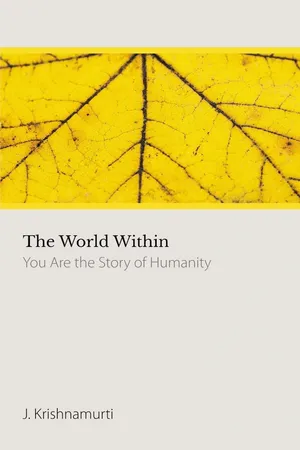
In this series of commentaries J. Krishnamurti, one of the great thinkers of our time, touches upon many human problems-our hopes, our fears, our illusions, our beliefs, our prejudices-and in the simplest language seems to pierce to their roots."The sheer simplicity is breathtaking. The reader is given, in one paragraph, often in one sentence, enough to keep him exploring, questioning, thinking for days." -Anne Morrow Lindbergh."The insight, spiritual and poetic, of these commentaries is as simply expressed as it is searching in its demand."-Times Literary Supplement (London)."Krishnamurti is no other than he seems, a free man, one of the first quality, growing older as diamonds do but the gem-like flame not dating, and alive in these Commentaries. It is a treasure."-Francis Hacket, The New Republic.
eBook - ePub
The World Within
About this book
Information
Topic
PhilosophySubtopic
Philosophy History & TheoryChapter 1
ANGER AND INTOLERANCE

E. came to ask how to overcome anger, as he was particularly incensed with his colleague, irritated with his ways and behaviour.
After some further talk, we pointed out that such anger arose as E. wished to make his colleague conform to a pattern of behaviour that E. had, which bred in him intolerance; and intolerance is thoughtlessness. If he left his present colleague and sought another job, the same problem would arise, for he was the problem and not his colleague. E. must understand the circumstances and not merely change them. If he depended on the environment to free him from anger, then he would be a slave to it. If he depended on the environment, then he would become thoughtless. It is like those who seek constant change in their relationship—being disillusioned or tired of the one or of the group, they seek friendship or love in another. Because they have not fully comprehended relationship, mere change of environment will again produce the same conflicts, disillusionment, and satiety under different forms.
So E. must become aware of his own thoughtlessness and its cause.
Chapter 2
THE VOICE OF REALITY?
S. came from a long distance to find out whether the voice which she heard was her own intuitive voice or the voice, or the thought, of tradition.
After questioning her, we found that this voice has been beneficent, leading her away from the sensate world to more and more nobility of thought and service to others. But now she was doubtful, questioning the voice, becoming anxious. The voice had asked her to obey and not question, and now it was indifferent after a number of years. What was she to do? Was the voice the voice of reality?
After talking the matter over considerably, we went into the question of desire, want: how it arises—perception, sensation, desire, identification, I want and I do not want—and expresses itself, fulfils itself through sensuousness, craving for immortality, and worldliness.
S. said she now meditated regularly, sitting on the floor.
Without understanding the course of desire, meditation will not lead to enlightenment.
She was meditating on the oneness of God and so on, as she was a student of Vedanta.
Meditation must be based on right thinking, not on mere formulations, however noble. Right thinking proceeds from the comprehension of desire as the ‘me’ and the ‘mine’. This selfishness is the selfishness of everyone, whether one lives in India, China, Europe, or here. The world is the projection of oneself. To understand the problems of the world, one must first understand oneself, not in self-enclosing comprehension but through that disinterested and kindly awareness of oneself. Self-knowledge is the beginning of right thinking, which is the true beginning of meditation.
She said her problem was taking on a new meaning: how, through her own craving, she was giving a significance to the voice, which might perhaps be her own intuitive perception.
Chapter 3
THE JOYOUS AND ACHING PROBLEM OF BIRTH AND DEATH
R. was greatly and grievously upset over the loss of her son in the war. Does he continue? Is reincarnation true?
It is difficult to consider wisely the problem of death when one is almost paralysed with sorrow. What is your chief consideration: your son or your own loss? Every person in the world is faced with this problem: the universality of birth and death, of joy and sorrow. None can escape from it; one may escape from it in fantasy, in some theory or belief, in some self-forgetfulness; but birth and death remain, a mystery to be solved not through rationalization, but through the experience of that which is eternal and which has no beginning and no ending.
Hatred of those who helped in bringing about your son’s death does not create the necessary state of mind which alone can experience reality. On the contrary, hate, grief, and possessiveness prevent the comprehension and experience of timelessness. In transcending hate, resentment, and anger, there is the dawning of compassion, which will purify the tortured mind. If you are concerned about the dead, you will create more death, but if you are concerned about the living, you will know of life’s eternity.
She said she did not understand what I was talking about. Mustn’t she love her son? Must she not hate those who killed him, must she forgive, must she embrace evil? Was not war necessary in purifying the world?
Evil means do not produce good ends, violent means do not result in peace. Each one of us has brought about this spectacular chaos through our daily so-called peaceful days, which are made up of envy, greed, ill will, antagonism, and suspicion. The other mother is also crying for her son, the other mother whom you hate. She is also tortured by grief. To her too there is the joyous and aching problem of birth and death. Hate does not solve this problem; hate only perpetuates the cruelty of man to man.
Gradually, I led her to her first question of continuity. She was too shaken to go into it, but came back again another day.
Chapter 4
THE ‘ME’ AND THE ‘MINE’
We must understand the creator of time—the past, present, and future—for time is birth and death. The consciousness of time creates continuity, everlastingness, but it is not the eternal, it is not timelessness.
The creator of time is the self, the consciousness of the ‘me’ and the ‘mine’: my property, my son, my power, my success, my experience, my immortality. The concern of the self over its own state creates time. The self is the cause of ignorance and sorrow, and its cause and effect is desire, the craving for power, wealth, fame. This self is unified by the will of desire, with its past memories, present resolutions, and future determinations. The future then becomes a form of lust, the present a passage to the future, and the past the driving motive. The self is a wheel within a wheel of pleasure and pain, enjoyment and grief, love and hate, ruthlessness and gentleness. These opposites are created for its own advantage, for its own gain, out of its own uncertainty. It is the cause of my birth, my death. Thought is held by the will of desire, by the will of self, but sorrow and pain begin their work of awakening thought; and if this awakening is not maintained, thought slips into comforting beliefs, into personal fantasies and hopes.
But if the slowly awakening thought begins to gently and patiently study the cause of sorrow and so begins to comprehend it, it will find that there is another will: the will of understanding. This will of understanding is not personal; it is of no country, of no people, of no religion. It is this will that opens the door to the eternal, to the timeless.
The study of the self is the beginning of right thinking—the self that is held in the will of desire. This self creates continuity by craving for immortality, but with it comes the everlastingness of sorrow, pain, and the conflict of the ‘me’ and the ‘mine’. There is no end to this save in the will of understanding, which alone dissolves the cause of sorrow.
Become aware of the course of desire; out of that awareness, there is born right thinking. Virtue is freeing thought from the ‘me’ and the ‘mine’ for compassion for the uncertainty that self-desire creates.
Chapter 5
PSYCHOLOGICAL DEPENDENCE
C. asked how it was that she was so tired; though she had plenty of energy for general work, deep in herself she was tired.
After some talk, we discovered that she was greatly dependent on her husband and her environment. This dependence, which was not financial, made her nervous, exhausted, anxious, impatient, and quick tempered.
Some psychological need must inevitably create dependence, which prevents coordination and integration.
She said she was aware of this need, but somehow she could not overcome it. She had determined not to be dependent, yet she could not be free from it. Dependence, we agreed, was not lack of love, but it confused love. It brought in other elements which were not of love; it created uncertainty and estrangement.
Dependence sets going the movement of aloofness and attachment, a constant conflict without comprehension, without a release. She must become aware of this process of attachment and detachment, become aware without condemnation, without judgement, and then she will perceive the significance of this conflict of opposites.
If she becomes deeply aware and so consciously directs thought towards comprehending the full meaning of dependence and need, then when her conscious mind is open and clear about it, the unconscious with its hidden motives, pursuits, intentions will project itself into the conscious. When this happens, she must study and understand each intimation of the subconscious. If she does this many times, becoming aware of the projections of the subconscious after the conscious has thought out the problem as clearly as possible, then even though she may give her attention to other matters, the conscious and the unconscious will be working out the problem of dependence or any other problem. Thus there is a constant awareness established which will patiently and gently bring about integration. This will, if her health and diet are all right, bring about fullness of being.
Chapter 6
MAN AND MACHINE
B. came from a long distance, and his problem was how to build the spirit of love into the aeroplane, for he was working in an aeroplane factory. He said he was seriously concerned about the state of the world, and since the aeroplane was here to stay, could not the spirit of love be built into it? Could he not, by being himself without hate, without the desire to kill, and with goodwill, build something of that quality into the machine of terror and destruction?
He was a seriously intentioned man, and so we discussed ignorance and the right means of livelihood. A machine, an inanimate thing put together by man, is not in itself either good or bad; it depends on the use man puts it to. So it is not the machine but man that must be considered. Does not ignorance lie in giving false values, in putting emphasis on things that have little significance, in giving importance to things that are unimportant? Till one changes one’s values, the machine will be used for mischievous and destructive ends.
The thoughts and feelings of man have to be changed from their present limited values to those that are transcendental. If man is pursuing sensation, power, and wealth, he is bound to create a world in which conflict, antagonism, and ruthlessness must prevail, and also the means to express them: machine, money, and so on. He must look into his heart to find out what he is seeking. If he is seeking the good of himself and so the good of the other, then kindliness and intelligence will dictate what his occupation and means of livelihood shall be.
First he must cleanse his heart and mind, and then alone will he be capable of being content with little.
Chapter 7
LUST IS IN THE MIND
B. said he was a slave to his sexual appetite; he had tried different ways of suppressing it, had joined different cults in the hope of transforming it, and had gone to an analyst on whom he found he was becoming more and more dependent—another form of pain. What was he to do?
First we talked of love and said it is not a...
Table of contents
- Cover Page
- Title Page
- Copyright
- Contents
- Foreword
- 1. Anger And Intolerance
- 2. The Voice of Reality?
- 3. The Joyous and Aching Problem of Birth And Death
- 4. The ‘Me’ and the ‘Mine’
- 5. Psychological Dependence
- 6. Man and Machine
- 7. Lust Is in the Mind
- 8. Charity Without Barriers
- 9. Devotions Nullified by Antagonism
- 10. A Different Standard of Living
- 11. You Have Created the World’s Problem
- 12. Healing Oneself
- 13. Society’s Barbarous Game
- 14. A Peaceful Interval or True Peace?
- 15. The Problem of Sex
- 16. Writing Down Your Thoughts
- 17. Right Thinking, Not Right Thoughts
- 18. The Self-Enclosing Walls
- 19. Beyond All Religions
- 20. What Is the Label, What Is the Actual?
- 21. Not by Bread Alone
- 22. Was it His Karma to Die in This Way?
- 23. The Poison of Hate
- 24. At the Crossroads of Life
- 25. Seeking Encouragement from Outside
- 26. Asceticism and the Other Ways of Power
- 27. What Is Awareness?
- 28. Disturbing Dreams
- 29. The Greatness of Relationship Is Its Very Insecurity
- 30. To Affect the Whole, the Part Must Transform Itself
- 31. Right Livelihood
- 32. Decision or Understanding?
- 33. Turning Everything to One’s Benefit
- 34. Prayer, a Complex Affair
- 35. Crying for the Living or for the Dead?
- 36. The Unspiritual Closed Circle
- 37. The Pages of Self-Knowledge
- 38. Your Subconscious Demands
- 39. Belief in the Masters
- 40. Loneliness, With Its Panicky Fears
- 41. Nationalism, a Poison
- 42. The Dull and the Sensitive Areas
- 43. How the Mind Reproduces Itself
- 44. On Smoking—and the Much Larger Problem
- 45. The Profession of Acting
- 46. On Homosexuality
- 47. The Flow of Self-Awareness into Pools of Meditation
- 48. When Your Inner Light Goes Out
- 49. Become Aware of the Past Through the Present
- 50. The Seeds of Corruption in Organizations
- 51. To Live Alone or in Close Relationship?
- 52. Aren’t You Wasting Your Life?
- 53. Repetitive, Trivial, Unfinished Thoughts
- 54. Digging Deeply and Lying Fallow
- 55. Understand a Problem Not on Its Own Level
- 56. Attachment and Detachment Are Both Gratifying
- 57. Theories and Explanations Are Hindrances
- 58. To Kill or Not to Kill
- 59. Re-Educating the Parents
- 60. The Observer and the Observed
- 61. The Conflict Between Instinct and Conditioning
- 62. Between Awareness and Distraction
- 63. The Mind Becomes What It Possesses
- 64. Aggressiveness in Relationships
- 65. Thought Points Out the Thinker
- 66. Feel out Rather Than Be Clever
- 67. Learning Through War Games the Language Of Killing
- 68. Escaping Through the Ideal and Through Insensitivity
- 69. Your Overcrowded Mind
- 70. To Think Is to Be Afraid
- 71. The Two Ways of Accepting Sorrow
- 72. The Clever, Forewarned Intellect
- 73. A Family to Fill Your Emptiness
- 74. The Maker of Effort, of Choice
- 75. Capacities and Gifts Are Dangerous Friends
- 76. In Seeking the Real, Bread Will Be Supplied
- 77. Memory Must Become as an Empty Shell
- 78. The Helper and the Helped
- 79. The Scars That Experience Leaves
- 80. To Reform Politics Is to Waste Thought
- 81. Speculation About Reality or Direct Experience?
- 82. Will You Allow Yourself to Be Killed by the Enemy?
- 83. A Teacher’s Dilemmas
- 84. Can I Find God in a Fox-Hole?
- 85. In the Immediate Does Not Lie the Answer
- 86. The Educated Shell of Our Conditioning
- 87. To Be Successful Is Misery to Others and for Oneself
- 88. Understanding Conflict
- 89. Patterns Comfort Us into Dullness
- 90. Right Meditation
Trusted by 375,005 students
Access to over 1.5 million titles for a fair monthly price.
Study more efficiently using our study tools.
Frequently asked questions
Yes, you can cancel anytime from the Subscription tab in your account settings on the Perlego website. Your subscription will stay active until the end of your current billing period. Learn how to cancel your subscription
No, books cannot be downloaded as external files, such as PDFs, for use outside of Perlego. However, you can download books within the Perlego app for offline reading on mobile or tablet. Learn how to download books offline
Perlego offers two plans: Essential and Complete
- Essential is ideal for learners and professionals who enjoy exploring a wide range of subjects. Access the Essential Library with 800,000+ trusted titles and best-sellers across business, personal growth, and the humanities. Includes unlimited reading time and Standard Read Aloud voice.
- Complete: Perfect for advanced learners and researchers needing full, unrestricted access. Unlock 1.5M+ books across hundreds of subjects, including academic and specialized titles. The Complete Plan also includes advanced features like Premium Read Aloud and Research Assistant.
We are an online textbook subscription service, where you can get access to an entire online library for less than the price of a single book per month. With over 1.5 million books across 990+ topics, we’ve got you covered! Learn about our mission
Look out for the read-aloud symbol on your next book to see if you can listen to it. The read-aloud tool reads text aloud for you, highlighting the text as it is being read. You can pause it, speed it up and slow it down. Learn more about Read Aloud
Yes! You can use the Perlego app on both iOS and Android devices to read anytime, anywhere — even offline. Perfect for commutes or when you’re on the go.
Please note we cannot support devices running on iOS 13 and Android 7 or earlier. Learn more about using the app
Please note we cannot support devices running on iOS 13 and Android 7 or earlier. Learn more about using the app
Yes, you can access The World Within by J Krishnamurti in PDF and/or ePUB format, as well as other popular books in Philosophy & Philosophy History & Theory. We have over 1.5 million books available in our catalogue for you to explore.