Until the end of his life at the age of ninety, Krishnamurti-the world teacher-traveled the world speaking as a private person. The rejection of all spiritual and psychological authority, including his own, is a fundamental theme. A major concern is the social structure and how it conditions the individual. The emphasis in his talks and writings is on the psychological barriers that prevent clarity of perception. Because his subject is all-embracing, the Collected Works which are in 18 Volumes, are of compelling interest. Within his talks in any one year. Krishnamurti was not able to cover the whole range of his vision, but broad amplifications of particular themes are found throughout these volumes. In them he lays the foundations of many of the concepts he used in later years. The Collected Works contain Krishnamurti`s previously published talks, discussions, answers to specific questions, and writings for the years 1933 through 1967. They are an authentic record of his teachings, taken from transcripts of verbatim shorthand reports and tape recordings. Jiddu Krishnamurti was born in 1895 of Brahmin Parents in South India. At the age of fourteen he was proclaimed the coming World Teacher by Annie Besant, then President of the Theosophical Society, an international organization that emphasized the unity of world religions. Mrs. Besant adopted the boy and took him to England, where he was educated and prepared for his coming role. In 1911 a new worldwide organization was formed with Krishnamurti as its head, solely to prepare its members for hisadvent as World Teacher. In 1929, after many years of questioning himself and the destiny imposed upon him, Krishnamurti disbanded this organization, saying: Truth is a pathless land, and you cannot approach it by any path whatsoever, by any religion, by any sect. Truth, being limitless, unconditioned, unapproachable by any path whatsoever, cannot be organized; nor should any organization be formed to lead or to coerce people along any particular path. My only concern is to set men absolutely, unconditionally free. Until he end of his life at the age of ninety, Krishnamurti traveled the world speaking as a private person. The rejection of all spiritual and psychological authority, including his own, is a fundamental theme. A major concern is the social structure and how it conditions the individual. The emphasis in his talks and writings is on the psychological barriers that prevent clarity of perception. In the mirror of relationship, each of us can come to understand the content of his own consciousness, which is common to all humanity. We can do this, not analytically, but directly in a manner Krishnamurti describes at length. In observing this content we discover within ourselves the division of the observer and what is observed. He points out that this division, which prevents direct perception, is the root of human conflict. His central vision did not waver after 1929, but Krishnamurti strove for the rest of his life to make his language even more simple and clear. There is a development in his exposition. From year to year he used new terms and new approaches to his subject, with different nuances. Because his subject is all embracing, the Collected Works are of compelling interest. Within his talks in any one year, Krishnamurti was not able to cover the whole range of his vision, but broad amplifications of particular themes are found throughout these volumes. In them he lays the foundations of many of the concepts he used in later years. The Collected Works containKrishnamurti`s previously published talks, discussions, answers to specific questions, and writings for the years 1933 through 1967. They are an authentic record of his teachings, taken from transcripts of verbatim shorthand reports and tape recordings.
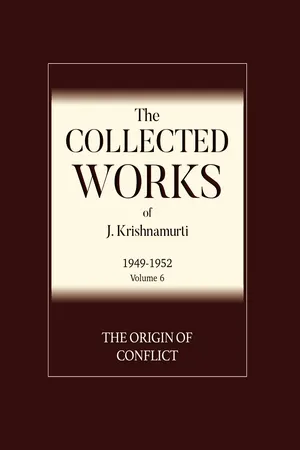
- English
- ePUB (mobile friendly)
- Available on iOS & Android
eBook - ePub
The Origin of Conflict
About this book
Information
Topic
PhilosophySubtopic
Philosophy History & TheoryTable of contents
- Cover Page
- Title Page
- Copyright
- Contents
- Preface
- Talks in Rajahmundry, India
- Talks in Madras, India
- Talks in Colombo, Ceylon
- Talks in Bombay, India
- Talks in Paris, France
- Talks in New York City, New York
- Talks in Seattle, Washington
- Talks in Madras, India
- Talks in London, England
- Questions
Trusted by 375,005 students
Access to over 1.5 million titles for a fair monthly price.
Study more efficiently using our study tools.
Frequently asked questions
Yes, you can cancel anytime from the Subscription tab in your account settings on the Perlego website. Your subscription will stay active until the end of your current billing period. Learn how to cancel your subscription
No, books cannot be downloaded as external files, such as PDFs, for use outside of Perlego. However, you can download books within the Perlego app for offline reading on mobile or tablet. Learn how to download books offline
Perlego offers two plans: Essential and Complete
- Essential is ideal for learners and professionals who enjoy exploring a wide range of subjects. Access the Essential Library with 800,000+ trusted titles and best-sellers across business, personal growth, and the humanities. Includes unlimited reading time and Standard Read Aloud voice.
- Complete: Perfect for advanced learners and researchers needing full, unrestricted access. Unlock 1.5M+ books across hundreds of subjects, including academic and specialized titles. The Complete Plan also includes advanced features like Premium Read Aloud and Research Assistant.
We are an online textbook subscription service, where you can get access to an entire online library for less than the price of a single book per month. With over 1.5 million books across 990+ topics, we’ve got you covered! Learn about our mission
Look out for the read-aloud symbol on your next book to see if you can listen to it. The read-aloud tool reads text aloud for you, highlighting the text as it is being read. You can pause it, speed it up and slow it down. Learn more about Read Aloud
Yes! You can use the Perlego app on both iOS and Android devices to read anytime, anywhere — even offline. Perfect for commutes or when you’re on the go.
Please note we cannot support devices running on iOS 13 and Android 7 or earlier. Learn more about using the app
Please note we cannot support devices running on iOS 13 and Android 7 or earlier. Learn more about using the app
Yes, you can access The Origin of Conflict by J Krishnamurti in PDF and/or ePUB format, as well as other popular books in Philosophy & Philosophy History & Theory. We have over 1.5 million books available in our catalogue for you to explore.