- English
- ePUB (mobile friendly)
- Available on iOS & Android
eBook - ePub
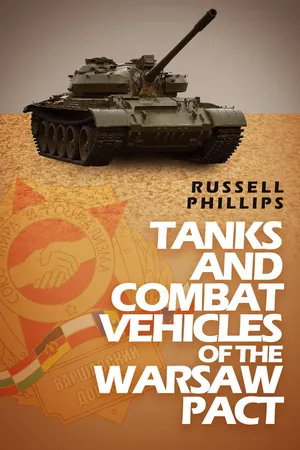
Tanks and Combat Vehicles of the Warsaw Pact
About this book
The Warsaw Pact fielded a variety of combat vehicles, from the 2P26 "Baby Carriage" to the T-80U main battle tank. Often innovative, always deadly, this reference work details over 100 war machines that would have confronted NATO if the Cold War turned hot.
Tools to learn more effectively

Saving Books

Keyword Search

Annotating Text

Listen to it instead
Information
Subtopic
Military & Maritime HistoryIndex
HistoryTanks
The wartime T-34/85 was considered by many to be one of the best, if not the best, tank design of the Second World War. Despite development of new tanks with larger, more powerful guns, the T-34/85 was kept in service with the Soviet army until the 1960s, with some Soviet client states keeping it in service for many more years. The T-44 was accepted into service in late 1944 as an improvement on the T-34. This had some teething problems, and was only produced in limited numbers, but formed the basis for the later T-54.
In the late 1950s, Khrushchev, a proponent of missiles over guns, ordered designers to investigate the possibility of tanks armed with missiles instead of guns. Despite widespread opposition to the idea, work continued after Khrushchev's removal from power, and eventually led to the deployment of gun-launched anti-tank missiles such as the AT-8 Songster.
The Soviet Union exported many tanks during the Cold War, to Warsaw Pact nations as well as other countries. The T-54 and T-55 in particular were widely exported. Care should be taken when comparing the effectiveness of exported tanks against Western tanks. Export models, especially those exported to non-communist countries, were not always of an equivalent standard to domestic tanks, and the operating country would sometimes choose to use cheaper, locally-produced ammunition rather than buying ammunition from the Soviet Union. In addition, the armour on export models of the T-72 was less effective than that fitted to domestic models.
It is interesting to note that by the mid-1970s the Soviet army had three largely similar tanks in production: the T-64, T-72, and T-80. Despite the communist system of government, there were three major competing tank design bureaus, and each used political influence to get their own design into service with the Soviet army.
Western analysts predicted that the use of composite armour would change the shape of Soviet tank turrets from the curved shape previously used, to an angular shape similar to the British Challenger or US M1 Abrams. Turret shapes did become less curved with the introduction of composite armour on the T-64, but they remained far less angular than those of Western tanks fitted with composite armour.
T-34/85
The original T-34, armed with a 76mm gun, entered service in 1940. Many changes were introduced during the Second World War, the main one being the replacement of the 76mm gun with an 85mm weapon, the new vehicle designated the T-34/85. It was still an important tank at the end of the war, and production continued in the Soviet Union until 1950. Czechoslovakia began production in 1951, followed by Poland in 1953, with the Polish vehicles incorporating several improvements. In the 1960s, some T-34/85s were taken out of storage and fitted with the same wheels and engines as the T-54, as well as mountings for a deep-wading snorkel.

T-34/85
The hull of the T-34/85 was of all-welded construction. The driver sat at the front left, with a bow machine gunner to his right. The fighting compartment was behind them, and the engine and transmission at the rear. The commander and gunner were on the left in the turret, with the loader on the right. All three were provided with periscopes; the loader had a hatch, and the commander had a cupola. On some models, the cupola could be traversed through 360°, and one model allowed the commander to line up the gun on a target.
External fuel tanks could be fitted to the sides and rear to provide additional range, and would be used before using the fuel in the internal tank. There was no NBC system or night-fighting equipment fitted.
The original main armament was the D5-T85 gun, but this was soon replaced by the ZIS-S53. Two 7.62mm DTM machine guns were fitted: one mounted co-axially with the main armament, and one on the right side of the front hull. These were fed from 63-round magazines. Some countries fitted a 12.7mm DShKM anti-aircraft machine gun on the turret roof.
Specifications: T-34/85
Crew: 5
Combat weight: 32 tonnes
Length: 6.19m (8.08m including gun)
Width: 3m
Height: 2.74m
Ground clearance: 0.38m
Maximum road speed: 55km/hour
Maximum road range: 300km
Gradient: 60%
Vertical obstacle: 0.73m
Trench: 2.5m
Combat weight: 32 tonnes
Length: 6.19m (8.08m including gun)
Width: 3m
Height: 2.74m
Ground clearance: 0.38m
Maximum road speed: 55km/hour
Maximum road range: 300km
Gradient: 60%
Vertical obstacle: 0.73m
Trench: 2.5m
Armament:
1x 85mm ZIS-S53 gun
2x 7.62mm DTM MG
2x 7.62mm DTM MG
Armour:
Hull front: 46mm @ 60° [Effective: 92mm]
Hull side: 46mm @ 40° [Effective: 60mm]
Hull rear: 47mm @ 50° [Effective: 73mm]
Hull top: 20mm
Belly: 20mm
Turret front: 90mm
Turret mantlet: 250mm
Turret sides: 75mm
Turret rear: 60mm
Turret top: 20mm
Hull side: 46mm @ 40° [Effective: 60mm]
Hull rear: 47mm @ 50° [Effective: 73mm]
Hull top: 20mm
Belly: 20mm
Turret front: 90mm
Turret mantlet: 250mm
Turret sides: 75mm
Turret rear: 60mm
Turret top: 20mm
T-44
Development of the T-44 was complete by 1944, but it was not produced in large numbers. Armed with the same 85mm gun as the T-34/85 in a similar turret, it had a new hull, which was both easier to manufacture and provided better protection. The engine was improved, but the new transmission was unreliable. By the end of the war, it was becoming increasingly obvious that the 85mm gun was insufficient. It could not penetrate the King Tiger's armour, and could only penetrate the German Panther at under 500m. Possibly of greater concern, the Soviets had acquired an American M26 Pershing under Lend-Lease, and they soon discovered that the 85mm gun could not penetrate the M26's armour.

T-44
The Soviet army had a 100mm gun available, the D-10, which had been proven in the SU-100 tank destroyer. Experiments were carried out fitting D-10s in both T-34s and T-44s, the vehicles being designated T-34-100 and T-44-100, respectively. Both were found to be workable designs, but by this time progress on the T-54 had reached the prototype stage. Designed from the outset for the 100mm gun, this was clearly a better design, and so no further work was done on the T-34-100 or T-44-100.
Specifications: T-44
Crew: 4
Combat weight: 32 tonnes
Length: 6.07m (7.65m including gun)
Width: 3.25m
Height: 2.46m
Ground clearance: 0.51m
Maximum road speed: 53km/hour
Maximum road range: 350km
Armour: Up to 120mm
Combat weight: 32 tonnes
Length: 6.07m (7.65m including gun)
Width: 3.25m
Height: 2.46m
Ground clearance: 0.51m
Maximum road speed: 53km/hour
Maximum road range: 350km
Armour: Up to 120mm
Armament:
1x 85mm ZIS-S53 gun (58 rounds)
2x 7.62mm DTM MG
IS-3
The IS-3 was developed as an improvement of the wartime IS-2, with a new turret and hull. Limited production began in the spring of 1945, but it was never used in combat. IS series heavy tanks were included in Soviet tank and mechanised divisions until the late 1950s, as well as being deployed in limited numbers by non-Soviet Warsaw Pact armies. Later, they were only assigned to special units, and were removed from Soviet combat units entirely by the late 1960s.

IS-3
The driver's compartment was in the front, with the fighting compartment in the centre and the engine in the rear. The driver sat in the centre of his compartment, with a single-piece hatch cover with integrated periscope. The commander and gunner were in the left of the turret, with the loader to their right. The commander had a cupola, and a hatch was provided for the loader.
Long-range fuel tanks could be fitted on the rear hull sides. The IS-3 had no NBC protection or night-vision equipment. The main armament was a 122mm D-25 gun, which had a double-baffle muzzle brake. A 7.62mm DTM machine gun was mounted co-axially with the main armament, and a 12.7mm DShKM machine gun was fitted to the roof for anti-aircraft use.
Specifications: IS-3
Crew: 4
Combat weight: 45.8 tonnes
Length: 6.77m (9.75m including gun)
Width: 3.07m
Height: 2.44m
Ground clearance: 0.46m
Maximum road speed: 37km/hour
Maximum road range: 150km
Gradient: 60%
Vertical obstacle: 1m
Combat weight: 45.8 tonnes
Length: 6.77m (9.75m including gun)
Width: 3.07m
Height: 2.44m
Ground clearance: 0.46m
Maximum road speed: 37km/hour
Maximum road range: 150km
Gradient: 60%
Vertical obstacle: 1m
Armament:
1x 122mm D-25 (28 rounds)
1x 7.62mm DTM MG (1,500 rounds)
1x 12.7mm DShKM MG (250 rounds)
1x 7.62mm DTM MG (1,500 rounds)
1x 12.7mm DShKM MG (250 rounds)
Armour:
Turret front: 160mm
Turret side: 100mm
Mantlet: 200mm
Hull glacis: 120mm @ 55º [Effective: 209mm]
Hull sides: 60mm @ 60º [Effective: 120mm]
Hull top: 25-45mm
Hull rear: 60-90mm
Belly: 20-35mm
Turret side: 100mm
Mantlet: 200mm
Hull glacis: 120mm @ 55º [Effective: 209mm]
Hull sides: 60mm @ 60º [Effective: 120mm]
Hull top: 25-45mm
Hull rear: 60-90mm
Belly: 20-35mm
IS-10/T-10
After the end of the Second World War, development of the IS series of heavy tanks continued, eventually culminating in the IS-10, armed with a 122mm D-25TA gun. It was accepted for service in 1952, but the tank was renamed the T-10 after Stalin's death in 1953.

T-10M
The hull was made of rolled armour, divided into three compartments. The driver was in the front, the fighting compartment in the centre, and the engine in the rear. The turret was cast steel. The gunner and commander were positioned to the left of the gun, the loader to the right. Armament consisted of a 122mm D-25TA gun with a double-baffle muzzle brake, a 12.7mm DShKM co-axial machine gun, and another 12.7mm DShKM anti-aircraft machine gun at the loader's hatch.
In 1956, the T-10A added stabilisation for the main gun in the vertical plane. In 1957 the T-10B added stabilisation in both vertical and horizontal planes, and two infra-red searchlights, one to the right of the main armament and one forward of the commander's hatch. The T-10M was introduced later in 1957. This version had NBC protection and a new M-62-T2 gun with a multi-baffle muzzle brake. The 12.7mm DShKM machine guns were replaced with 14.5mm machine guns (KPVT in the co-axial mount, KPV at the loader's hatch). The T-10M was produced at two different plants, with incompatible parts, until 1962, when a single design was finally settled on. From 1963, T-10Ms were fitted with deep-wading snorkels, and from 1967 they were supplied with APDS and HEAT ammunition.
Specifications: IS-10/T-10 (T-10M in parentheses)
Crew: 4
Combat weight: 50 tonnes (52 tonnes)
Length: 7.04m (9.88m including gun) (10.6m including gun)
Width: 3.56m
Height: 2.25m (2.43m)
Ground clearance: 0.43m
Maximum road speed: 42km/hour
Maximum road range: 250km (420km with long-range fuel tanks)
Gradient: 62.5%
Vertical obstacle: 0.9m
Trench: 3m
Combat weight: 50 tonnes (52 tonnes)
Length: 7.04m (9.88m including gun) (10.6m including gun)
Width: 3.56m
Height: 2.25m (2.43m)
Ground clearance: 0.43m
Maximum road speed: 42km/hour
Maximum road range: 250km (420km with long-range fuel tanks)
Gradient: 62.5%
Vertical obstacle: 0.9m
Trench: 3m
Armament:
1x 122mm D-25TA gun (30 rounds) (1x 122mm M-62-T2, 30 rounds)
2x 12.7mm DShKM MG (1x 14.5mm KPV, 1x 14.5mm KPVT)
2x 12.7mm DShKM MG (1x 14.5mm KPV, 1x 14.5mm KPVT)
Armour:
Hull front upper: 120mm @ 60° [Effective: 240mm]
Hull front lower: 100mm @ 55° [Effective: 174mm]
Hull side: 90mm @ 60° [Effective: 180mm]
Hull rear upper: 60mm @ 30° [Effective: 69mm]
Hull rear lower: 30mm @ 50° [Effective: 47mm]
Hull top: 35mm
Belly: 20mm
Turret front: 250mm
Turret mantlet: 250mm
Turret sides: 75-115mm
Turret rear: 60mm
Turret top: 30mm
Hull front lower: 100mm @ 55° [Effective: 174mm]
Hull side: 90mm @ 60° [Effective: 180mm]
Hull rear upper: 60mm @ 30° [Effective: 69mm]
Hull rear lower: 30mm @ 50° [Effective: 47mm]
Hull top: 35mm
Belly: 20mm
Turret front: 250mm
Turret mantlet: 250mm
Turret sides: 75-115mm
Turret rear: 60mm
Turret top: 30mm
PT-76
After the Second World War, the Soviet army decided that it needed a new light tank and armoured personnel carrier. Both were to be amphibious and share automotive components. This requirement led to the PT-76 light tank and BTR-50P APC. Prototypes were completed in 1950, and the PT-76 entered service the following year. The original PT-76 lacked NBC protection and infra-red night-vision equipment.

PT-76B
The PT-76 was fully amphibious, the only preparation for swimming being to switch on the electric bilge pumps (a manual pump was also fitted for emergency use) and erect the trim vane at the front of the hull. In the water, the vehicle was propelled by a pair of water jets, and steered by closing a hatch over one of the jets.
Main armament was an unstabilised 76.2mm D-56T gun, with a 7.62mm SGMT mounted co-axially. In 1962, the PT-76B was introduced, with the D-56T replaced by a 76.2mm D-56TM gun. The D-56TM was stabilised in both vertical and horizontal planes, had a bore evacuator, and a double-baffle muzzle brake in place of the slotted muzzle brake on the D-56T. The PT-76B also had NBC protection for the crew, a modified hull shape to improve buoyancy in the water, and a pair of auxiliary fuel tanks, each with a capacity of 95 litres.
Starting in 1967, overhauled PT-76s had the co-axial SGMT machine gun replaced with a newer PKT machine gun. Improved communication systems and infra-red night-vision equipment were also fitted.
Specifications: PT-76B
Crew: 3
Combat weight: 14.6 tonnes
Length: 6.91m (7.63m including gun)
Width: 3.14m
Height: 2.26m
Ground clearance: 0.37m
Maximum road speed: 44km/hour
Maximum road range: 370km
Gradient: 70%
Vertical obstacle: 1.1m
Trench: 2.8m
Combat weight: 14.6 tonnes
Length: 6.91m (7.63m including gun)
Width: 3.14m
Height: 2.26m
Ground clearance: 0.37m
Maximum road speed: 44km/hour
Maximum road range: 370km
Gradient: 70%
Vertical obstacle: 1.1m
Trench: 2.8m
Armament:
1x 76.2mm D-56TM gun (40 rounds)
1x 7.62mm SGMT MG (later 1x 7.62mm PKT) (1,000 rounds)
1x 7.62mm SGMT MG (later 1x 7.62mm PKT) (1,000 rounds)
Armour:
Hull front upper: 11mm @ 80° [Effective: 63mm]
Hull front lower: 14mm @ 45° [Effective: 20mm]
Hull side: 14mm
Hull rear upper: 7mm
Hull rear lower: 7mm @ 45° [Effective: 10mm]
Hull top: 7mm
Belly: 5mm
Turret front: 17mm @ 35° [Effective: 21mm]
Turret mantlet: 11mm @ 33° [Effective: 13mm]
Turret sides: 16mm @ 35° [Effective: 20mm]
Turret rear: 11mm @ 35° [Effective: 13mm]
Turret top: 8mm
Hull front lower: 14mm @ 45° [Effective: 20mm]
Hull side: 14mm
Hull rear upper: 7mm
Hull rear lower: 7mm @ 45° [Effective: 10mm]
Hull top: 7mm
Belly: 5mm
Turret front: 17mm @ 35° [Effective: 21mm]
Turret mantlet: 11mm @ 33° [Effective: 13mm]
Turret sides: 16mm @ 35° [Effective: 20mm]
Turret rear: 11mm @ 35° [Effective: 13mm]
Turret top: 8mm
T-54
Design work on the T-54 began in 1944. The first prototype was built in 1945, with low-rate production starting in 1947. Full production started in 1953. Initially, the T-54 did not have NBC protection, though this was added to later models and retrofitted to existing vehicles. Turret traverse and gun elevation was manual.

T-54
Main armament was an unstabilised 100mm D-10T gun, with a 7.62mm SGMT machine gun mounted co-axially with the main armament. A second 7.62mm SGMT...
Table of contents
- Tanks and Combat Vehicles of the Warsaw Pact
- Introduction
- Tanks
- Infantry Fighting Vehicles
- Armoured Personnel Carriers
- Anti-Tank Vehicles
- Reconnaissance Vehicles
- Self-Propelled Anti-Aircraft Weapons
- Self-Propelled Guns, Howitzers, and Mortars
- Multiple Rocket Launchers
- Tactical Ballistic Missiles
- Glossary
- About Russell Phillips
- Image Credits
Frequently asked questions
Yes, you can cancel anytime from the Subscription tab in your account settings on the Perlego website. Your subscription will stay active until the end of your current billing period. Learn how to cancel your subscription
No, books cannot be downloaded as external files, such as PDFs, for use outside of Perlego. However, you can download books within the Perlego app for offline reading on mobile or tablet. Learn how to download books offline
Perlego offers two plans: Essential and Complete
- Essential is ideal for learners and professionals who enjoy exploring a wide range of subjects. Access the Essential Library with 800,000+ trusted titles and best-sellers across business, personal growth, and the humanities. Includes unlimited reading time and Standard Read Aloud voice.
- Complete: Perfect for advanced learners and researchers needing full, unrestricted access. Unlock 1.4M+ books across hundreds of subjects, including academic and specialized titles. The Complete Plan also includes advanced features like Premium Read Aloud and Research Assistant.
We are an online textbook subscription service, where you can get access to an entire online library for less than the price of a single book per month. With over 1 million books across 990+ topics, we’ve got you covered! Learn about our mission
Look out for the read-aloud symbol on your next book to see if you can listen to it. The read-aloud tool reads text aloud for you, highlighting the text as it is being read. You can pause it, speed it up and slow it down. Learn more about Read Aloud
Yes! You can use the Perlego app on both iOS and Android devices to read anytime, anywhere — even offline. Perfect for commutes or when you’re on the go.
Please note we cannot support devices running on iOS 13 and Android 7 or earlier. Learn more about using the app
Please note we cannot support devices running on iOS 13 and Android 7 or earlier. Learn more about using the app
Yes, you can access Tanks and Combat Vehicles of the Warsaw Pact by Russell Phillips in PDF and/or ePUB format, as well as other popular books in History & Military & Maritime History. We have over one million books available in our catalogue for you to explore.