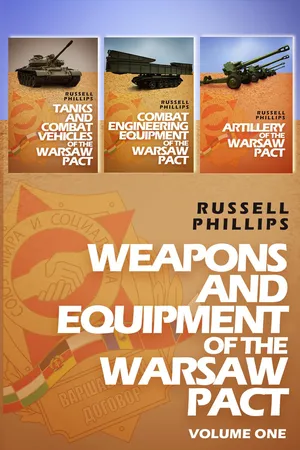
When East and West survived on a knife-edge between peace and war, both sides were busy preparing themselves for military action. But what exactly would NATO's troops have faced if the Cold War had suddenly turned hot? This ebook box set contains the first three books of the Weapons and Equipment of the Warsaw Pact series: Tanks and Combat Vehicles of the Warsaw Pact, Combat Engineering Equipment of the Warsaw Pact, and Artillery of the Warsaw Pact.
- English
- ePUB (mobile friendly)
- Available on iOS & Android
eBook - ePub
About this book
Trusted by 375,005 students
Access to over 1.5 million titles for a fair monthly price.
Study more efficiently using our study tools.
Information
Subtopic
Military & Maritime HistoryIndex
HistoryRiver Crossing
During the Cold War, the Soviet army studied the disposition of rivers in Western Europe. It concluded that they would have to cross water obstacles up to 100m wide every 35 to 60km. Every 100 to 150km, they would encounter a water obstacle between 100m and 300m wide. Every 250 to 300km, they would encounter one that was wider still. In a war in Western Europe, the Soviet army expected to advance an average of 100km per day, leading to a significant number of river crossings. NATO would obviously try to destroy bridges to slow the advance. Therefore, the Warsaw Pact armies put a great deal of emphasis on their ability to cross water obstacles quickly and efficiently. A range of equipment was created to bridge gaps or ferry vehicles over rivers. River reconnaissance systems were developed to quickly measure water depth and river width. Some of these were mounted on sleds that were towed behind boats or amphibious vehicles. Many light armoured vehicles could swim. Main battle tanks carried snorkels that allowed them to wade through water up to five metres deep.
Most river crossings would have been assault crossings from the march, at sites that were only lightly defended, if at all. Reconnaissance patrols, equipped with specialised equipment, would find suitable sites. These would be up to platoon size, and operated up to 50km ahead of the main body. When a crossing site had been selected, a forward detachment would secure the site. This detachment would be two to three hours ahead of the main body, and would avoid enemy contact. A typical forward detachment would consist of a motor rifle battalion with an attached tank company and artillery battalion. Amphibians, ferries, air defence, anti-tank, and chemical defence units would also be attached. Heliborne, or occasionally airborne, troops could also be used in this role.
If the crossing site was defended, the attack would be carried out with significant artillery and air support. River crossings got priority for air support, and were considered particularly vulnerable to enemy air attack. Air defence assets would be deployed close to the crossing site, and would cross the river as soon as feasible to extend their coverage.
The crossing itself would be carried out by APCs or IFVs swimming across the river, supported by tank and artillery fire from the near shore. A few tanks may have crossed in the first wave, but most would provide fire from the near bank and cross later. Artillery and anti-tank units would cross immediately after the infantry to provide support in holding the bridgehead. Tanks would cross using ferries, bridges, or by snorkelling.
Snorkelling
The ability to wade, or snorkel, through water up to 5m deep was a standard feature in Soviet main battle tanks. It seems likely that ferries or bridges were the preferred method of crossing water obstacles. That said, a 1971 British army intelligence report stated that the Soviet army considered snorkelling "a practical operation of war". Every tank crew was fully trained in it. Training took place on purpose-built sites with good facilities. Emphasis was placed on ensuring the crew were confident in their ability to snorkel well and safely.
Training was split into two phases. The first phase, lasting up to two months, concentrated on preparing the crews to operate tanks under water. Training covered swimming, diving, and carrying out procedures underwater whilst wearing escape masks. There was a good deal of safety training, which helped with crew confidence and morale. Rescue operations were practised on simulators. Crews were not allowed to move onto the second phase until they had passed this first phase.
In the second phase of training, the crew put their skills to the test. A five-metre deep lake was used to practice driving underwater. Initially, drivers would drive 90m underwater, progressing to 150m as their skills improved. At least some sites also had facilities for blind driving, with the driver guided only by the tank's gyro compass. After passing this second phase of training, crews would join their units.
Sealing and preparing a tank for snorkelling could take as little as 15 minutes. Older tanks took longer, up to half an hour. This would be done in a concealed area 3 to 5km from the river. When the tanks got to within 1 to 2km of the river, snorkels would be fitted. Tanks crossed at slow speed, in a column formation, with a 30m gap between vehicles. Drivers would not change gear or stop while in the water. Once across, the tank would have to stop while the crew removed the waterproofing. Until this was done, the turret could not be traversed or the gun fired. If a tank stalled in the river, the crew would flood the vehicle, then escape through the hatches.
An alternative method used winches to pull unmanned tanks across. A pair of armoured recovery vehicles would set up on the far bank with a pulley block and anchoring unit. Up to three tanks could be pulled across the river simultaneously. Using this method, a 10-tank company could cross a 200m-wide river in 35 minutes, assuming the tanks had already been sealed. The crews would cross separately, either in amphibious vehicles such as APCs, or on boats.
Snorkelling was not to be carried out under fire, and in some cases the banks would make it impossible. The entry bank had to have a slope of less than 25º, the exit bank one of less than 15º, and the current no more than three metres per second. In winter, drifting ice could damage the snorkel. The river bottom had to be reasonably firm, and free of boulders and craters.
Swimming
Many lighter AFVs were amphibious, and could swim across water obstacles. All APCs from the BTR-50 onwards, and all IFVs, were fully amphibious. The BRDM series of reconnaissance vehicles, and even some self-propelled artillery and AA vehicles, could swim. Many were propelled in the water by their wheels or tracks, although some used water jets to achieve better performance in the water.

BTR-80 Swimming
Water obstacles would only be crossed under fire as a last resort. In these cases, a great deal of artillery would be called upon to support the operation. If at all possible, helicopter troops would be landed on the far bank, and attack simultaneously with the crossing. Tanks would stay on the near bank to provide covering fire, while amphibious armoured vehicles swam across. Once a bridgehead was established, tanks and other vehicles would snorkel or be ferried across. These would then continue the advance, while engineers used pontoons to make a permanent bridge crossing.
Vehicle-Launched Bridges
Soviet estimates found that two-thirds of the river obstacles they would encounter in Europe were less than 20m wide. This led to the development of vehicle-launched bridges capable of quickly crossing these narrow gaps. The Polish army developed a tracked bridge, which was pushed into place by a tank. Small numbers of a T-34-based bridging tank were delivered to the Soviet army in 1957. This was soon superseded by the MTU-54, sometimes referred to as the MTU or MTU-1.
MTU-54
In 1958, the MTU-54 was introduced, based on a T-54 chassis. This mounted a simple 12.3m bridge, carried horizontally. Unlike later vehicles, the bridge was not folded for transit. To launch, a chain-drive mechanism moved the bridge forward, before it was lowered into place. This method had the advantage of keeping the silhouette low during launch and recovery operations. The MTU-54 could bridge an 11m gap, and had a load capacity of 50 tonnes. Launch time was three to five minutes, and recovery could take place from either end of the bridge.

MTU-54
It was fitted with a DShKM machine gun for defence, mounted in the centre of the vehicle. This had to be removed before launching the bridge. Later vehicles were fitted with a deep-wading snorkel, NBC protection, and automatic fire-suppression system.
Specifications: MTU-54
Crew: 2
Weight: 34 tonnes (including bridge)
Length: 12.3m (including bridge)
Width: 3.27m (including bridge)
Height: 2.87m (including bridge)
Ground clearance: 0.43m
Maximum road speed: 48km/hour
Maximum road range: 400km
Gradient: 60%
Vertical obstacle: 0.8m
Armament: 1x12.7mm DShKM MG
Weight: 34 tonnes (including bridge)
Length: 12.3m (including bridge)
Width: 3.27m (including bridge)
Height: 2.87m (including bridge)
Ground clearance: 0.43m
Maximum road speed: 48km/hour
Maximum road range: 400km
Gradient: 60%
Vertical obstacle: 0.8m
Armament: 1x12.7mm DShKM MG
Armour:
Hull glacis: 100mm @ 60º [Effective: 200mm]
Hull sides: 70mm
Hull top: 30mm
Hull rear: 60mm
Belly: 20mm
Hull sides: 70mm
Hull top: 30mm
Hull rear: 60mm
Belly: 20mm
MT-34 (Czechoslovakia)
Introduced in 1960, the Czech MT-34 mounted a scissor bridge on a T-34-85 chassis, with a boxy superstructure holding the cable winches and hydraulic units. A contemporary of the Soviet MTU-54, the bridge was much shorter than the Soviet design when in transit, making it less cumbersome. It was much easier to spot when launching, however, since the bridge was raised to vertical before being unfolded into place. It had a bow mounting for a 7.62mm DTM machine gun, but the machine gun was not usually fitted. The system served with various Warsaw Pact armies, in addition to the Czech army.
Specifications: MT-34
Crew: 3
Weight: 32 tonnes (including bridge)
Length: 8.5m (including bridge)
Width: 3.2m (including bridge)
Height: 3.7m (including bridge)
Ground clearance: 0.4m
Maximum road speed: 55km/hour
Maximum road range: 300km
Gradient: 45%
Vertical obstacle: 0.73m
Weight: 32 tonnes (including bridge)
Length: 8.5m (including bridge)
Width: 3.2m (including bridge)
Height: 3.7m (including bridge)
Ground clearance: 0.4m
Maximum road speed: 55km/hour
Maximum road range: 300km
Gradient: 45%
Vertical obstacle: 0.73m
Armour:
Hull glacis: 45mm @ 60º [Effective: 90mm]
Hull sides (upper): 45mm @ 40º [Effective: 59mm]
Hull sides (lower): 45mm
Hull top: 18-22mm
Hull rear: 45mm @ 50º [Effective: 70mm]
Belly: 18-22mm
Hull sides (upper): 45mm @ 40º [Effective: 59mm]
Hull sides (lower): 45mm
Hull top: 18-22mm
Hull rear: 45mm @ 50º [Effective: 70mm]
Belly: 18-22mm
MTU-20
From 1967, the MTU-20, based on a T-55 chassis, became the primary Soviet tank-launched bridge. In order to allow a longer span length whilst maintaining a low launch silhouette, the ends of the bridge folded back on top when in transit. When launching the bridge, a stabiliser at the front was lowered. The ends of the bridge were then unfolded and the bridge rolled forward, before being lowered into place. The MTU-20 had a span length of 20m, with a load capacity of 60 tonnes. Launching the bridge took five minutes, recovery from either end took between five and seven minutes. Both launching and recovery could be carried out while the crew remained inside the vehicle. It was fitted with a deep-wading snorkel, NBC protection, and an automatic fire-suppression system.

MTU-20
Specifications: MTU-20
Crew: 2
Weight: 37 tonnes (including bridge)
Length: 11.64m (including bridge)
Width: 3.3m (including bridge)
Height: 3.4m (including bridge)
Ground clearance: 0.43m
Maximum road speed: 50km/hour
Maximum road range: 500km
Gradient: 40%
Vertical obstacle: 0.8m
Weight: 37 tonnes (including bridge)
Length: 11.64m (including bridge)
Width: 3.3m (including bridge)
Height: 3.4m (including bridge)
Ground clearance: 0.43m
Maximum road speed: 50km/hour
Maximum road range: 500km
Gradient: 40%
Vertical obstacle: 0.8m
Armour:
Hull glacis: 100mm @ 60º [Effective: 200mm]
Hull sides: 70mm @ 40º [Effective: 91mm]
Hull top: 30mm
Hull rear: 60mm
Belly: 20mm
Hull sides: 70mm @ 40º [Effective: 91mm]
Hull top: 30mm
Hull rear: 60mm
Belly: 20mm
BLG-60 (Poland/DDR)
The non-Soviet Warsaw Pact armies showed a preference for the more common scissor bridge design. Poland and East Germany jointly developed the BLG-60, which mounted a 50-tonne, 21.6m scissor bridge on a T-55 chassis. The bridge was launched by being lifted up to the vertical, then unfolded and simultaneously lowered over the gap. This design gave a quicker launch time than the Soviet designs, at the expense of a very high silhouette during launch. The BLG-60 was fitted with NBC protection and a deep-wading snorkel. An improved version, the BLG-67, was introduced in the late 1970s.
Specifications: BLG-60
Crew: 2-3
Weight: 37 tonnes (including bridge)
Length: 10.57m (including bridge)
Width: 3.48m (including bridge)
Height: 3.4m (including bridge)
Ground clearance: 0.43m
Maximum road speed: 50km/hour
Maximum road range: 500km
Gradient: 58%
Vertical obstacle: 0.8m
Weight: 37 tonnes (including bridge)
Length: 10.57m (including bridge)
Width: 3.48m (including bridge)
Height: 3.4m (including bridge)
Ground clearance: 0.43m
Maximum road speed: 50km/hour
Maximum road range: 500km
Gradient: 58%
Vertical obstacle: 0.8m
Armour:
Hull glacis: 100mm @ 60º [Effective: 200mm]
Hull sides: 7mm @ 40º [Effective: 9mm]
Hull top: 30mm
Hull rear: 60mm
Belly: 20mm
Hull sides: 7mm @ 40º [Effective: 9mm]
Hull top: 30mm
Hull rear: 60mm
Belly: 20mm
Bridge:
Weight: 6 tonnes
Length extended: 21.6m
Width: 3.2m
Load capacity: 50 tonnes
Length extended: 21.6m
Width: 3.2m
Load capacity: 50 tonnes
MT-55A (Czechoslovakia)
Like the earlier MT-34, the MT-55A mounted a scissor bridge, but was based on a T-55 chassis. A front spade stopped the vehicle being tipped over by the weight of the bridge. Launch time was two to three minutes, recovery time five to six minutes. Both tasks could be carried out from inside the vehicle. It could span an obstacle of up to 18m, and load capacity was 50 tonnes. A gap-measuring device and inclinometer were fitted, to help with finding a suitable site for the bridge. Other equipment included infra-red night-vision equipment, a snorkel, an automatic fire extinguisher, and NBC protection. Unusually, the Soviet army adopted the MT-55A, albeit in small numbers.

MT-55A (later model bridge)
Initially, the scissor bridge carried by the MT-55A had circular holes in the sides of the bridge. Later models had solid sides. Multiple bridges could be combined to span larger gaps.
Specifications: MT-55A
Crew: 2
Weight: 36 tonnes (including bridge)
Length: 10.0...
Weight: 36 tonnes (including bridge)
Length: 10.0...
Table of contents
- Weapons and Equipment of the Warsaw Pact
- Tanks and Combat Vehicles of the Warsaw Pact
- Introduction
- Tanks
- Infantry Fighting Vehicles
- Armoured Personnel Carriers
- Anti-Tank Vehicles
- Reconnaissance Vehicles
- Self-Propelled Anti-Aircraft Weapons
- Self-Propelled Guns, Howitzers, and Mortars
- Multiple Rocket Launchers
- Tactical Ballistic Missiles
- Glossary
- Image Credits
- Combat Engineering Equipment of the Warsaw Pact
- Introduction
- River Crossing
- Mine Warfare
- Armoured Engineer Vehicles
- Recovery and Repair Vehicles
- Earth-Moving Equipment
- Glossary
- Image Credits
- Artillery of the Warsaw Pact
- Introduction
- Artillery Vehicles
- Lorries Used as Tow Vehicles
- Towed Guns and Howitzers
- Self-Propelled Guns, Howitzers, and Mortars
- Mortars
- Recoilless Guns
- Multiple Rocket Launchers
- Tactical Ballistic Missiles
- Glossary
- Image Credits
- About Russell Phillips
Frequently asked questions
Yes, you can cancel anytime from the Subscription tab in your account settings on the Perlego website. Your subscription will stay active until the end of your current billing period. Learn how to cancel your subscription
No, books cannot be downloaded as external files, such as PDFs, for use outside of Perlego. However, you can download books within the Perlego app for offline reading on mobile or tablet. Learn how to download books offline
Perlego offers two plans: Essential and Complete
- Essential is ideal for learners and professionals who enjoy exploring a wide range of subjects. Access the Essential Library with 800,000+ trusted titles and best-sellers across business, personal growth, and the humanities. Includes unlimited reading time and Standard Read Aloud voice.
- Complete: Perfect for advanced learners and researchers needing full, unrestricted access. Unlock 1.5M+ books across hundreds of subjects, including academic and specialized titles. The Complete Plan also includes advanced features like Premium Read Aloud and Research Assistant.
We are an online textbook subscription service, where you can get access to an entire online library for less than the price of a single book per month. With over 1.5 million books across 990+ topics, we’ve got you covered! Learn about our mission
Look out for the read-aloud symbol on your next book to see if you can listen to it. The read-aloud tool reads text aloud for you, highlighting the text as it is being read. You can pause it, speed it up and slow it down. Learn more about Read Aloud
Yes! You can use the Perlego app on both iOS and Android devices to read anytime, anywhere — even offline. Perfect for commutes or when you’re on the go.
Please note we cannot support devices running on iOS 13 and Android 7 or earlier. Learn more about using the app
Please note we cannot support devices running on iOS 13 and Android 7 or earlier. Learn more about using the app
Yes, you can access Weapons and Equipment of the Warsaw Pact by Russell Phillips in PDF and/or ePUB format, as well as other popular books in History & Military & Maritime History. We have over 1.5 million books available in our catalogue for you to explore.