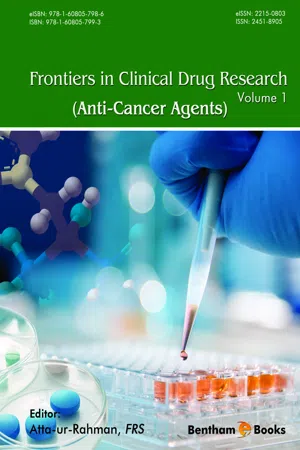
Frontiers in Clinical Drug Research - Anti-Cancer Agents - Volume 1 should prove to be a valuable resource for pharmaceutical scientists and postgraduate students seeking updated and critical information for developing clinical trials and devising research plans in the field. The chapters in this volume have been written by leading experts from the field.
The contents of this book include new approaches to cancer therapy, treatment of metastatic non-small cell lung cancer with epidermal growth factor receptor-tyrosine kinase inhibitors, targeting key signaling pathways in pediatric brain tumors, current status of cladribine in lymphoid and myeloid malignancies, natural anti-cancer products and the mechanisms of telomere and telomerase regulation in hematologic malignancies.
The eBook series is essential to all scientists involved in clinical drug research who wish to keep abreast of rapid and important developments in the field. The readers will find these reviews valuable and will certainly trigger further research in the pharmaceutical development of anti-cancer agents.
- English
- ePUB (mobile friendly)
- Available on iOS & Android
eBook - ePub
Frontiers in Clinical Drug Research - Anti-Cancer Agents: Volume 1
About this book
Trusted by 375,005 students
Access to over 1.5 million titles for a fair monthly price.
Study more efficiently using our study tools.
Information
Topic
Ciencias físicasSubtopic
Química clínicaThe Treatment of Metastatic Non-Small Cell Lung Cancer with Epidermal Growth Factor Receptor-Tyrosine Kinase Inhibitors
Vera Hirsh*
Chief, Hematology-Oncology Services, Santa Cabrini Hospital; Associate Physician, Oncology Services, Royal Victoria Hospital and Montréal General Hospital; Associate Professor, Department of Oncology, Faculty of Medicine, McGill University, Montréal, Québec, Canada
Abstract
Lung cancer is one of the most commonly diagnosed malignancies and the leading cause of cancer-related mortality in North America. The heterogeneity of non-small cell lung cancer (NSCLC) and the importance of linking new, targeted agents to the appropriate disease subtype require an individualized approach to treatment. In patients with epidermal growth factor receptor (EGFR) mutations, EGFR tyrosine kinase inhibitors (EGFR-TKIs) provide a highly effective treatment option, with improved toxicity compared with standard chemotherapy. Newer irreversible EGFR-TKIs have additional advantages and are able to overcome the resistance seen with the older reversible agents. A number of clinical trials using EGFR-TKIs are showing promising results, including a superior side-effect profile and improved quality of life when compared with standard chemotherapy. Studies using EGFR-TKIs will aid in determining the optimal positioning of these therapies. With improvements in both testing and access to treatment, targeted use of EGFR-TKIs may greatly improve outcomes in NSCLC.
Keywords:: Non-small cell lung cancer, epidermal growth factor receptor, epidermal growth factor receptor mutation, epidermal growth factor receptor-tyrosine kinase inhibitors, afatinib, erlotinib, gefitinib, adverse drug event, skin rash, diarrhea, quality of life.
* Corresponding author Vera Hirsh: Chief, Hematology-Oncology Services, Santa Cabrini Hospital; Associate Physician, Oncology Services, Royal Victoria Hospital and Montréal General Hospital; Associate Professor, Department of Oncology, Faculty of Medicine, McGill University, Montréal, Québec, Canada;, E-mail: [email protected]
EPIDEMIOLOGY OF LUNG CANCER
Lung cancer is the leading cause of cancer-related mortality in the United States. Each year, for the past 25 years, more women have died from lung cancer than
breast cancer. The estimated number of new cases of lung cancer in 2012 is 226,160, approximately 14% of all cancer diagnoses for the year. The number of deaths due to lung cancer is estimated at 160,340. The five-year survival rate for all lung cancers is 16%, higher (52%) if diagnosed at an early stage. However, only 15% of cases present when the disease is localized as the majority of patients present with advanced stage disease at diagnosis [1, 2].
The biggest risk factor for lung cancer is cigarette smoking, causing up to 90% of cases in the United States [3]. Risk increases with the duration of smoking and the number of cigarettes smoked. Risk of lung cancer also increases with pipe and cigar smoking. Second-hand smoke, smoke inhaled from other people’s cigarettes, pipes, and cigars, causes approximately 3,000 lung cancer deaths in people who have never smoked [3]. The second leading cause of lung cancer in North America is exposure to radon gas, which is emitted from rocks, soil, and building materials, accounting for 20,000 new cases of lung cancer each year in the United States [3]. Other risk factors include exposure to toxic substances such as asbestos, arsenic, cadmium, and chromium, and a family history of lung cancer [2].
Lung cancer is classified by histology type. The majority of lung cancers come from malignancies of the epithelial cells, or carcinomas, with the two main types being small cell lung cancer (SCLC) and non-small cell lung cancer (NSCLC). NSCLC makes up approximately 85% of all lung cancers [2].
NON-SMALL CELL LUNG CANCER
NSCLC consists of a heterogeneous group of histologies traditionally grouped together because of similarities in treatment and prognosis. The three main subtypes of NSCLC are adenocarcinoma, squamous cell carcinoma, and large cell carcinoma, with other types occurring less frequently [4, 5].
Adenocarcinoma — the most common type of NSCLC — comprises 40% of all lung cancers. It usually originates in the periphery of the lung and is slow growing, taking years to become invasive. This type of lung cancer occurs primarily in smokers. However, it is also the most common type of lung cancer in never smokers [6]. Adenocarcinoma is more common among Asian populations [7] as well as women [6, 8].
Squamous cell carcinoma accounts for between 25% and 30% of lung cancers. It usually originates centrally in the larger bronchi and, like adenocarcinoma, is slow growing [6, 9]. This type of lung cancer is almost always linked to smoking.
Large-cell carcinoma makes u...
Table of contents
- Welcome
- Table of Contents
- Title
- BENTHAM SCIENCE PUBLISHERS LTD.
- LIST OF CONTRIBUTORS
- PREFACE
- A New Approach to Cancer Therapy: The Tumor Microenvironment as Target
- The Current Status of Cladribine in the Treatment of Lymphoid and Myeloid Malignancies
- The Mechanisms of Telomere and Telomerase Regulation in Hematologic Malignancies
- The Treatment of Metastatic Non-Small Cell Lung Cancer with Epidermal Growth Factor Receptor-Tyrosine Kinase Inhibitors
- Targeting Key Signaling Pathways in Pediatric Brain Tumors
- Natural Anti-Cancer Products
Frequently asked questions
Yes, you can cancel anytime from the Subscription tab in your account settings on the Perlego website. Your subscription will stay active until the end of your current billing period. Learn how to cancel your subscription
No, books cannot be downloaded as external files, such as PDFs, for use outside of Perlego. However, you can download books within the Perlego app for offline reading on mobile or tablet. Learn how to download books offline
Perlego offers two plans: Essential and Complete
- Essential is ideal for learners and professionals who enjoy exploring a wide range of subjects. Access the Essential Library with 800,000+ trusted titles and best-sellers across business, personal growth, and the humanities. Includes unlimited reading time and Standard Read Aloud voice.
- Complete: Perfect for advanced learners and researchers needing full, unrestricted access. Unlock 1.5M+ books across hundreds of subjects, including academic and specialized titles. The Complete Plan also includes advanced features like Premium Read Aloud and Research Assistant.
We are an online textbook subscription service, where you can get access to an entire online library for less than the price of a single book per month. With over 1.5 million books across 990+ topics, we’ve got you covered! Learn about our mission
Look out for the read-aloud symbol on your next book to see if you can listen to it. The read-aloud tool reads text aloud for you, highlighting the text as it is being read. You can pause it, speed it up and slow it down. Learn more about Read Aloud
Yes! You can use the Perlego app on both iOS and Android devices to read anytime, anywhere — even offline. Perfect for commutes or when you’re on the go.
Please note we cannot support devices running on iOS 13 and Android 7 or earlier. Learn more about using the app
Please note we cannot support devices running on iOS 13 and Android 7 or earlier. Learn more about using the app
Yes, you can access Frontiers in Clinical Drug Research - Anti-Cancer Agents: Volume 1 by Atta-ur-Rahman in PDF and/or ePUB format, as well as other popular books in Ciencias físicas & Química clínica. We have over 1.5 million books available in our catalogue for you to explore.