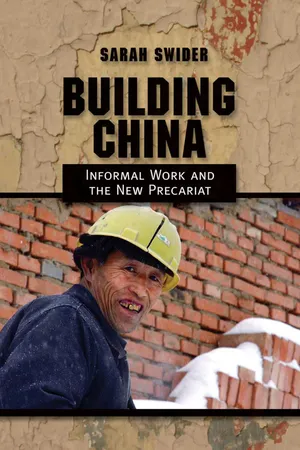
Roughly 260 million workers in China have participated in a mass migration of peasants moving into the cities, and construction workers account for almost half of them. In Building China, Sarah Swider draws on her research in Beijing, Guangzhou, and Shanghai between 2004 and 2012, including living in an enclave, working on construction jobsites, and interviews with eighty-three migrants, managers, and labor contractors. This ethnography focuses on the lives, work, family, and social relations of construction workers. It adds to our understanding of China's new working class, the deepening rural-urban divide, and the growing number of undocumented migrants working outside the protection of labor laws and regulation. Swider shows how these migrants—members of the global "precariat," an emergent social force based on vulnerability, insecurity, and uncertainty—are changing China's class structure and what this means for the prospects for an independent labor movement.The workers who build and serve Chinese cities, along with those who produce goods for the world to consume, are mostly migrant workers. They, or their parents, grew up in the countryside; they are farmers who left the fields and migrated to the cities to find work. Informal workers—who represent a large segment of the emerging workforce—do not fit the traditional model of industrial wage workers. Although they have not been incorporated into the new legal framework that helps define and legitimize China's decentralized legal authoritarian regime, they have emerged as a central component of China's economic success and an important source of labor resistance.
- 216 pages
- English
- ePUB (mobile friendly)
- Available on iOS & Android
eBook - ePub
About this book
Trusted by 375,005 students
Access to over 1.5 million titles for a fair monthly price.
Study more efficiently using our study tools.
Information
Chapter 1
BUILDING CHINA AND THE MAKING OF A NEW WORKING CLASS
Of Cement and Cigarettes
Dan squats near the gate and takes a slow drag from his South Sea cigarette. These cigarettes, called Zhongnanhai in Chinese, are named after an imperial garden next to the Communist Party headquarters. The name is rightfully earned, given that these are purported to have been Mao Zedong’s favorite cigarettes. When Dan exhales, the billow of smoke lingers in the hot, still Beijing air. Dan is from Hebei—a province that surrounds Beijing and a place where everyone seems to smoke South Sea cigarettes. He crushes the hot ash between his calloused, cement-caked fingers, rises slowly from squatting position, and returns to work.
Dan spends most of his day bent over with his back facing the sun as he swings a shovel, mixing and moving cement. In 2010, China used 57 percent of the global production of cement for less than 20 percent of the world’s population, and between 2008 and 2010, it used more cement than the United States used during the entire twentieth century (Smil 2013, 91). As Dan works, a fine dust fills his lungs and covers his body in a white-gray sheen. Sweat drips from his forehead into this textured material that is the key ingredient in building China.
Cement is used in both mortar and concrete: it is the glue that holds things together and the substance that gives most buildings their shape. Similarly, migrants like Dan are the glue and substance of China’s modern cities. Like cement, they are ubiquitous yet easily overlooked. The estimated 260 million migrant workers in China are concentrated in the cities, representing 25 percent of the population of Shanghai, 30 percent of Beijing, and 40 percent of Guangzhou. Like mortar, these migrants hold the cities together, doing all the menial jobs that make things hum: they are porters, food preparers and servers, domestic workers, nannies, cleaners, retail and street vendors, sanitation workers, and workers in manufacturing and, of course, construction.
These workers are also like mortar in that they connect the large cities of China’s East Coast to the rest of the country. One can almost map the origins of workers on a jobsite based on the cigarettes they smoke. In addition to Dan’s favored brand, South Sea (Zhongnanhai), which indicates his home province, Hebei, a quick glance around the jobsite reveals workers smoking Pride (Jiaozi) from Sichuan, Double Happiness (Shuangxi) from Shanghai, Happy Cat (Haomao) from Shaanxi, Jade Creek (Yuxi) and Red Tower (Hongta Shan) from Yunnan, and Red Sand (Baisha) from Henan.
Just as migrant construction workers build China’s cities, so too are their lives built around their work in the cities. Dan is only nineteen. He did not go to high school, and like hundreds of millions of other migrant workers, he came to the city to follow his dreams and find his future. He has two major life goals: to have a family and to become rich. He traveled to Beijing to acquire the “three keys” that are necessary to realize his dreams: a key to an office, a key to a house, and a key to a car. To reach his goals, Dan must first work his way into a good job (the key to an office); in construction, this means striking out on your own to become the boss or a contractor. Then, he will be able to afford a house and a car, or at least a motorcycle. Dan is from a poor family, and it is almost impossible to find a bride without something to offer; in China today, a groom is expected to bring the three keys to the table. How many shovelfuls of cement will it take for him to reach his goals?
This morning, Dan woke at 6:00 a.m. and was on the jobsite working by 7:00 a.m. Along with millions of other migrants, he does this day after day, year after year. He sometimes hums a tune as he swings the shovel. In the cool morning hours, it is not uncommon to hear humming or songs throughout the jobsite or to see smiles on workers’ faces. By midmorning, breaks for cigarettes and water are a part of the rhythm, breaking the monotony of mixing, shoveling, and hauling. Inhaled smoke, coupled with small sips of warm water, provides relief from the alkaline dust. It also gives the body a moment to rest, the mind a moment to wander, and the spirit a moment to recover.
Like the concrete used in the buildings, these migrants give cities their form. In doing so, they become part of the cities they build. Dan has worked in Beijing for almost two years but has saved little money. I look over at Anlin, who is also smoking a South Sea cigarette. He is fifty years old, and his back is permanently hunched from years of lifting and bending as he works piles of cement. His hands are coarse, his face and back are darkened from long days in Beijing’s unrelenting sun, his arms are scarred by accidents, and his body is gaunt from arduous work with minimal food. He doesn’t return home anymore; his wife left, and his children grew up without him as he worked year after year in cities chasing his dreams. Cigarettes and cement, like the songs of the Sirens, lure many migrant workers away from home and down this path.1 They offer the irresistible promise of a “Chinese Dream,” but like the sailors trying to reach the Sirens, the workers are destroyed in the process of trying to realize that dream.2
Dan and Anlin are part of the growing number of informal precarious workers who are building a new, modern China. In the process, these workers are not only erecting concrete buildings and changing the cities but also reshaping China’s working class.
Constructing China: Urbanization, Migration, and Informalization
Historically, the process of building cities has been a people-driven response to demographic shifts. As people move into cities, buildings and structures are built to accommodate them, which is how most cities grow.3 However, the current historical period has witnessed a shift in the process of urbanization from people-driven to capital-driven. In cities characterized by capital-driven growth, capital investment has moved from manufacturing and production into building and real estate (Harvey 1985). Construction becomes a strategy of capital accumulation, changing from providing a means to an end to becoming an end in itself.
China is the paradigmatic example of this process. Urbanization is the cornerstone of China’s modernization project and a driving force behind the nation’s economic growth. In places like India and Africa, urban land expansion is driven by urban population growth. By contrast, in China it is driven more by growth in the per capita gross domestic product (GDP), which accounted for almost half of China’s urban land expansion between 1970 and 2000 (Seto et al. 2011). Accordingly, China’s construction industry experienced a spectacular annual average growth rate of 22 percent from 2001 to 2008 (Huang, Lan, and Bai 2013), representing about one-fourth (US$1.4 trillion) of China’s GDP (National Bureau of Statistics of China 2010). Recently, its output value has surpassed that of the construction industry in the United States, making it the largest in the world. China is projected to account for about one-fifth of the global construction industry within the next decade (Ai-ju 2011).
This massive building spree is literally and figuratively remaking China. It is restructuring space as some of the world’s longest bridges, tallest buildings, largest dams, and most expansive manufacturing facilities spring up across the landscape. An important part of this restructuring involves the movement of people, as hundreds of millions of migrants leave rural areas for growing cities. By the end of 2011, over 50 percent of China’s 1 billion people lived in urban areas, many of them large cities. There are 160 cities with more than 1 million people; four of these have more than 10 million, and two megacities, Shanghai and Guangzhou, have more than 20 million.4
The process of building China is also (re)making its working class. The workers who build and serve the cities, along with those who produce goods for the world to consume, are mostly migrant workers.5 They, or their parents, grew up in the countryside; they are farmers who left the fields and migrated to the cities to find work. In China, migration is regulated by the hukou system. This system involves an internal passport that, among other functions, restricts mobility and requires that migrants register in their new location, even if it is a temporary one. However, many migrants do not register. These unregistered migrants are similar to illegal migrants in other countries in that they have no access to social welfare or public goods, and as unregistered residents, they technically have no right to be in the city.6 One estimate suggests that unregistered migrants make up roughly 12 percent of the urban population (X. Wu 2005); another study reveals that in many of the larger cities of the East Coast, more than half the migrants are unregistered (FL. Wang 2005, 78).
Most unregistered migrants end up working in precarious jobs in the informal economy.7 Informal work includes jobs that pay wages but do not conform to labor laws and regulations, along with self-employment in businesses that are not registered with the state (Williams and Windeband 1998).8 In China, the informal sector has evolved in tandem with economic marketization, urbanization, and integration into the global economy. Informal employment has grown from 15,000 workers in 1978, when economic reforms began, to more than 168 million in 2006, now representing over 60 percent of total urban employment (P. Huang 2009). Migrant workers perform most of the informal work.9 It is concentrated in specific industries, including the construction and service industries, and specific occupations, including street vending, domestic work, child care, and recycling.
Examining the construction industry provides us with an understanding how the forces of urbanization, migration, and informalization are reshaping both China and its workforce. This industry involves one-third to one-half of all migrant workers and is the number-one industry hiring male migrants.10 Informal employment in construction has grown from roughly 17 percent in 1999 to an estimated 70 percent in 2008 (Wells and Jason 2010; Lu and Fox 2001). In sum, the construction industry is an important sector representing informal precarious work in urban China.
Moving beyond the Façade: Uncovering and Understanding Informal Work in China
In an effort to understand the dynamics of informal work in China’s construction industry, I immersed myself in the everyday life and work of male migrant construction workers for almost a year in 2004–5, followed by three shorter follow-up visits between 2008 and 2012. During this time, I gathered data from four types of research sites: enclaves including the one where I lived; construction jobsites including those where I worked; street labor markets; and governmental and nongovernmental organizations that serve migrant workers in Beijing and Guangzhou. The process of choosing sites and gaining access was complex and required a multipronged approach, which is detailed in appendix A. This ethnographic method allowed me to explore some of the processes that shape this large and growing informal precarious workforce. It produced a rich tapestry of data that provide a unique lens into their everyday lives, work, and existence in the cities.
Most of my effort focused on construction workers. I spent most of my time on construction sites in Beijing, Shanghai, and Guangzhou (see appendix B).11 In total, I interviewed 130 people: 83 people in 2004–5; 24 interviews in 2009; and 23 interviews in 2012 (see appendix C).12 These interview data are supplemented by field notes and journals that include observations and insights gained from participating in the lives of workers in the enclaves and on the jobsites.13 During the data collection process in Beijing, I mapped out informal employment in the industry, developed the concept of “employment configuration,” and identified three different employment configurations. I continued data collection until saturation was reached, meaning that new interviews and observations were not yielding significant new insights or data. I then decided to collect data in both Shanghai and Guangzhou in an effort to determine whether Beijing was a unique case or if it resembled other cities. I found that the three employment configurations existed in the construction industry in all three cities, but the prominence of each varied across these places. Since the main purpose of this book is to define and describe employment configurations in the industry, I draw mostly from the rich data accumulated from research in Beijing, and then, in the final chapter, I discuss similarities and differences across the cities and how they can inform future research.
This book makes three main contributions to our understanding of informal work in China. First, it documents diversity in employment relations and the labor market. This diversity exists in spite of the fact that all of these workers are similar: they are all men who are unregistered migrants working informally in the construction industry in major cities in China. This book helps us make sense of that diversity and the diversity of informal precarious work more generally. Second, it expands our understanding of China’s emerging labor regime, which is central to labor control, intimately related to the urbanization process, and ultimately linked to China’s overall economic success. Finally, it shows how these migrants struggle against the disciplining process, contest exploitation, and protest in unique ways. Just as with other workers toiling under capitalism, important structural forces shape their work and lives but are not deterministic. Thus, this large, emerging segment of workers should not be overlooked when analyzing the complexities of class and class politics in China.
Mapping out Diversity of Informal Work: Employment Configurations
The diversity of employment arrangements and working conditions that I found among these informal precarious workers is surprising because the scholarship tends to focus, explicitly and implicitly, on the difference between the categories of formal and informal work. As Williams and Lansky’s (2013) review of the literature reveals, informal employment is either framed in opposition to formal employment, or it is defined in terms of what it is not. In the absence of a strong definition, formal work is seen as standard employment offering decent pay and good working conditions, and informal work is seen as nonstandard employment characterized by low wages, poor working conditions, and harsh labor control regimes (Castells and Portes 1989; Sassen 1994).14 However, the boundaries bet...
Table of contents
- Preface
- Acknowledgments
- 1. Building China and the Making of a New Working Class
- 2. The Hukou System, Migration, and the Construction Industry
- 3. Mediated Employment
- 4. Embedded Employment
- 5. Individual Employment
- 6. Protest and Organizing among Informal Workers under Restrictive Regimes
- 7. Informal Precarious Workers, Protests, and Precarious Authoritarianism
- Appendix A
- Appendix B
- Appendix C
- Notes
- References
- Index
Frequently asked questions
Yes, you can cancel anytime from the Subscription tab in your account settings on the Perlego website. Your subscription will stay active until the end of your current billing period. Learn how to cancel your subscription
No, books cannot be downloaded as external files, such as PDFs, for use outside of Perlego. However, you can download books within the Perlego app for offline reading on mobile or tablet. Learn how to download books offline
Perlego offers two plans: Essential and Complete
- Essential is ideal for learners and professionals who enjoy exploring a wide range of subjects. Access the Essential Library with 800,000+ trusted titles and best-sellers across business, personal growth, and the humanities. Includes unlimited reading time and Standard Read Aloud voice.
- Complete: Perfect for advanced learners and researchers needing full, unrestricted access. Unlock 1.5M+ books across hundreds of subjects, including academic and specialized titles. The Complete Plan also includes advanced features like Premium Read Aloud and Research Assistant.
We are an online textbook subscription service, where you can get access to an entire online library for less than the price of a single book per month. With over 1.5 million books across 990+ topics, we’ve got you covered! Learn about our mission
Look out for the read-aloud symbol on your next book to see if you can listen to it. The read-aloud tool reads text aloud for you, highlighting the text as it is being read. You can pause it, speed it up and slow it down. Learn more about Read Aloud
Yes! You can use the Perlego app on both iOS and Android devices to read anytime, anywhere — even offline. Perfect for commutes or when you’re on the go.
Please note we cannot support devices running on iOS 13 and Android 7 or earlier. Learn more about using the app
Please note we cannot support devices running on iOS 13 and Android 7 or earlier. Learn more about using the app
Yes, you can access Building China by Sarah Swider in PDF and/or ePUB format, as well as other popular books in Politics & International Relations & Chinese History. We have over 1.5 million books available in our catalogue for you to explore.