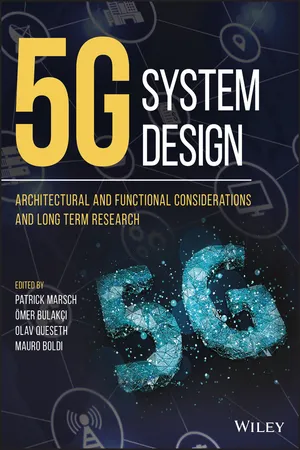
This book provides a comprehensive overview of the latest research and standardization progress towards the 5th generation (5G) of mobile communications technology and beyond. It covers a wide range of topics from 5G use cases and their requirements, to spectrum, 5G end-to-end (E2E) system architecture including core network (CN), transport network (TN) and radio access network (RAN) architecture, network slicing, security and network management. It further dives into the detailed functional design and the evaluation of different 5G concepts, and provides details on planned trials and pre-commercial deployments across the globe. While the book naturally captures the latest agreements in 3rd Generation Partnership Project (3GPP) New Radio (NR) Release 15, it goes significantly beyond this by describing the likely developments towards the final 5G system that will ultimately utilize a wide range of spectrum bands, address all envisioned 5G use cases, and meet or exceed the International Mobile Telecommunications (IMT) requirements for the year 2020 and beyond (IMT-2020).
5G System Design: Architectural and Functional Considerations and Long Term Research is based on the knowledge and consensus from 158 leading researchers and standardization experts from 54 companies or institutes around the globe, representing key mobile network operators, network vendors, academic institutions and regional bodies for 5G. Different from earlier books on 5G, it does not focus on single 5G technology components, but describes the full 5G system design from E2E architecture to detailed functional design, including details on 5G performance, implementation and roll-out.
Digital technologies have a profound transformative impact on our societies and economies. The digital revolution opens the door to novel activities, applications and business cases that could not be envisaged before. As part of the Digital Single Market initiative launched as one of the ten priorities of the Juncker Commission, the European Commission proposed in 2016 an ambitious package of measures to foster the advent of a digital society and economy in Europe.
5G is an important pillar of this strategy. The European 5G vision co‐created with a multiplicity of actors is fully aligned with our wider digitization strategy, as 5G is designed to support smart connectivity in domains as diverse as the automotive, healthcare, factories, energy or media sectors.
The stakes are high. 5G has the potential to open new B2B businesses, whilst operators are currently facing a stagnation of their revenues in Europe. Market estimates point at a potential of € 550 billion extra revenues in 2025 from vertical industries, adding to the classical broadband consumer markets. The “connectivity package” released in September 2016 by the European Commission has thus proposed an ambitious strategy for 5G in Europe. It includes a new connectivity strategy moving Europe in the Gigabit/s connectivity era, a reform of the telecom regulatory framework with specific spectrum and investment friendly measures, and a 5G Action Plan with a package of actions to put in place the right framework conditions for the launch of 5G in Europe in 2020.
European efforts are indeed key to keep abreast of a fierce global competition. The USA and South Korea have already announced the deployment of early versions of 5G technology in 2018. Japan plans 5G introductions in 2020, and China pursues a bold technological development plan. These pre‐commercial initiatives are putting high pressure on the quick release of the required standards. In that context, it is imperative that the European 5G strategy targeting vertical markets gets quickly validated, both from a technology and business perspective. The 5G Action Plan consequently calls for early cross‐industry and large‐scale trials in Europe. These will be supported by the next phase of the 5G Public Private Partnership (5G PPP), a € 700 million Research and Innovation initiative launched in 2013 by the European Commission to materialize our bold ambitions in this domain.
The European 5G vision requires a versatile network platform that can adapt to demanding requirements of a multiplicity of business models, whilst current networks are more designed as “one size fits all” platforms. Moving towards 5G, deployment will largely piggyback on the results of previous phases of the 5G PPP, which have invested tremendous 5G research efforts in a multiplicity of domains, covering issues as diverse as new radio access technologies, network architectures with co‐operation of a multiplicity of fixed or mobile access networks including satellites, operation of new spectrum in the millimeter wave ranges, network virtualization, redesign of the core network, applications of software techniques to network management, as typical examples.
This book presents the results of the research carried out in these multiple domains during the first phase (2014‐16) of the 5G PPP. It shows an impressive set of technological achievements, unlocking many of the roadblocks on the road towards achieving the most demanding KPIs of 5G, such as data rates beyond 10 Gbit/s, latencies in the milliseconds range, or service creation and deployment within a few minutes. This work has also been instrumental in supporting the European industry to make informed choices for what concerns 5G standards and spectrum requirements and allocation.
I am grateful to all the colleagues who have shown undivided commitment to make 5G a reality in Europe, and I am sure that the readers will enjoy reading this book as a testimony to these efforts.
Khalil Rouhana, Deputy Director‐General in DG CONNECT, European Commission
Foreword 2
As chairman of the 5G Infrastructure Association board, it is with great pleasure that I see this book come to fruition, and I welcome the chance to add a personal message of support. I believe this is a timely and important work, which in hindsight will be seen as one of the key results from the 5G pre‐standardization period.
Although not limited to only European research work, the major input to this book represents the key results from the 5G Public Private Partnership (5G‐PPP) research programme. Within the 5G PPP programme, the 5G Infrastructure Association (5G IA) is the organization which represents European industry. The 5G IA is committed to the advancement of 5G in Europe and to building global consensus on 5G. To this aim, the Association brings together a global industry community of telecoms & digital actors, such as operators, manufacturers, research institutes, universities, verticals and SMEs. I believe this book may play a useful role for this 5G IA goal of advancement of 5G, by providing a definitive source for the current state of 5G research.
This book is timely because we are at a water shed in both the 5G PPP and in terms of 5G in general. Within the 5G PPP, we are at a time where most of the phase 1 projects have completed or are about to complete. This means that a lot of the fundamental 5G research has been completed and the focus of the programme in phase 2 will move more towards demonstration of trial systems and integration of vertical domains such as automotive, e‐health and Industry 4.0. As such, it is a perfect time to document and disseminate the key results of those phase 1 5G PPP projects.
In terms of the broader view, 5G is also moving from the pre‐standardization to post‐standardization phase. At the time of writing this book, 3GPP has almost concluded on the so‐called first drop of 5G technology, focusing on non‐stand‐alone operation of 5G in conjunction with (e)LTE. This first drop will of course not include the complete functionality, and it is important to point out that standardization will need many years to completely specify 5G. Nonetheless, some aspects of 5G will be finalized in the near future, and the influence of the 5G PPP projects on many of the design choices made both through direct research and creation of pre‐standardization consensus should not be underestimated.
As well as giving an important snapshot of where we are in terms of 5G today and some clear guidance of where we think it should go in the future, I believe the depth and quality shown in this book is a clear validation for the vision and goals of the 5G PPP in general. There is still much work to do to make 5G a reality that lives up to the promised goals, and I believe this book is an important step on that journey.
Dr. Colin Willcock, Chairman of the Board, 5G Infrastructure Association
Acknowledgments
In the mid of 2015, the first phase of 5th Generation Public Private Partnership (5G PPP) projects kicked off, and the time until now has been hectic, but also very rewarding. During this period, 5G has moved from vision and concepts to technologies that are almost ready to be deployed, and we are glad and proud to have been part of this work.
This book is based on the outcome of 12 projects within the 5G PPP framework, as detailed in Section 1.2, and complemented by contributions from various additional 5G experts across the globe. We would like to thank all the contributors for the substantial effort and engagement invested into this book, despite the fact that the writing of the book collided with that of the final deliverables of most of the involved projects. In particular, we would like to express a big thank you to the main chapter editors for consolidating the often diverse viewpoints and terminologies used by different projects or entities into a coherent story. Knowing that many contributors have also spent their free time to finalize the book, and given that the work behind the development of new technologies like 5G is typically as demanding and time‐consuming as it is rewarding and inspiring, we would also like to thank the families of the contributors for their continuous patience and support.
Naturally, we would like to thank the European Commission for funding the projects that have led to this book, and in particular Bernard Barani for his personal support of the book.
Beyond the researchers who have been directly involved in the projects, there are of course much more persons involved in our home organizations. We would hence like to thank all our colleagues in the mobile communications industry, research institutes and universities for inspiring discussions, the contribution of ideas, and the help on various tasks.
Dr. Bulakçı would also like to thank Wu Jianjun and Dr. Egon Schulz from Huawei for the support in preparation of this book.
Last but not least, we would like to thank Sandra Grayson, Louis Manoharan and Adalfin Jayasingh from Wiley for the pleasant collaboration and continuous support throughout the writing and production process of this book.
Patrick Marsch, Ömer Bulakçı, Olav Queseth and Mauro Boldi On behalf of the book contributors
Table of contents
Cover
Title Page
Table of Contents
Contributor List
Foreword 1
Foreword 2
Acknowledgments
List of Abbreviations
Part 1: Introduction and Basics
Part 2: 5G System Architecture and E2E Enablers
Part 3: 5G Functional Design
Part 4: Performance Evaluation and Implementation
Index
End User License Agreement
Trusted by 375,005 students
Access to over 1.5 million titles for a fair monthly price.
Study more efficiently using our study tools.
Frequently asked questions
Yes, you can cancel anytime from the Subscription tab in your account settings on the Perlego website. Your subscription will stay active until the end of your current billing period. Learn how to cancel your subscription
No, books cannot be downloaded as external files, such as PDFs, for use outside of Perlego. However, you can download books within the Perlego app for offline reading on mobile or tablet. Learn how to download books offline
Perlego offers two plans: Essential and Complete
Essential is ideal for learners and professionals who enjoy exploring a wide range of subjects. Access the Essential Library with 800,000+ trusted titles and best-sellers across business, personal growth, and the humanities. Includes unlimited reading time and Standard Read Aloud voice.
Complete: Perfect for advanced learners and researchers needing full, unrestricted access. Unlock 1.5M+ books across hundreds of subjects, including academic and specialized titles. The Complete Plan also includes advanced features like Premium Read Aloud and Research Assistant.
Both plans are available with monthly, semester, or annual billing cycles.
We are an online textbook subscription service, where you can get access to an entire online library for less than the price of a single book per month. With over 1.5 million books across 990+ topics, we’ve got you covered! Learn about our mission
Look out for the read-aloud symbol on your next book to see if you can listen to it. The read-aloud tool reads text aloud for you, highlighting the text as it is being read. You can pause it, speed it up and slow it down. Learn more about Read Aloud
Yes! You can use the Perlego app on both iOS and Android devices to read anytime, anywhere — even offline. Perfect for commutes or when you’re on the go. Please note we cannot support devices running on iOS 13 and Android 7 or earlier. Learn more about using the app
Yes, you can access 5G System Design by Patrick Marsch, Ömer Bulakci, Olav Queseth, Mauro Boldi, Patrick Marsch,Ömer Bulakci,Olav Queseth,Mauro Boldi in PDF and/or ePUB format, as well as other popular books in Technology & Engineering & Electrical Engineering & Telecommunications. We have over 1.5 million books available in our catalogue for you to explore.