Anatomy & Physiology Workbook For Dummies with Online Practice
eBook - ePub

Anatomy & Physiology Workbook For Dummies with Online Practice

  1. English
  2. ePUB (mobile friendly)
  3. Available on iOS & Android
eBook - ePub

Anatomy & Physiology Workbook For Dummies with Online Practice

About this book

Practice your way to a high score in your anatomy & physiology class

The human body has 11 major anatomical systems, 206 bones, and dozens of organs, tissues, and fluids—that's a lot to learn if you want to ace your anatomy & physiology class! Luckily, you can master them all with this hands-on book + online experience. Memorization is the key to succeeding in A&P, and Anatomy & Physiology Workbook For Dummies gives you all the practice you need to score high. 

Inside and online, you'll find exactly what you need to help you understand, memorize, and retain every bit of the human body.  Jam packed with memorization tricks, test-prep tips, and hundreds of practice exercises, it's the ideal resource to help you make anatomy and physiology your minion! 

  • Take an online review quiz for every chapter
  • Use the workbook as a supplement to classroom learning
  • Be prepared for whatever comes your way on test day
  • Gain confidence with practical study tips

If you're gearing up for a career in the medical field and need to take this often-tough class to fulfill your academic requirements as a high school or college student, this workbook gives you the edge you need to pass with flying colors.

Trusted by 375,005 students

Access to over 1.5 million titles for a fair monthly price.

Study more efficiently using our study tools.

Information

Publisher
For Dummies
Year
2018
Print ISBN
9781119473596
Edition
3
eBook ISBN
9781119473664
Part 1

The Building Blocks of the Body

IN THIS PART …
Learn the language of anatomy and physiology.
Explore the basic building blocks and functions that make the parts of the body what they are. Dig into atoms, elements, chemical reactions, and metabolism.
Crack open the cell to see what’s happening at life’s most fundamental level. Find out about the cell membrane, the nucleus, organelles, proteins, and the cell life cycle.
Plunge into cell division, which has several phases: interphase, prophase, metaphase, anaphase, telophase, and cytokinesis.
Use histology to build all of the body’s tissues — epithelial, connective, muscular, and nervous — from the inside out.
Chapter 1

The Language of Anatomy & Physiology

IN THIS CHAPTER
check
Learning to speak the language
check
Casing the cavities
check
Orienting yourself to the body
Human anatomy is the study of our bodies’ structures while physiology is how they work. It makes sense, then, to learn the two in tandem. But before we can dive in to the body systems and their intricate structures, you must first learn to speak the language of the science.

Organization of the Body

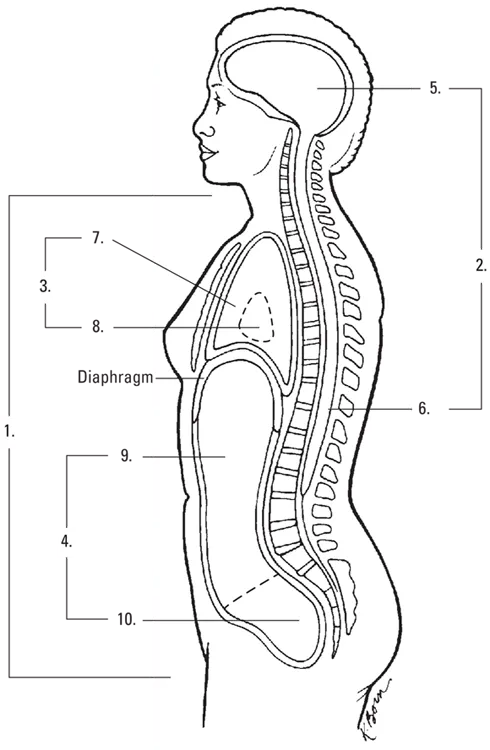
As you know, the body is organized into systems, grouping together the organs that work together to achieve a common goal. To house all these organs, our body must create spaces to hold them. The body has two cavities that achieve this: the dorsal cavity, which holds the brain and spinal cord and the ventral cavity that holds everything else. The dorsal cavity splits into the spinal cavity, which holds the spinal cord, and the cranial cavity that houses the brain. The ventral cavity is split into the thoracic cavity and the abdominopelvic cavity by a large band of muscle called the diaphragm. Within the thoracic cavity are the right and left pleural cavities, which hold each lung, and the mediastinum. Within the mediastinum is the pericardial cavity which contains the heart. The abdominopelvic cavity divides into the abdominal cavity (with the stomach, liver, and intestines) and the pelvic cavity (with the bladder and reproductive organs), though there’s no distinct barrier between the two.
In order to create these cavities within our bodies, we have membranes to border the space. The visceral membrane lies atop of the organs, making direct contact with them. For example, the outermost layer of the heart is called the visceral pericardium and on the lungs it’s the visceral pleura. The parietal membrane lies on the other side of the spaces or lining the cavity itself. So the lining of the abdominopelvic cavity is known as the parietal peritoneum (note that it’s not the parietal abdominopelvic that just sounds weird).
The other parts of the body are divided into axial and appendicular areas. The axial portions are the parts of your body that form your axis — the head, chest, and abdomen. The appendicular portions form your appendages — your arms and legs. For consistency when referencing them, there are proper terms for all of the body’s areas. The terminology used in identifying many of the regions is found in Table 1-1. You’ll notice these terms popping up all over this book.
Table 1-1 The Body’s Regions
Proper Term
Region
Proper Term
Region
Antebrachial
forearm
Genicular
knee
Antecubital
inner elbow
Inguinal
groin/inner thigh
Axillary
armpit
Lumbar
lower back
Brachial
upper arm
Mental
chin
Bucchal
cheek
Orbital
eye
Carpal
wrist
Otic
ear
Cephalic
head
Pectoral
chest
Cervical
neck
Pedal
foot
Coxal
hip
Plantar
sole/bottom of foot
Crural
shin
Popliteal
back of knee
Cubital
elbow
Sural
calf
Dorsum
back
Tarsal
ankle
Femoral
thigh
Vertebral
backbone
Frontal
forehead
That’s a lot of new terms for the first chapter! Let’s see how well they’re sticking.
example
Q. Which of the following organs would you find in the mediastinum?
I. lungs
II. heart
III. liver
  1. I only
  2. II only
  3. III only
  4. I & II
  5. I, II, & III
A. The correct answer is only the heart. The mediastinum is defined as the area between the lungs and the liver is in the abdominopelvic cavity.
1-10 Label the body cavities illustrated in Figure 1-1.
image
Illustration by Kathryn Born, MA
FIGURE 1-1: Body cavities.
  1. Abdominal
  2. Abdominopelvic
  3. Cranial
  4. Dorsal
  5. Pelvic
  6. Pericardial
  7. Pleural
  8. Spinal
  9. Thoracic
  10. Ventral
11-16 Match the description to identify the membranes that create the body’s cavities.
a. parietal pericardium
b. parietal peritoneum
c. parietal pleura
d. visceral pericardium
e. visceral peritoneum
f. visceral pleura
  1. _____ The outermost layer encasing the heart
  2. _____ The membrane that lies on the surface of the liver
  3. _____ The surface of the heart
  4. _____ The lining of the thoracic cavity
  5. _____ The membrane making direct contact with the lungs
  6. _____ The layer that lines the abdominopelvic cavity
17 True or False: The cephalic region is considered part of the appendicular body.
18 Which body part would be affected if you injured your tarsal region?
  1. knee
  2. wrist
  3. ankle
  4. shoulder
  5. hip
19 If you suffered a laceration (cut) to your chin, the injury would be located in the ____ region.
  1. cubital
  2. cervical
  3. buccal
  4. mental
  5. frontal
20 Identify the correct pairing of terms:
  1. popliteal – inner elbow
  2. lumbar – back of the neck
  3. antecubital – upper arm
  4. coxal - shoulder
  5. sural – back of lower leg

Getting into Position

In anatomy and physiology, we often identify the body’s features in reference to other body parts. Because of this, we need a standardized point of reference, which is known as anatomical po...

Table of contents

  1. Cover
  2. Table of Contents
  3. Introduction
  4. Part 1: The Building Blocks of the Body
  5. Part 2: Weaving It Together: Bones, Muscles, and Skin
  6. Part 3: Mission Control: All Systems Go
  7. Part 4: Feed and Fuel: Supply and Transport
  8. Part 5: Survival of the Species
  9. Part 6: The Part of Tens
  10. About the Authors
  11. Advertisement Page
  12. Connect with Dummies
  13. Index
  14. End User License Agreement

Frequently asked questions

Yes, you can cancel anytime from the Subscription tab in your account settings on the Perlego website. Your subscription will stay active until the end of your current billing period. Learn how to cancel your subscription
No, books cannot be downloaded as external files, such as PDFs, for use outside of Perlego. However, you can download books within the Perlego app for offline reading on mobile or tablet. Learn how to download books offline
Perlego offers two plans: Essential and Complete
  • Essential is ideal for learners and professionals who enjoy exploring a wide range of subjects. Access the Essential Library with 800,000+ trusted titles and best-sellers across business, personal growth, and the humanities. Includes unlimited reading time and Standard Read Aloud voice.
  • Complete: Perfect for advanced learners and researchers needing full, unrestricted access. Unlock 1.5M+ books across hundreds of subjects, including academic and specialized titles. The Complete Plan also includes advanced features like Premium Read Aloud and Research Assistant.
Both plans are available with monthly, semester, or annual billing cycles.
We are an online textbook subscription service, where you can get access to an entire online library for less than the price of a single book per month. With over 1.5 million books across 990+ topics, we’ve got you covered! Learn about our mission
Look out for the read-aloud symbol on your next book to see if you can listen to it. The read-aloud tool reads text aloud for you, highlighting the text as it is being read. You can pause it, speed it up and slow it down. Learn more about Read Aloud
Yes! You can use the Perlego app on both iOS and Android devices to read anytime, anywhere — even offline. Perfect for commutes or when you’re on the go.
Please note we cannot support devices running on iOS 13 and Android 7 or earlier. Learn more about using the app
Yes, you can access Anatomy & Physiology Workbook For Dummies with Online Practice by Erin Odya,Pat DuPree in PDF and/or ePUB format, as well as other popular books in Biological Sciences & Teaching Science & Technology. We have over 1.5 million books available in our catalogue for you to explore.