Fingerprint Development Techniques
eBook - ePub

Fingerprint Development Techniques

Theory and Application

  1. English
  2. ePUB (mobile friendly)
  3. Available on iOS & Android
eBook - ePub

Fingerprint Development Techniques

Theory and Application

About this book

A comprehensive review of the latest fingerprint development and imaging techniques

With contributions from leading experts in the field, Fingerprint Development Techniques offers a comprehensive review of the key techniques used in the development and imaging of fingerprints. It includes a review of the properties of fingerprints, the surfaces that fingerprints are deposited on, and the interactions that can occur between fingerprints, surfaces and environments. Comprehensive in scope, the text explores the history of each process, the theory behind the way fingerprints are either developed or imaged, and information about the role of each of the chemical constituents in recommended formulations.

The authors explain the methodology employed for carrying out comparisons of effectiveness of various development techniques that clearly demonstrate how to select the most effective approaches. The text also explores how techniques can be used in sequence and with techniques for recovering other forms of forensic evidence. In addition, the book offers a guide for the selection of fingerprint development techniques and includes information on the influence of surface contamination and exposure conditions.

This important resource:

  • Provides clear methodologies for conducting comparisons of fingerprint development technique effectiveness
  • Contains in-depth assessment of fingerprint constituents and how they are utilized by development and imaging processes
  • Includes background information on fingerprint chemistry
  • Offers a comprehensive history, the theory, and the applications for a broader range of processes, including the roles of each constituent in reagent formulations

Fingerprint Development Techniques offers a comprehensive guide to fingerprint development and imaging, building on much of the previously unpublished research of the Home Office Centre for Applied Science and Technology.

Frequently asked questions

Yes, you can cancel anytime from the Subscription tab in your account settings on the Perlego website. Your subscription will stay active until the end of your current billing period. Learn how to cancel your subscription.
No, books cannot be downloaded as external files, such as PDFs, for use outside of Perlego. However, you can download books within the Perlego app for offline reading on mobile or tablet. Learn more here.
Perlego offers two plans: Essential and Complete
  • Essential is ideal for learners and professionals who enjoy exploring a wide range of subjects. Access the Essential Library with 800,000+ trusted titles and best-sellers across business, personal growth, and the humanities. Includes unlimited reading time and Standard Read Aloud voice.
  • Complete: Perfect for advanced learners and researchers needing full, unrestricted access. Unlock 1.4M+ books across hundreds of subjects, including academic and specialized titles. The Complete Plan also includes advanced features like Premium Read Aloud and Research Assistant.
Both plans are available with monthly, semester, or annual billing cycles.
We are an online textbook subscription service, where you can get access to an entire online library for less than the price of a single book per month. With over 1 million books across 1000+ topics, we’ve got you covered! Learn more here.
Look out for the read-aloud symbol on your next book to see if you can listen to it. The read-aloud tool reads text aloud for you, highlighting the text as it is being read. You can pause it, speed it up and slow it down. Learn more here.
Yes! You can use the Perlego app on both iOS or Android devices to read anytime, anywhere — even offline. Perfect for commutes or when you’re on the go.
Please note we cannot support devices running on iOS 13 and Android 7 or earlier. Learn more about using the app.
Yes, you can access Fingerprint Development Techniques by Stephen M. Bleay,Ruth S. Croxton,Marcel De Puit in PDF and/or ePUB format, as well as other popular books in Medicina & Medicina forense. We have over one million books available in our catalogue for you to explore.

Information

Publisher
Wiley
Year
2018
Print ISBN
9781119992615
eBook ISBN
9781119187448
Edition
1

1
Introduction

Stephen M. Bleay1 and Marcel de Puit2
1 Home Office Centre for Applied Science and Technology, Sandridge, UK
2 Ministerie van Veiligheid en Justitie, Nederlands Forensisch Instituut, Digitale Technologie en Biometrie, The Hague, The Netherlands

Key points

  • The traces left by contact between the hands and other surfaces are an essential tool in forensic investigations.
  • Such traces can be used in several ways: to provide contextual information about the contact event and to identify individuals.
  • All potential forensic applications of such contact traces rely on them being visualised by some means.
There are several books that deal with how latent fingermarks, and to some level the visualisation thereof, are used for identification purposes. To a great extent, the comparison and identification of latent fingermarks in criminal investigations remains their principal application.
In this book we will describe the chemistry (and other properties) of fingermarks in more depth and describe how fingermarks can be used for more than just identification purposes. We will describe how fingermarks may be deposited, the chemical and biological composition of the fingermark and its physical properties, the chemical and physical techniques used to visualise latent fingermarks and the importance of combining fingermark visualisation with recovery of other forensic evidence. Consideration is also given to the importance of communication between individuals visualising fingermarks and those responsible for their comparison and identification.
The traces that may be left by the contact between the palmar regions of hands and a surface are potentially the most informative forms of evidence available to the forensic scientist. The skin on the inside of the hands can flex and adapt to perform a wide range of manipulative tasks, and there are few actions (legal or illegal) that can be carried out without holding objects and/or touching surfaces. The nature of each of these contacts will be different, but in all cases Locard’s exchange principle (Locard, 1934) applies, and there is the potential for the transfer of material between the hand and the surface.
In the context of crime investigation, there are many levels of information that can potentially be extracted from these areas of contact if it is possible for a forensic scientist to first locate and then enhance and analyse them.
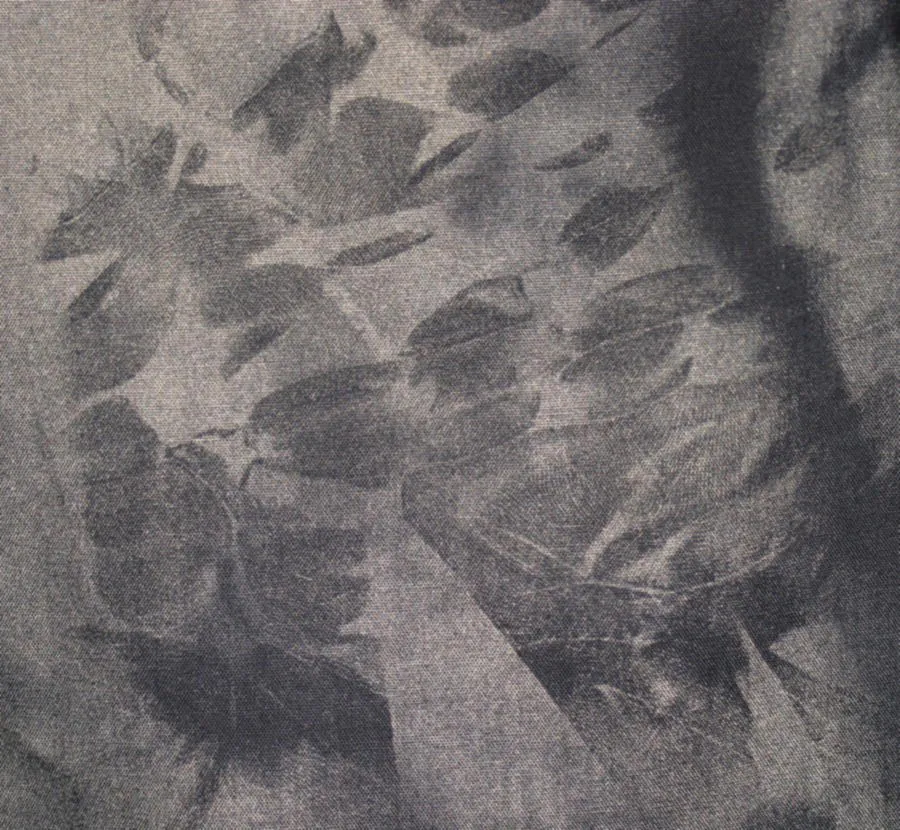
At the coarsest level, the configuration of the palm and fingers during the contact with the surface and their position on it can provide useful contextual information about how the surface was touched or gripped. This can be particularly useful in corroborating or disproving particular accounts of events. Figure 1.1 illustrates a situation where the one individual claimed that an assailant had grasped his shirt, whilst the other individual claimed that he had merely pushed the wearer of the shirt away.
Image described by caption.
Figure 1.1 A contact (grab) mark on a black cotton shirt developed using vacuum metal deposition.
Reproduced courtesy of the Home Office.
The mark that has been revealed suggests that the fabric of the shirt has been gathered together by the hand, and therefore the account of the shirt being grasped by an assailant is more likely than a push with an open hand. Figure 1.2 shows two different orientations of fingermarks on a glass bottle.
A bottle held by a hand (a); fingermarks on a bottle applied with aluminum powder (b); a hand holding a bottle upside down (c); and blood stain and fingermarks in a bottle applied with aluminum powder (d).
Figure 1.2 The orientation of fingermarks on a glass bottle originating from different actions. (a) Bottle being held to drink from. (b) Fingermarks developed using aluminium powder after drinking. (c) Bottle being held as if to strike. (d) Fingermarks developed using aluminium powder after use as a weapon.
In the first case, the bottle has been held whilst drinking from the neck of the bottle. In the second case, the bottle has been gripped as if the bottle has been picked up for use as a weapon. Again, by examination of the configuration of the marks, it may be possible to infer how an item was handled, and this may become evidentially important.
Obviously, there are many more possible scenarios than the two examples presented here, and it should be noted that these are merely illustrative examples. In real casework the propositions (hypotheses) and subsequent examinations are likely to be more complex.
Revealing the distribution of a contaminant (an exogenous material) on the hand may also provide useful information that can be indicative of certain actions. In another example, the firing of a gun will result in the transfer of gunshot residue onto the hands (Figure 1.3). Although the hands can be swabbed to reveal the presence of gunshot residue, if its distribution across the hand can be shown, this may be far more useful in showing that it was much more likely that the gun was held and fired rather than the residue coming from accidental contact. This distribution of contaminant may also be subsequently reproduced in any marks left by the hand.
Image described by caption.
Figure 1.3 A white gelatin lift taken from the back of the hand taken after firing a gun and enhanced using a chemical selectively targeting traces of lead.
Reproduced courtesy of the Home Office.
At a slightly finer level, a closer analysis of the areas of palm and finger contact can also reveal information about the events during the time of contact. Although many of these events may consist of single, light contacts, others may be of longer duration and may include movement of the hand or multiple contacts, for example, as a grip on an object is readjusted. By analysis of the traces left by the contacts, it is possible to ob...

Table of contents

  1. Cover
  2. Title Page
  3. Table of Contents
  4. Series Preface
  5. Acknowledgements
  6. 1 Introduction
  7. 2 Formation of fingermarks
  8. 3 Composition and properties of fingermarks
  9. 4 Ageing of fingermarks
  10. 5 Initial examination and the selection of fingermark enhancement processes
  11. 6 Optical detection and enhancement techniques
  12. 7 Vapour phase techniques
  13. 8 Solid phase selective deposition techniques
  14. 9 Amino acid reagents
  15. 10 Reagents for other eccrine constituents
  16. 11 Lipid reagents
  17. 12 Liquid phase selective deposition techniques
  18. 13 Enhancement processes for marks in blood
  19. 14 Electrical and electrochemical processes
  20. 15 Miscellaneous processes: lifting and specialist imaging
  21. 16 Evaluation and comparison of fingermark enhancement processes
  22. 17 Sequential processing and impact on other forensic evidence
  23. 18 Interpreting the results of fingermark enhancement
  24. Index
  25. End User License Agreement