This ready reference presents environmentally friendly and stereoselective methods of modern biocatalysis. The experienced and renowned team of editors have gathered top international authors for this book. They cover such emerging topics as chemoenzymatic methods and multistep enzymatic reactions, while showing how these novel methods and concepts can be used for practical applications. Multidisciplinary topics, including directed evolution, dynamic kinetic resolution, and continuous-flow methodology are also discussed.
From the contents:
* Directed Evolution of Ligninolytic Oxidoreductases: from Functional Expression to Stabilization and Beyond
* New Trends in the In Situ Enzymatic Recycling of NAD(P)(H) Cofactors
* Monooxygenase-Catalyzed Redox Cascade Biotransformations
* Biocatalytic Redox Cascades Involving w-Transaminases
* Multi-Enzyme Systems and Cascade Reactions Involving Cytochrome P450 Monooxygenases
* Chemo-Enzymatic Cascade Reactions for the Synthesis of Glycoconjugates
* Synergies of Chemistry and Biochemistry for the Production of Beta-Amino Acids
* Racemizable Acyl Donors for Enzymatic Dynamic Kinetic Resolution
* Stereoselective Hydrolase-Catalyzed Processes in Continuous-Flow Mode
* Perspectives on Multienzyme Process Technology
* Nitrile Converting Enzymes Involved in Natural and Synthetic Cascade Reactions
* Mining Genomes for Nitrilases
* Key-Study on the Kinetic Aspects of the In-Situ NHase/AMase Cascade System of M. imperiale Resting Cells for Nitrile Bioconversion
* Enzymatic Stereoselective Synthesis of Beta-Amino Acids
* New Applications of Transketolase: Cascade Reactions for Assay Development
* Aldolases as Catalyst for the Synthesis of Carbohydrates and Analogs
* Enzymatic Generation of Sialoconjugate Diversity
* Methyltransferases in Biocatalysis
* Chemoenzymatic Multistep One-Pot Processes
eBook - ePub
Cascade Biocatalysis
Integrating Stereoselective and Environmentally Friendly Reactions
- English
- ePUB (mobile friendly)
- Available on iOS & Android
eBook - ePub
Cascade Biocatalysis
Integrating Stereoselective and Environmentally Friendly Reactions
About this book
Trusted by 375,005 students
Access to over 1.5 million titles for a fair monthly price.
Study more efficiently using our study tools.
Information
Chapter 1
Directed Evolution of Ligninolytic Oxidoreductases: from Functional Expression to Stabilization and Beyond
Eva Garcia-Ruiz, Diana M. Mate, David Gonzalez-Perez, Patricia Molina-Espeja, Susana Camarero, Angel T. Martínez, Antonio O. Ballesteros, and Miguel Alcalde
1.1 Introduction
The ligninolytic enzymatic consortium, formed mainly by nonspecific oxidoreductases (laccases, peroxidases, and H2O2-supplying oxidases), is a potentially powerful multipurpose tool for industrial and environmental biotechnology. In nature, these enzymes are typically produced by basidiomycete white-rot fungi that are involved in lignin decay. Thanks to their broad substrate specificity, high redox potential, and minimal requirements, these enzymes have many potential applications in the field of green chemistry, including the production of biofuels, bioremediation, organic syntheses, pulp biobleaching, food and textile industries, and the design of bionanodevices. The implementation of this enzymatic armoury in different biotechnological sectors has been hampered by the lack of appropriate molecular instruments (including heterologous hosts for directed evolution) with which to improve their properties. Over the last 10 years, a wealth of directed evolution strategies in combination with hybrid approaches has emerged in order to adapt these oxidoreductases to the drastic conditions associated with many biotechnological settings (e.g., high temperatures, the presence of organic co-solvents, extreme pHs, the presence of inhibitors). This chapter summarizes all efforts and endeavors to convert these ligninolytic enzymes into useful biocatalysts by means of directed evolution: from functional expression to stabilization and beyond.
1.2 Directed Molecular Evolution
Enzymes are versatile biomolecules that exhibit a large repertory of functions acquired over millions of years of natural evolution. Indeed, they are the fastest known catalysts (accelerating chemical reactions as much as 1019-fold) and are environmentally friendly molecules, working efficiently at mild temperatures, in water, and releasing few by-products. Moreover, they can exhibit high enantioselectivity and chemoselectivity. Nonetheless, when an enzyme is removed from its natural environment and introduced into a specific biotechnological location (e.g., the transformation of a hydrophobic compound in the presence of co-solvents or at high temperatures), its molecular structure may not tolerate the extreme operational conditions and may unfold becoming inactive. Unfortunately, the enzymes that cells use to regulate strict metabolic pathways and that promote fitness and survival in nature are not always applicable to the harsh requirements of many industrial processes.
The development of the polymerase chain reaction (PCR) in the early 1980s heralded a biotechnological revolution for protein engineers, allowing us for the first time to manipulate and design enzymes by site-directed mutagenesis supported by known protein structures: the so-called rational design. However, further advances were frustrated owing to the limited understanding of protein function and the lack of protein structures available at the time. Nevertheless, the following decade saw a second biotechnological revolution with the development of directed molecular evolution. This powerful protein engineering tool does not require prior knowledge of protein structure to enhance the known features or to generate novel enzymatic functions, which are not generally required in natural environments. The key events of natural evolution (random mutation, DNA recombination, and selection) are recreated in the laboratory, permitting scientifically interesting and technologically useful enzymes to be designed [1–3]. Diversity is generated by introducing random mutations and/or recombination in the gene encoding a specific protein [4, 5]. In this process, the best performers in each round of evolution are selected and used as the parental types in a new round, a cycle that can be repeated as many times as necessary until a biocatalyst that exhibits the desired traits is obtained: for example, improved stability at high temperatures, extreme pHs, or in the presence of nonconventional media such as organic solvents or ionic fluids; novel catalytic activities; improved specificities and/or modified enantioselectivities; and heterologous functional expression [6–8] (Figure 1.1). Of great interest is the use of directed evolution strategies to engineer ligninolytic oxidoreductases while employing rational approaches to understand the mechanisms underlying each newly evolved property.
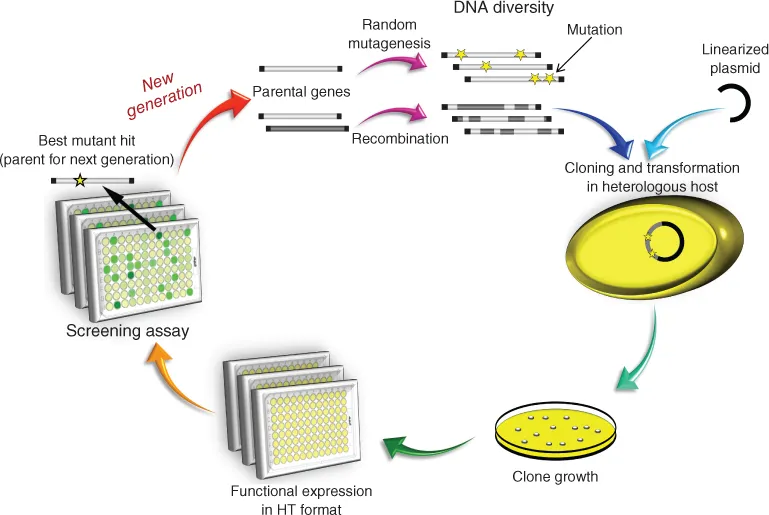
Figure 1.1 Directed molecular evolution. The basic premises to carry out a successful directed evolution experiment are (i) a robust heterologous expression system (typically S. cerevisiae or E. coli); (ii) a reliable high-throughput (HT)-screening assay; and (iii) the use of different molecular tools for the generation of DNA diversity.
1.3 The Ligninolytic Enzymatic Consortium
Lignin is the most abundant natural aromatic polymer and the second most abundant component of plant biomass after cellulose. As a structural part of the plant cell wall, lignin forms a complex matrix that protects cellulose and hemicellulose chains from microbial attack and hence from enzymatic hydrolysis. This recalcitrant and highly heterogeneous biopolymer is synthesized by the dehydrogenative polymerization of three precursors belonging to the p-hydroxycinnamyl alcohol group: p-coumaryl, coniferyl, and sinapyl alcohols [9]. As one-third of the carbon fixed as lignocellulose is lignin, its degradation is considered a key step in the recycling of carbon in the biosphere and in the use of the plant biomass for biotechnological purposes [10, 11]. Lignin is modified and degraded to different extents by a limited number of microorganisms, mainly filamentous fungi and bacteria. Lignin degradation by bacteria is somewhat limited and much slower than that mediated by filamentous fungi [12, 13]. Accordingly, the only organisms capable of completing the mineralization of lignin are the white-rot fungi, which produce a white-colored material upon delignification because of the enrichment in cellulose [14, 15].
Through fungal genome reconstructions, recent studies have linked the formation of coal deposits during the Permo-Carboniferous period (∼260 million years ago) with the nascent and evolution of white-rot fungi and their lignin-degrading enzymes [16]. Lignin combustion by white-rot fungi involves a very complex extracellular oxidative system that includes high-redox potential laccases (HRPLs), peroxidases and unspecific peroxygenases (UPOs), H2O2-supplying oxidases and auxiliary enzymes, as well as radicals of aromatic compounds and oxidized metal ions tha...
Table of contents
- Cover
- Related Titles
- Title Page
- Copyright
- List of Contributors
- Preface
- Chapter 1: Directed Evolution of Ligninolytic Oxidoreductases: from Functional Expression to Stabilization and Beyond
- Chapter 2: New Trends in the In Situ Enzymatic Recycling of NAD(P)(H) Cofactors
- Chapter 3: Monooxygenase-Catalyzed Redox Cascade Biotransformations
- Chapter 4: Biocatalytic Redox Cascades Involving ω-Transaminases
- Chapter 5: Multi-Enzyme Systems and Cascade Reactions Involving Cytochrome P450 Monooxygenases
- Chapter 6: Chemo-Enzymatic Cascade Reactions for the Synthesis of Glycoconjugates
- Chapter 7: Synergies of Chemistry and Biochemistry for the Production of β-Amino Acids
- Chapter 8: Racemizable Acyl Donors for Enzymatic Dynamic Kinetic Resolution
- Chapter 9: Stereoselective Hydrolase-Catalyzed Processes in Continuous-Flow Mode
- Chapter 10: Perspectives on Multienzyme Process Technology
- Chapter 11: Nitrile Converting Enzymes Involved in Natural and Synthetic Cascade Reactions
- Chapter 12: Mining Genomes for Nitrilases
- Chapter 13: Key-Study on the Kinetic Aspects of the In Situ NHase/AMase Cascade System of M. imperiale Resting Cells for Nitrile Bioconversion
- Chapter 14: Enzymatic Stereoselective Synthesis of β-Amino Acids
- Chapter 15: New Applications of Transketolase: Cascade Reactions for Assay Development
- Chapter 16: Aldolases as Catalyst for the Synthesis of Carbohydrates and Analogs
- Chapter 17: Enzymatic Generation of Sialoconjugate Diversity
- Chapter 18: Methyltransferases in Biocatalysis
- Chapter 19: Chemoenzymatic Multistep One-Pot Processes
- Index
- End User License Agreement
Frequently asked questions
Yes, you can cancel anytime from the Subscription tab in your account settings on the Perlego website. Your subscription will stay active until the end of your current billing period. Learn how to cancel your subscription
No, books cannot be downloaded as external files, such as PDFs, for use outside of Perlego. However, you can download books within the Perlego app for offline reading on mobile or tablet. Learn how to download books offline
Perlego offers two plans: Essential and Complete
- Essential is ideal for learners and professionals who enjoy exploring a wide range of subjects. Access the Essential Library with 800,000+ trusted titles and best-sellers across business, personal growth, and the humanities. Includes unlimited reading time and Standard Read Aloud voice.
- Complete: Perfect for advanced learners and researchers needing full, unrestricted access. Unlock 1.5M+ books across hundreds of subjects, including academic and specialized titles. The Complete Plan also includes advanced features like Premium Read Aloud and Research Assistant.
We are an online textbook subscription service, where you can get access to an entire online library for less than the price of a single book per month. With over 1.5 million books across 990+ topics, we’ve got you covered! Learn about our mission
Look out for the read-aloud symbol on your next book to see if you can listen to it. The read-aloud tool reads text aloud for you, highlighting the text as it is being read. You can pause it, speed it up and slow it down. Learn more about Read Aloud
Yes! You can use the Perlego app on both iOS and Android devices to read anytime, anywhere — even offline. Perfect for commutes or when you’re on the go.
Please note we cannot support devices running on iOS 13 and Android 7 or earlier. Learn more about using the app
Please note we cannot support devices running on iOS 13 and Android 7 or earlier. Learn more about using the app
Yes, you can access Cascade Biocatalysis by Sergio Riva, Wolf-Dieter Fessner, Sergio Riva,Wolf-Dieter Fessner in PDF and/or ePUB format, as well as other popular books in Sciences biologiques & Biotechnologie. We have over 1.5 million books available in our catalogue for you to explore.