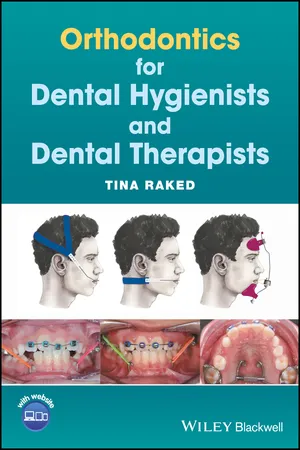
Orthodontics for Dental Hygienists and Dental Therapists
eBook - ePub

Orthodontics for Dental Hygienists and Dental Therapists

  1. English
  2. ePUB (mobile friendly)
  3. Available on iOS & Android
eBook - ePub

Orthodontics for Dental Hygienists and Dental Therapists

About this book

Covers essential orthodontic theory for dental hygienists and dental therapists 

Clear, comprehensive, and easy to read, Orthodontics for Dental Hygienists and Dental Therapists outlines orthodontic theory and explains clinical techniques, without assuming prior knowledge. By learning the orthodontic mechanics and fundamentals, dental hygiene and therapy students can become valuable team members in an orthodontic practice.

Written in a student-friendly style, the text begins by outlining craniofacial growth and tooth development, orthodontic assessment, and biomechanics and anchorage, before introducing fixed and removable appliances, class I, II and III treatment principles, and cleft palate treatment, and ending with a chapter on adult orthodontics. 

  • Student-friendly guide to essential orthodontic theory and clinical techniques for dental hygienists, dental therapists, and oral health therapists
  • Superbly illustrated with explanations on terminologies, orthodontic appliances, instruments, and procedures
  • Features multiple choice questions at the end of each chapter and interactive self-assessment questions on a companion website to help you test your knowledge

The ideal overall introduction to orthodontics, Orthodontics for Dental Hygienists and Dental Therapists is an indispensable companion for those wishing to pursue a career in orthodontic practices after graduation.

Trusted by 375,005 students

Access to over 1.5 million titles for a fair monthly price.

Study more efficiently using our study tools.

Information

Year
2017
Print ISBN
9781119251880
eBook ISBN
9781119251866
Edition
1
Subtopic
Dentistry

1
Scope of Practice and Competency

Dental care services may require a team of dental professionals to carry out the necessary treatments. There are several divisions for registered dental practitioners in different types of healthcare settings with diverse scopes of practice based on their training, education and competence. These divisions in the dental industry vary greatly between countries.

Dentists

Dentists are independent practitioners with a range of responsibilities associated with assessment, prevention, diagnosis, treatment and management of dental lesions, deformities, traumas and diseases of human teeth and associated structures. Care is provided to patients of all ages. Dentists can practise all aspects of dentistry that is within their education, training and competency and can further pursue a specialist training to become dental specialists in various fields of dentistry. Examples of these specialties include:
  • orthodontics
  • endodontics
  • oral and maxillofacial surgery
  • oral pathology
  • oral surgery
  • periodontics
  • paediatric dentistry
  • prosthodontics
  • special needs dentistry.

Oral Health Therapists

This dual‐qualified programme provides graduates with sufficient knowledge of all aspects of dental hygiene and dental therapy. In a general dental setting, the scope is to provide assessment, diagnosis and treatment for children and adolescents, working closely with dentists. Depending on the national board approved programme, the treatment can be carried out for patients of all ages. The scope is regulated to preventative services, restorative work and fillings, extraction of deciduous teeth, treatment of periodontal diseases, oral health education and promotion. Oral health therapists work closely with specialists in an orthodontic setting to carry out the treatment plan designed by the orthodontist. Based on the training and education provided in the programme, the level of competency greatly varies.

Dental Hygienists

Assessment, diagnosis, treatment and management of mild to moderate periodontal diseases are the primary roles of dental hygienists. Treating severe periodontal cases with a surgical approach is beyond the scope of dental hygienists. In these instances, dental hygienists work closely with periodontists to manage the condition. The main role is oral health education and prevention of oral diseases in patients of all ages, by promoting better oral health and hygiene. In a general dental setting, dental hygienists only work within a structured professional relationship with dentists. In the orthodontic setting, dental hygienists work under the guidance and supervision of an orthodontist.

Dental Therapists

The primary role of the dental therapist is assessment, diagnosis and management of dental caries. This is achieved by providing preventative care services, pulpotomies and extraction of deciduous teeth, restorative procedures for children and adolescents. Depending on the national board approved programmes, the age limits vary and some scopes allow treatment for patients of all ages. One of the key roles of dental therapists is enhancing better oral health with oral health promotion and education for patients of all ages. Dental therapists are only permitted to work within a structured professional relationship established with dentists.

Orthodontic Treatment

The scope of orthodontics is not narrowed solely to straightening teeth. The field of orthodontics is about treatment of irregularities in growth and development of the orofacial complex, enhancing function and aesthetics. Orthodontic treatment contributes to improving the physical and mental wellbeing of the patient. A team approach by dental professionals is needed to achieve successful outcomes and to provide the patient with a pleasant experience. Some cases may require a team of specialists cooperating together to guide the patient towards their orthodontic goal and providing them with a balanced facial appearance, healthy periodontium and a functional occlusion with an aesthetically pleasing smile.
In an orthodontic practice, oral health therapists, dental therapists and dental hygienists work closely with orthodontists to carry out the treatment plan under the supervision of the specialist. The level of training of dental practitioners varies greatly worldwide. Thus, for efficient and quality dental treatment, it is critical to confirm the limitations and scope of practice within each state or country before any form of clinical practice. Oral health therapists, dental hygienists and dental therapists can be valuable team members in an orthodontic setting, but they also play an important role in general dental clinics. A greater knowledge of orthodontics is therefore essential for these practitioners to help to monitor dental growth and development closely during regular dental visits and to make appropriate referrals as required.
Every orthodontist will manage their patients differently based on their education and training. Over the years, there have been well‐known specialists who have contributed to the evolution of orthodontics by introducing advanced and contemporary techniques and appliances. There can be numerous ways to reach a common goal using various treatment options and appliances. These goals may not always be what the specialist considers as the norm or ideal. The treatment objective is to address the chief complaint and to respect the goals and objectives requested by the patient.
There is sufficient knowledge and understanding of the ideal occlusion. One scheme that is well known and used as guidance by many specialists is Andrews’ six keys (Andrews, 1972). An ideal occlusion is shown in Figure 1.1. The six keys are as follows:
  1. Correct molar relationship
  2. Correct crown angulation
  3. Correct crown inclination
  4. No rotations
  5. No spaces
  6. Flat occlusal plane.
Right buccal view (left), front buccal view (middle), and left buccal view (right) of normal occlusion.
Figure 1.1 Normal occlusion.
Source: Courtesy of Professor Ali Darendeliler.
A variety of treatment options can be outlined to reach the desired goals. These goals and procedures must be discussed in depth and approved by the patient. A treatment plan may indicate the need or combination of the following:
  • extractions
  • functional appliances (influences dentoalveolar and muscular changes)
  • orthopaedic appliances (stimulate bone growth and position)
  • removable appliances
  • full/partial upper and lower fixed appliances
  • single arch fixed appliances
  • orthognathic surgery
  • acceptance of the malocclusion.
Typically, treatment in deciduous dentition is not indicated and is delayed until early mixed dentition, with an exception for significant facial asymmetry and craniofacial deformities. Early treatment aids in minimising the severity of the orthodontic problem and reduces the need for complex treatment o...

Table of contents

  1. Cover
  2. Title Page
  3. Table of Contents
  4. Preface
  5. Acknowledgements
  6. About the Companion Website
  7. 1 Scope of Practice and Competency
  8. 2 Growth and Development
  9. 3 Orthodontic Assessment and Treatment Planning Strategies
  10. 4 Biomechanics and Treatment Principles
  11. 5 Fixed Appliances and Orthodontic Instruments
  12. 6 Treatment for Class I Malocclusion
  13. 7 Treatment for Class II Malocclusion
  14. 8 Treatment for Class III Malocclusion
  15. 9 Treatment for Cleft Palate
  16. 10 Retention
  17. 11 Adult Orthodontics
  18. Self‐Evaluation Answers
  19. Index
  20. End User License Agreement

Frequently asked questions

Yes, you can cancel anytime from the Subscription tab in your account settings on the Perlego website. Your subscription will stay active until the end of your current billing period. Learn how to cancel your subscription
No, books cannot be downloaded as external files, such as PDFs, for use outside of Perlego. However, you can download books within the Perlego app for offline reading on mobile or tablet. Learn how to download books offline
Perlego offers two plans: Essential and Complete
  • Essential is ideal for learners and professionals who enjoy exploring a wide range of subjects. Access the Essential Library with 800,000+ trusted titles and best-sellers across business, personal growth, and the humanities. Includes unlimited reading time and Standard Read Aloud voice.
  • Complete: Perfect for advanced learners and researchers needing full, unrestricted access. Unlock 1.5M+ books across hundreds of subjects, including academic and specialized titles. The Complete Plan also includes advanced features like Premium Read Aloud and Research Assistant.
Both plans are available with monthly, semester, or annual billing cycles.
We are an online textbook subscription service, where you can get access to an entire online library for less than the price of a single book per month. With over 1.5 million books across 990+ topics, we’ve got you covered! Learn about our mission
Look out for the read-aloud symbol on your next book to see if you can listen to it. The read-aloud tool reads text aloud for you, highlighting the text as it is being read. You can pause it, speed it up and slow it down. Learn more about Read Aloud
Yes! You can use the Perlego app on both iOS and Android devices to read anytime, anywhere — even offline. Perfect for commutes or when you’re on the go.
Please note we cannot support devices running on iOS 13 and Android 7 or earlier. Learn more about using the app
Yes, you can access Orthodontics for Dental Hygienists and Dental Therapists by Tina Raked in PDF and/or ePUB format, as well as other popular books in Medicine & Dentistry. We have over 1.5 million books available in our catalogue for you to explore.