New Code of Estimating Practice
eBook - ePub

New Code of Estimating Practice

,
  1. English
  2. ePUB (mobile friendly)
  3. Available on iOS & Android
eBook - ePub

New Code of Estimating Practice

,

About this book

The essential, authoritative guide to providing accurate, systematic, and reliable estimating for construction projects—newly revised

Pricing and bidding for construction work is at the heart of every construction business, and in the minds of construction consultants' poor bids lead to poor performance and nobody wins. New Code of Estimating Practice examines the processes of estimating and pricing, providing best practice guidelines for those involved in procuring and pricing construction works, both in the public and private sectors. It embodies principles that are applicable to any project regardless of size or complexity.

This authoritative guide has been completely rewritten to include much more contextual and educational material as well as the code of practice. It covers changes in estimating practice; the bidding process; the fundamentals in formulating a bid; the pre-qualification process; procurement options; contractual arrangements and legal issues; preliminaries; temporary works; cost estimating techniques; risk management; logistics; resource and production planning; computer-aided estimating; information and time planning; resource planning and pricing; preparation of an estimator's report; bid assembly and adjudication; pre-production planning and processes; and site production.

  • Established standard for the construction industry, providing the only code of practice on construction estimating
  • Prepared under the auspices of the Chartered Institute of Building and endorsed by a range of other professional bodies
  • Completely rewritten since the 7th edition, to include much more contextual and educational material, as well as the core code of practice

New Code of Estimating Practice is an important book for construction contractors, specialist contractors, quantity surveyors/cost consultants, and for students of construction and quantity surveying.
Tools to learn more effectively

Saving Books

Saving Books

Keyword Search

Keyword Search

Annotating Text

Annotating Text

Listen to it instead

Listen to it instead

Section One
Principles – the theory and background

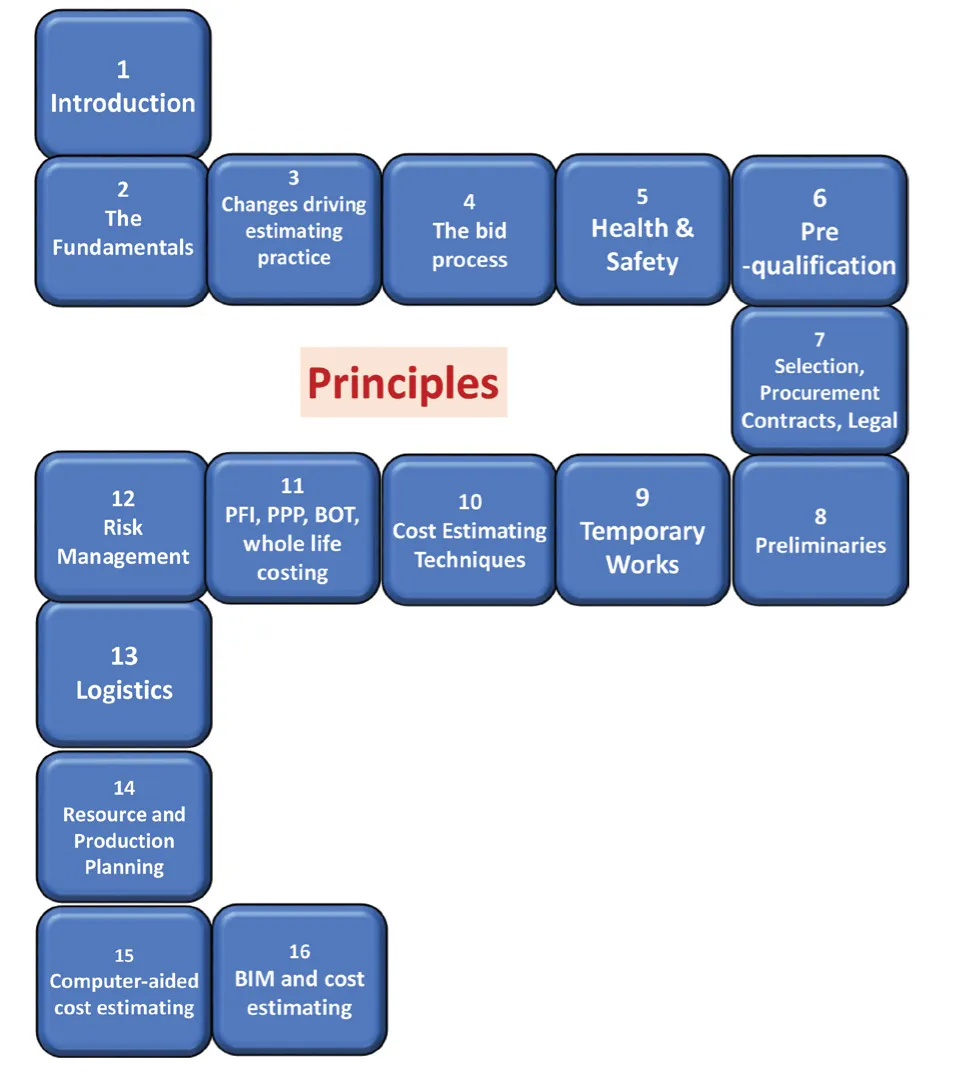
The Principles section is made up of 16 chapters which can be accessed by selecting a square in the graphic below. The order of the chapters is not significant; they are designed to be stand‐alone, providing a reference document for the reader.
Graphical illustration of interpretation of probability-related terms.

Chapter 1
Introduction

Estimating is the systematic analytical calculation of projected labour, material, plant, equipment and overhead costs for a project. The aim is to produce the most accurate, reliable and best estimates, inclusive of contingencies reflecting the project risks, using the most reliable and complete project and pricing information available at the time the estimate is prepared.
The terms cost, price, estimating and cost estimating are used extensively in the New CoEP. Cost is the expense that an organisation incurs in bringing a product or service to market. Price is the amount a customer pays for that product or service. The difference between the price that is paid and the cost that is incurred is the profit. Cost is often split into two elements: the variable cost (costs that vary in proportion to the turnover) and fixed costs (costs that are required, but that do not vary as output varies). An estimate is the judgement of the resources required based upon the best information available.
This New Code of Estimating Practice (CoEP) provides users with recommendations for accepted good practice. It reflects the changing practices of estimating, pricing and bidding for work in the construction sector. The CoEP sets out procedures and practice that can assist estimators in pricing the work and other bid preparation professionals to establish and maintain a set of procedures for estimating, tailored to the needs of their particular company.
Some of the procedures set out may be unnecessary or too complex for some organisations because of the nature of the work being undertaken. However, the underlying principles are generally applicable and should be borne in mind. The principles are equally applicable for public and private sector building and civil engineering works and for use by micro, small, medium and large contractors on small, medium and large projects.
Estimating is involved from the strategic definition stage of a project, through the design, tendering and production stage, up to completion and use. It ensures construction organisations can survive in the highly competitive market place by securing work at the right price, whilst the risks have been considered and taken into account.
English Dictionary definition of estimate: roughly calculate or judge the value/number/quantity/extent of, approximate, make an estimate of, guess, evaluate, judge, gauge, reckon, rate, appraise, form an opinion of, form an impression of, get the measure of, determine, weigh up.
Every organisation involved in construction from contractors to suppliers and manufacturers must have good, robust, reliable, accurate, estimating and feedback systems in order to survive.

1.1 An imprecise science

Estimating cannot be a precise science; it deals with uncertainty and many unknowns. Assumptions have to be made about the weather, ground conditions, productivity factors, inflation and the mitigation of risk.
People are the most important element; computer systems and software have helped, but lack of information will inevitably cause difficulties for the estimator. Estimators/bid managers * have to be innovative and creative in the way they address tender responses. Every acti...

Table of contents

  1. Cover
  2. Title page
  3. Copyright
  4. Table of Contents
  5. Foreword
  6. Glossary
  7. Code of estimating and tendering practice – principles and proceduresMarch 2018
  8. Foreword
  9. Section One: Principles – the theory and background
  10. Section Two: Processes – the practice
  11. Bibliography and References
  12. Index
  13. End User License Agreement

Frequently asked questions

Yes, you can cancel anytime from the Subscription tab in your account settings on the Perlego website. Your subscription will stay active until the end of your current billing period. Learn how to cancel your subscription
No, books cannot be downloaded as external files, such as PDFs, for use outside of Perlego. However, you can download books within the Perlego app for offline reading on mobile or tablet. Learn how to download books offline
Perlego offers two plans: Essential and Complete
  • Essential is ideal for learners and professionals who enjoy exploring a wide range of subjects. Access the Essential Library with 800,000+ trusted titles and best-sellers across business, personal growth, and the humanities. Includes unlimited reading time and Standard Read Aloud voice.
  • Complete: Perfect for advanced learners and researchers needing full, unrestricted access. Unlock 1.4M+ books across hundreds of subjects, including academic and specialized titles. The Complete Plan also includes advanced features like Premium Read Aloud and Research Assistant.
Both plans are available with monthly, semester, or annual billing cycles.
We are an online textbook subscription service, where you can get access to an entire online library for less than the price of a single book per month. With over 1 million books across 990+ topics, we’ve got you covered! Learn about our mission
Look out for the read-aloud symbol on your next book to see if you can listen to it. The read-aloud tool reads text aloud for you, highlighting the text as it is being read. You can pause it, speed it up and slow it down. Learn more about Read Aloud
Yes! You can use the Perlego app on both iOS and Android devices to read anytime, anywhere — even offline. Perfect for commutes or when you’re on the go.
Please note we cannot support devices running on iOS 13 and Android 7 or earlier. Learn more about using the app
Yes, you can access New Code of Estimating Practice by in PDF and/or ePUB format, as well as other popular books in Technology & Engineering & Construction & Architectural Engineering. We have over one million books available in our catalogue for you to explore.