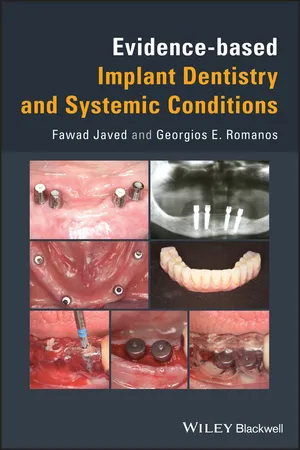
Evidence-based Implant Dentistry and Systemic Conditions
eBook - ePub

Evidence-based Implant Dentistry and Systemic Conditions

  1. English
  2. ePUB (mobile friendly)
  3. Available on iOS & Android
eBook - ePub

Evidence-based Implant Dentistry and Systemic Conditions

About this book

Evidence-based Implant Dentistry and Systemic Conditions provides essential information on the osseointegration and survival of dental implants in medically challenged patients.Ā 

  • Aggregates the major research on the impact of systemic conditions on implant therapy success
  • Discusses a range of conditions, including oral and systemic cancers, AIDS, osteonecrosis, arthritis, and more
  • Provides clinical recommendations for every condition listed
  • Compiles studies from indexed databases such as PubMed, MEDLINE, ISI web of knowledge, Scopus, and EMBASE

Ā 

Trusted byĀ 375,005 students

Access to over 1.5 million titles for a fair monthly price.

Study more efficiently using our study tools.

Information

Year
2018
Print ISBN
9781119212249
eBook ISBN
9781119212263
Edition
1
Subtopic
Dentistry

1
Introduction

For centuries, dental practitioners have relied on partial dentures, complete dentures, and fixed prosthesis (such as bridges) for the replacement of missing teeth. Dental implants have revolutionized modern clinical practice and are a contemporary substitute to such traditional fixed and removable dental prosthesis. It is well known that dental implants can osseointegrate and remain functionally and aesthetically stable over long durations in patients with missing teeth. Studies have reported high success and survival rates of dental implants in systemically healthy individuals; however, dental implant therapy has also been reported to be successful among patients with systemic disorders, such as diabetes mellitus and acquired immune deficiency syndrome (AIDS).
This book provides essential information on the osseointegration and survival of dental implants in medically challenged patients. In this book, we compiled studies from indexed databases (including PubMed, MEDLINE, ISI web of knowledge, Scopus, and EMBASE) with reference to their impact on the survival and success of dental implants. These studies have formulated into individual chapters focusing on specific focused questions and data has been presented using a systematic review approach. The content of this book is centered on evidence‐based dental implant therapy among patients with systemic diseases. Moreover, each chapter discusses the outcomes of the respective studies and recommendations for future research are also presented.

2
Evidence‐Based Grading of Studies

This book follows an evidence‐based grading approach in order to make judgments about quality of evidence and strength of the study/studies included in each chapter. This approach will give researchers, clinicians, and students a clear overview of the level of scientific evidence relating to each chapter. This grading system is based on the methodology adopted across studies.
Level of Evidence Grade
A Evidence from randomized controlled trials
B Evidence from at least one randomized controlled trial
C Evidence from at least one well designed case‐control study
D Evidence from at least one well‐designed clinical study that was not randomized
E No evidence

3
Dental Implants in Adult Patients with Autism Spectrum Disorders

Introduction

Autism spectrum disorder, or ASD, is a group of developmental disorders that includes a variety/spectrum of symptoms, skills, and levels of disability (Scott et al., 2017). Patients with ASD usually have these characteristics: (a) Ongoing social problems such as resistance to communication and interaction with others; (b) repetitive behaviors and limited interests or activities; (c) Symptoms that hurt an individuals’ ability to function in various areas of life (Scott et al., 2017). The precise etiology of ASD remains unclear; however, a number of risk factors have been associated with the etiology of ASD. These include genetic factors (genetic differences associated with the X chromosome), neurobiological factors (problems with genetic code development involving multiple brain regions), and environmental factors (exposure to drugs and environmental toxicants) (Abrahams and Geschwind, 2010; Coe et al., 2012a; Coe et al., 2012b; Landrigan et al., 2012).
A compromised oral health status has been reported in adult patients with ASD. In a study from Sweden, dental caries and periodontal health status were assessed among 47 adults with ASD and 69 age‐ and gender‐matched controls (Blomqvist et al., 2015). The results showed a significantly reduced stimulated salivary flow rate among patients with ASD as compared to controls. Buccal gingival recession was more often manifested in patients with ASD than controls (Blomqvist et al., 2015). Although there was no statistically significant difference in dental caries among patients with and without ASD, the authors hypothesized that adults with ASD are more susceptible to dental caries than healthy adults, most likely as a consequence of a reduced salivary flow rate in ASD adults (Blomqvist et al., 2015). However, in another study, a statistically significant association was reported between ASD and the prevalence of dental caries. Other oral manifestations among adults with ASD are bruxism, self‐perpetrate...

Table of contents

  1. Cover
  2. Table of Contents
  3. Preface
  4. 1 Introduction
  5. 2 Evidence‐Based Grading of Studies
  6. 3 Dental Implants in Adult Patients with Autism Spectrum Disorders
  7. 4 Dental Implants in Patients with Cardiovascular Disorders
  8. 5 Dental Implants in Patients with Crohn’s Disease
  9. 6 Dental Implants in Patients with Eating Disorders
  10. 7 Dental Implants in Patients with Epilepsy
  11. 8 Dental Implants in Patients with Hepatic Disorders
  12. 9 Dental Implants in Patients with Diabetes Mellitus
  13. 10 Impact of Oral Cancer Therapy on the Survival of Dental Implants
  14. 11 Oral Cancer Arising around Dental Implants
  15. 12 Dental Implants in Patients with Periodontitis
  16. 13 Success and Survival of Dental Implants during Pregnancy
  17. 14 Dental Implants in Patients with Psychological/Psychiatric Disorders
  18. 15 Dental Implants in Patients Using Recreational Drugs
  19. 16 Dental Implants in Patients with Renal Disorders
  20. 17 Dental Implants in Patients with Rheumatic Diseases
  21. 18 Dental Implants in Patients with Scleroderma
  22. 19 Dental Implants in Patients with Sjƶgren’s Syndrome
  23. 20 Dental Implants in Patients Who Habitually Use Smokeless Tobacco Products
  24. 21 Dental Implants in Patients who Habitually Smoke Tobacco
  25. 22 Dental Implants in Patients with Genetic Disorders
  26. 23 Dental Implants in Patients with Human Immunodeficiency Virus Infection or Acquired Immune Deficiency Syndrome
  27. Index
  28. End User License Agreement

Frequently asked questions

Yes, you can cancel anytime from the Subscription tab in your account settings on the Perlego website. Your subscription will stay active until the end of your current billing period. Learn how to cancel your subscription
No, books cannot be downloaded as external files, such as PDFs, for use outside of Perlego. However, you can download books within the Perlego app for offline reading on mobile or tablet. Learn how to download books offline
Perlego offers two plans: Essential and Complete
  • Essential is ideal for learners and professionals who enjoy exploring a wide range of subjects. Access the Essential Library with 800,000+ trusted titles and best-sellers across business, personal growth, and the humanities. Includes unlimited reading time and Standard Read Aloud voice.
  • Complete: Perfect for advanced learners and researchers needing full, unrestricted access. Unlock 1.5M+ books across hundreds of subjects, including academic and specialized titles. The Complete Plan also includes advanced features like Premium Read Aloud and Research Assistant.
Both plans are available with monthly, semester, or annual billing cycles.
We are an online textbook subscription service, where you can get access to an entire online library for less than the price of a single book per month. With over 1.5 million books across 990+ topics, we’ve got you covered! Learn about our mission
Look out for the read-aloud symbol on your next book to see if you can listen to it. The read-aloud tool reads text aloud for you, highlighting the text as it is being read. You can pause it, speed it up and slow it down. Learn more about Read Aloud
Yes! You can use the Perlego app on both iOS and Android devices to read anytime, anywhere — even offline. Perfect for commutes or when you’re on the go.
Please note we cannot support devices running on iOS 13 and Android 7 or earlier. Learn more about using the app
Yes, you can access Evidence-based Implant Dentistry and Systemic Conditions by Georgios E. Romanos,Fawad Javed in PDF and/or ePUB format, as well as other popular books in Medicine & Dentistry. We have over 1.5 million books available in our catalogue for you to explore.