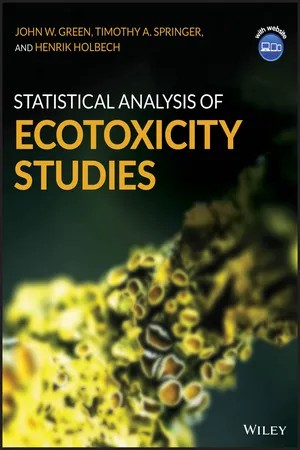
Statistical Analysis of Ecotoxicity Studies
eBook - ePub

Statistical Analysis of Ecotoxicity Studies

  1. English
  2. ePUB (mobile friendly)
  3. Available on iOS & Android
eBook - ePub

Statistical Analysis of Ecotoxicity Studies

About this book

A guide to the issues relevant to the design, analysis, and interpretation of toxicity studies that examine chemicals for use in the environment

Statistical Analysis of Ecotoxicity Studies offers a guide to the design, analysis, and interpretation of a range of experiments that are used to assess the toxicity of chemicals. While the book highlights ecotoxicity studies, the methods presented are applicable to the broad range of toxicity studies. The text contains myriad datasets (from laboratory and field research) that clearly illustrate the book's topics. The datasets reveal the techniques, pitfalls, and precautions derived from these studies.

The text includes information on recently developed methods for the analysis of severity scores and other ordered responses, as well as extensive power studies of competing tests and computer simulation studies of regression models that offer an understanding of the sensitivity (or lack thereof) of various methods and the quality of parameter estimates from regression models. The authors also discuss the regulatory process indicating how test guidelines are developed and review the statistical methodology in current or pending OECD and USEPA ecotoxicity guidelines. This important guide:

  • Offers the information needed for the design and analysis to a wide array of ecotoxicity experiments and to the development of international test guidelines used to assess the toxicity of chemicals
  • Contains a thorough examination of the statistical issues that arise in toxicity studies, especially ecotoxicity
  • Includes an introduction to toxicity experiments and statistical analysis basics
  • Includes programs in R and excel
  • Covers the analysis of continuous and Quantal data, analysis of data as well as Regulatory Issues
  • Presents additional topics (Mesocosm and Microplate experiments, mixtures of chemicals, benchmark dose models, and limit tests) as well as software

Written for directors, scientists, regulators, and technicians, Statistical Analysis of Ecotoxicity Studies provides a sound understanding of the technical and practical issues in designing, analyzing, and interpreting toxicity studies to support or challenge chemicals for use in the environment.

Trusted byĀ 375,005 students

Access to over 1 million titles for a fair monthly price.

Study more efficiently using our study tools.

Information

Publisher
Wiley
Year
2018
Print ISBN
9781119088349
eBook ISBN
9781119488811

Chapter 1
An Introduction to Toxicity Experiments

This chapter introduces some basic concepts that apply to all chapters. It begins with a discussion of the nature of toxicology or ecotoxicology studies that distinguish them from experiments more generally. Then some basic experimental design issues are discussed, such as types of control groups, replicates and pseudo‐replicates, and units of analysis. The various types of responses that occur are introduced, with pointers to chapters in which methods of statistical analysis of the various types of response are developed. An introduction is given to the use of historical controls and how these studies relate to regulatory risk assessment of chemicals in the environment. Then a hierarchy of statistical models is provided that, in broad terms, defines the statistics used in this field of study and, specifically, in this text. Finally, a topic is introduced that is the cause of considerable tension in ecotoxicology and biological analysis of data in general, namely the difference between biological and statistical significance.

1.1 NATURE AND PURPOSE OF TOXICITY EXPERIMENTS

The purpose of a toxicity experiment is to obtain a quantifiable measure of how toxic a given substance is to a group of organisms or community of organisms. The primary purpose of this book is to describe the design and statistical analysis of laboratory experiments on groups of organisms of a single species exposed to controlled levels of a substance thought to have the potential to produce an adverse effect on the test organisms. Such experiments have the goal of quantifying the level of exposure to the substance that has an adverse effect of biological concern. Some consideration is also given to how information from multiple toxicity experiments on different species can be combined to assess the adverse effect of the test substance on an ecological community. This chapter is intended to provide a general overview of toxicity studies and an introduction to the topics covered in this book.

1.1.1 Designed Experiments Compared to Observational Studies

Historically, the toxicity of chemicals has been studied using experiments performed under carefully controlled conditions in the laboratory and by observation of responses in uncontrolled settings such as the environment. Observational studies that gather information by survey or monitoring have the advantage of providing insight into toxicological responses under real‐world conditions. Such studies are valuable in alerting researchers to potential problems resulting from chemical exposure. However, in surveys and monitoring studies, many uncontrolled factors can affect responses, and exposure of organisms to a chemical of interest (e.g. dose and concentration) usually cannot be estimated accurately. As a result, conclusions concerning the relationship between possible toxicological responses and exposure to the chemical are difficult to establish with certainty.
On the other hand, designed experiments typically control most of the factors that affect response, and dose or exposure concentration can be accurately measured. Designed experiments performed in a laboratory are usually performed at constant temperature with constant exposure to a test substance. Control of test substance exposure and other experimental factors allow the relationship between exposure and response to be modeled.
Exposure to the test substance in these experiments may be: via food or water ingested, air breathed, from contact with the soil or sediment or contact with spray application or spray drift on plants, through gavage or intravenous injection, or by direct application to the skin or eyes. The measure of exposure can be the concentration in the food or water or air, the quantity of chemical per unit of body weight, the quantity of chemical per unit of land area, or the concentration of the chemical in the blood.
Toxicity experiments are generally classified as a...

Table of contents

  1. Cover
  2. Table of Contents
  3. Preface
  4. Chapter 1: An Introduction to Toxicity Experiments
  5. Chapter 2: Statistical Analysis Basics
  6. Chapter 3: Analysis of Continuous Data
  7. Chapter 4: Analysis of Continuous Data
  8. Chapter 5: Analysis of Continuous Data with Additional Factors
  9. Chapter 6: Analysis of Quantal Data
  10. Chapter 7: Analysis of Quantal Data
  11. Chapter 8: Analysis of Count Data
  12. Chapter 9: Analysis of Ordinal Data
  13. Chapter 10: Time‐to‐Event Data
  14. Chapter 11: Regulatory Issues
  15. Chapter 12: Species Sensitivity Distributions
  16. Chapter 13: Studies with Greater Complexity
  17. Appendix 1: Dataset
  18. Appendix 2: Mathematical Framework
  19. Appendix 3: Tables
  20. References
  21. Author Index
  22. Subject Index
  23. End User License Agreement

Frequently asked questions

Yes, you can cancel anytime from the Subscription tab in your account settings on the Perlego website. Your subscription will stay active until the end of your current billing period. Learn how to cancel your subscription
No, books cannot be downloaded as external files, such as PDFs, for use outside of Perlego. However, you can download books within the Perlego app for offline reading on mobile or tablet. Learn how to download books offline
Perlego offers two plans: Essential and Complete
  • Essential is ideal for learners and professionals who enjoy exploring a wide range of subjects. Access the Essential Library with 800,000+ trusted titles and best-sellers across business, personal growth, and the humanities. Includes unlimited reading time and Standard Read Aloud voice.
  • Complete: Perfect for advanced learners and researchers needing full, unrestricted access. Unlock 1.4M+ books across hundreds of subjects, including academic and specialized titles. The Complete Plan also includes advanced features like Premium Read Aloud and Research Assistant.
Both plans are available with monthly, semester, or annual billing cycles.
We are an online textbook subscription service, where you can get access to an entire online library for less than the price of a single book per month. With over 1 million books across 990+ topics, we’ve got you covered! Learn about our mission
Look out for the read-aloud symbol on your next book to see if you can listen to it. The read-aloud tool reads text aloud for you, highlighting the text as it is being read. You can pause it, speed it up and slow it down. Learn more about Read Aloud
Yes! You can use the Perlego app on both iOS and Android devices to read anytime, anywhere — even offline. Perfect for commutes or when you’re on the go.
Please note we cannot support devices running on iOS 13 and Android 7 or earlier. Learn more about using the app
Yes, you can access Statistical Analysis of Ecotoxicity Studies by John W. Green,Timothy A. Springer,Henrik Holbech in PDF and/or ePUB format, as well as other popular books in Physical Sciences & Industrial & Technical Chemistry. We have over one million books available in our catalogue for you to explore.