Triangulations, and more precisely meshes, are at the heart of many problems relating to a wide variety of scientific disciplines, and in particular numerical simulations of all kinds of physical phenomena. In numerical simulations, the functional spaces of approximation used to search for solutions are defined from meshes, and in this sense these meshes play a fundamental role. This strong link between the meshes and functional spaces leads us to consider advanced simulation methods in which the meshes are adapted to the behaviors of the underlying physical phenomena. This book presents the basic elements of this meshing vision.
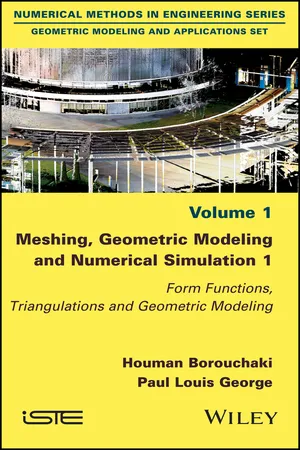
eBook - ePub
Meshing, Geometric Modeling and Numerical Simulation 1
Form Functions, Triangulations and Geometric Modeling
- English
- ePUB (mobile friendly)
- Available on iOS & Android
eBook - ePub
Meshing, Geometric Modeling and Numerical Simulation 1
Form Functions, Triangulations and Geometric Modeling
About this book
Information
Chapter 1
Finite Elements and Shape Functions
There is a wide range of existing literature on finite elements, both on theoretical aspects (for example [Oden, Reddy-1977], [Ciarlet-1978], [Hughes-1987], [Ciarlet-1991]) and on practical aspects ([Zienkiewicz, Taylor-1989], [Bathe-1996], [Dhatt et al. 2007]). The purpose of this chapter, therefore, is not to provide yet another description of this method, but rather to introduce a point of view that is strongly oriented toward the underlying geometric aspects. Indeed, classically, these are all the aspects of approximations of functions (polynomial space or others, convergence, convergence rate, etc.) that are examined. We will, thus, only review basic definitions related to finite elements1, as well as their shape functions. The classic case of finite elements whose degrees of freedom are nodal values of the considered functions (in other words, like Lagrange elements) is described for complete elements, reduced elements as well as rational elements. The less common finite elements such as Hermite elements, for example, where nodal or other derivatives are involved are not explicitly considered2.
1.1. Basic concepts
The finite elements method allows us to calculate an approximate solution to a problem formulated in terms of a system of partial derivatives over a continuum Ω across two related approximations: a spatial approximation and an approximation for calculated solutions. The physical problem under study is modeled by a system of partial derivatives equations that constitutes a continuous problem with its operators, parameters, data and boundary conditions. The finite element method consists of searching for solutions in a particular space of functions (a Sobolev space) that is bu...
Table of contents
- Cover
- Table of Contents
- Dedication
- Title
- Copyright
- Foreword
- Introduction
- Chapter 1: Finite Elements and Shape Functions
- Chapter 2: Lagrange and Bézier Interpolants
- Chapter 3: Geometric Elements and Geometric Validity
- Chapter 4: Triangulation
- Chapter 5: Delaunay Triangulation
- Chapter 6: Triangulation and Constraints
- Chapter 7: Geometric Modeling: Methods
- Chapter 8: Geometric Modeling: Examples
- Chapter 9: A Few Basic Algorithms and Formulae
- Conclusions and Perspectives
- Bibliography
- Index
- End User License Agreement
Trusted by 375,005 students
Access to over 1.5 million titles for a fair monthly price.
Study more efficiently using our study tools.
Frequently asked questions
Yes, you can cancel anytime from the Subscription tab in your account settings on the Perlego website. Your subscription will stay active until the end of your current billing period. Learn how to cancel your subscription
No, books cannot be downloaded as external files, such as PDFs, for use outside of Perlego. However, you can download books within the Perlego app for offline reading on mobile or tablet. Learn how to download books offline
Perlego offers two plans: Essential and Complete
- Essential is ideal for learners and professionals who enjoy exploring a wide range of subjects. Access the Essential Library with 800,000+ trusted titles and best-sellers across business, personal growth, and the humanities. Includes unlimited reading time and Standard Read Aloud voice.
- Complete: Perfect for advanced learners and researchers needing full, unrestricted access. Unlock 1.5M+ books across hundreds of subjects, including academic and specialized titles. The Complete Plan also includes advanced features like Premium Read Aloud and Research Assistant.
We are an online textbook subscription service, where you can get access to an entire online library for less than the price of a single book per month. With over 1.5 million books across 990+ topics, we’ve got you covered! Learn about our mission
Look out for the read-aloud symbol on your next book to see if you can listen to it. The read-aloud tool reads text aloud for you, highlighting the text as it is being read. You can pause it, speed it up and slow it down. Learn more about Read Aloud
Yes! You can use the Perlego app on both iOS and Android devices to read anytime, anywhere — even offline. Perfect for commutes or when you’re on the go.
Please note we cannot support devices running on iOS 13 and Android 7 or earlier. Learn more about using the app
Please note we cannot support devices running on iOS 13 and Android 7 or earlier. Learn more about using the app
Yes, you can access Meshing, Geometric Modeling and Numerical Simulation 1 by Houman Borouchaki,Paul Louis George in PDF and/or ePUB format, as well as other popular books in Mathematics & Mathematical Analysis. We have over 1.5 million books available in our catalogue for you to explore.