The Lean Dairy Farm
eBook - ePub

The Lean Dairy Farm

Eliminate Waste, Save Time, Cut Costs - Creating a More Productive, Profitable and Higher Quality Farm

  1. English
  2. ePUB (mobile friendly)
  3. Available on iOS & Android
eBook - ePub

The Lean Dairy Farm

Eliminate Waste, Save Time, Cut Costs - Creating a More Productive, Profitable and Higher Quality Farm

About this book

Make your farm better, smarter, and more productive

The Lean method is revolutionising farming globally with its proven approach for reducing waste, improving productivity and sustaining profits.In The Lean Dairy Farm, dairy farmer and Lean consultant Jana Hocken explains why this approach is essential to every dairy farm and how to apply these tools, practices and principles to your dairy operation.

The Lean Dairy Farm helps reduce the common problems and stressors faced by farmers every day: long work hours, high staff turnovers, repeat problems, breakdowns, wastage, safety and high costs. Using her own family's dairy farm as a case study, Jana provides insight into how the Lean approach applies to farming, introduces practical tools to help you improve efficiency and reduce waste, and shows you how to create a farm culture that supports Lean thinking.

Even if Lean is entirely new to you, this book offers a simple blueprint for applying its principles and practices to improve your farm.

  • Quickly make use of basic Lean concepts on your farm
  • Identify and eliminate waste in farm processes
  • Organise your farm effectively to improve productivity
  • Standardise your processes to do everything right the first time
  • Develop an engaged, high performing team

If you want a more efficient, profitable and robust dairy farm, The Lean Dairy Farm is for you.
Frequently asked questions

Yes, you can cancel anytime from the Subscription tab in your account settings on the Perlego website. Your subscription will stay active until the end of your current billing period. Learn how to cancel your subscription.
At the moment all of our mobile-responsive ePub books are available to download via the app. Most of our PDFs are also available to download and we're working on making the final remaining ones downloadable now. Learn more here.
Perlego offers two plans: Essential and Complete
  • Essential is ideal for learners and professionals who enjoy exploring a wide range of subjects. Access the Essential Library with 800,000+ trusted titles and best-sellers across business, personal growth, and the humanities. Includes unlimited reading time and Standard Read Aloud voice.
  • Complete: Perfect for advanced learners and researchers needing full, unrestricted access. Unlock 1.4M+ books across hundreds of subjects, including academic and specialized titles. The Complete Plan also includes advanced features like Premium Read Aloud and Research Assistant.
Both plans are available with monthly, semester, or annual billing cycles.
We are an online textbook subscription service, where you can get access to an entire online library for less than the price of a single book per month. With over 1 million books across 1000+ topics, we’ve got you covered! Learn more here.
Look out for the read-aloud symbol on your next book to see if you can listen to it. The read-aloud tool reads text aloud for you, highlighting the text as it is being read. You can pause it, speed it up and slow it down. Learn more here.
Yes! You can use the Perlego app on both iOS or Android devices to read anytime, anywhere — even offline. Perfect for commutes or when you’re on the go.
Please note we cannot support devices running on iOS 13 and Android 7 or earlier. Learn more about using the app.
Yes, you can access The Lean Dairy Farm by Jana Hocken,Mat Hocken in PDF and/or ePUB format, as well as other popular books in Business & Agribusiness. We have over one million books available in our catalogue for you to explore.

Information

Publisher
Wiley
Year
2019
Print ISBN
9780730368410
eBook ISBN
9780730368427
Edition
1
Subtopic
Agribusiness

PART I
The concept of ‘Lean'

I have dedicated the first part of this book to giving farmers a little bit of a background and insight into Lean management so that you have a better understanding of what it is and where it's come from. For many of you this may be the first time you have heard of ‘Lean' and I want to make sure you don't think it's some kind of exercise program! Also, it's important for you to understand the methodology, how it was developed and where it has come from so that when you are talking to people or your team about Lean you can confidently explain what it actually means and give it some context. It also gives you some confidence that this is a real, proven methodology that's used by thousands of businesses globally (including farms across Europe and the United States) and isn't something I've invented. I have also used this section to give you a brief insight into why Lean applies to dairy farming and why it can have such a big impact on your farm.

Chapter 1
Before we get started …

The Lean Dairy Farm focuses on improvements that any farmer can make on their farm. However, to implement any type of improvement you will need to first be open to change, and to accept that your farm isn't perfect and there are opportunities to improve. Further, you must acknowledge that while there are some things that affect your farm that you can't control, there are many opportunities and improvements that are within your control and solely dependent on your decisions and management. In this chapter I will discuss two concepts to help you transition your thinking so that Lean can be applied successfully on your farm: ‘external vs internal locus of control' and ‘the “possible” mindset'.

External vs internal locus of control

Profit and success are based on a lot of factors. To truly make your farm a Lean Farm will mean thinking differently (see figure 1.1, overleaf), whether you are the farm owner, manager, assistant or anyone else working in the industry. First, it's important to note that Lean is not going to solve all your problems. It can't change many factors that are inherent in farming — what I call the ‘external factors'. These include:
  • weather
  • global dairy prices
  • interest rates
  • politics
  • taxes
  • policies/regulations.
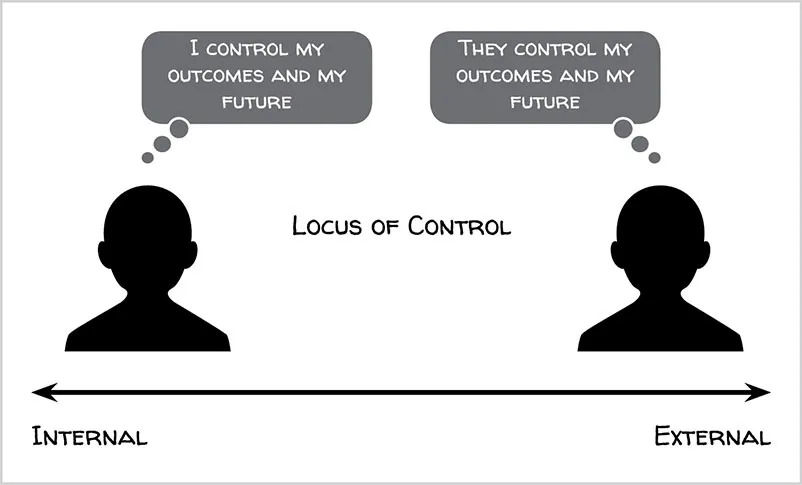
The figure represents the locus of control model. It considers the human tendency to believe that control resides internally within them (e.g., I control my outcomes and my future) or externally with others or the situation (e.g., they control my outcomes and my future).
Figure 1.1 the locus of control
Based on a model by Julian Rotter
What Lean can help with is the things you can control on your farm. These are the ‘internal factors' and include:
  • your work environment
  • what you do and how you do it
  • your quality
  • your waste
  • your efficiency.
Therefore, to gain real value from this book and be able to implement Lean thinking effectively, we need to shift our mindset. We need to stop focusing and complaining about the external factors that we can't control. We need to stop believing that everything is outside of our control and blaming these external factors for our inefficiencies or telling ourselves things like ‘we can't do anything', ‘our hands are tied because milk prices are down' and so on. Instead we need to start accepting responsibility and taking control of the internal factors in our farm business.
This is what Lean and the concept of kaizen (we talk about this in chapter 2) are based on: continuously improving the things that are in our scope of control.
Toyota is a perfect example: they have many external factors that affect their business and are beyond their control, such as strong competition, fluctuating currencies, political situations, steel prices and so on. Yet they are still the world's most profitable car manufacturer because they use Lean principles and focus on the internal factors that they control and can continuously improve on.

The ‘possible' mindset

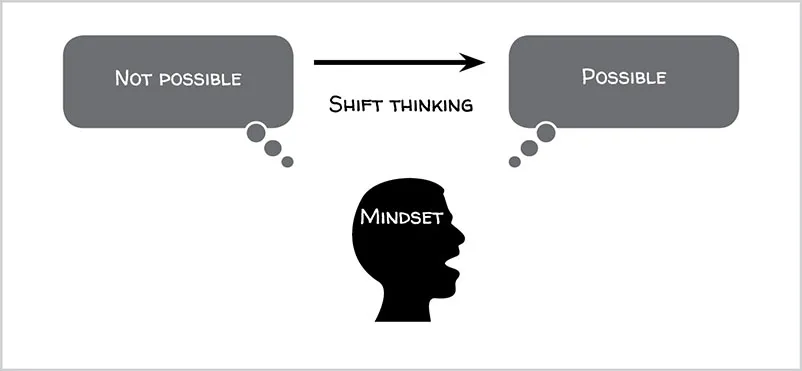
The second concept that farmers need to open up to is something I call the ‘possible' mindset (see figure 1.2).
The figure describes the possible mindset. It considers the shift in thinking from “not possible” to “possible.”
Figure 1.2 the possible mindset
Basically, we need to shift our thinking from ‘not possible' mode to ‘possible' mode. Instead of believing that it's not possible to do something, we need to start asking ourselves how we can make it possible: how can we do thi...

Table of contents

  1. Title Page
  2. Copyright
  3. Acknowledgements
  4. Introduction
  5. Part I The concept of ‘Lean'
  6. Part II 10 Lean tools that will transform your farm
  7. Part III The culture of a Lean Farm
  8. About the authors
  9. Index
  10. WILEY END USER LICENSE AGREEMENT