This book provides engineers with a comprehensive review of the state-of-the-art in reflectarray antenna research and development. The authors describe, in detail, design procedures for a wide range of applications, including broadband, multi-band, multi-beam, contour-beam, beam-scanning, and conformal reflectarray antennas. They provide sufficient coverage of basic reflectarray theory to fully understand reflectarray antenna design and analysis such that the readers can pursue reflectarray research on their own. Throughout the book numerous illustrative design examples including numerical and experimental results are provided.
Featuring in-depth theoretical analysis along with practical design examples, Reflectarray Antennas is an excellent text/reference for engineering graduate students, researchers, and engineers in the field of antennas. It belongs on the bookshelves of university libraries, research institutes, and industrial labs and research facilities.
Communicating over long distances had long been a dream for mankind until 1901 when Marconi demonstrated the first cross Atlantic wireless signal transmission. Since then, long distance communications have evolved to a degree where mankind can communicate wirelessly across the Solar System and beyond. Long distance communication requires large antennas in order to establish the wireless link between the transmitter and receiver. One of the most practical types of electrically large antennas are reflectors. While reflectors were originally built as optical devices [1], the discovery of electromagnetic waves by Maxwell, began a new era for communication with these antennas. The first experimental demonstration of wireless communication by Hertz in 1887, used a dipole‐fed cylindrical parabolic antenna, which is believed to be the first reflector antenna operating at non‐optical frequencies. Since then, reflectors have become the most widely used high‐gain antenna in communications, radio astronomy, remote sensing, and radar [2].
An alternative approach to realization of a large antenna is by using several smaller antennas in the form of an array [3]. The first antenna array was built over 100 years ago [4]. In order to increase the directivity of a single monopole, Brown used two vertical antennas separated by half a wavelength and fed them out of phase [5]. He and several other notable scientists such as Marconi, Braun, and Adcock explored the unique characteristics of antenna array over the years [6]–[8]. Antenna array engineering evolved rapidly thereafter, particularly during the Second World War; however, it was the development of semiconductor technology in the 1960s and the printed circuit board technology in the 1970s that had the largest impact on their development. In particular the microstrip patch antenna proposed by Deschamps in 1953 [9] and later made practical by Munson in 1972 [10], revolutionized array engineering. Microstrip antenna arrays have since then played an important role in modern phased array systems.
While reflectors and arrays still compete for large aperture jobs in many types of systems, in the recent years, a new generation of high‐gain antennas has emerged, which have attracted increasing interest from the antenna/electromagnetic community because of their low‐profile, low‐mass, and in many cases, low‐cost features. This antenna is known as the reflectarray antenna [11]–[13]. The reflectarray antenna is a hybrid design, which combines many favorable features of reflectors and printed arrays, and as such can provide advantages over these two conventional antennas. The parabolic reflector is difficult to manufacture in many cases due to its curved surface that requires expensive custom molds and also become more difficult to manufacture at higher microwave frequencies. On the other hand, while antenna arrays offer the advantages of flexible design freedoms and versatile radiation performance, its feeding network suffers from the energy loss and design complexity, and the cost of the T/R modules [14] in active phased arrays becomes prohibitively high for many applications. As such, the reflectarray has fast been gaining attention as an alternative to these more mature technologies as it is able to mitigate the disadvantages associated with both of these high‐gain antennas.
The reflectarray is an antenna with a flat reflecting surface consisting of hundreds of elements on its aperture and an illuminating feed antenna, as shown in Figure 1.1.
Figure 1.1 The geometry of an offset‐fed reflectarray antenna.
The feed antenna spatially illuminates the aperture where the elements are designed to reflect the incident field with certain phase shifts in order to collimate the beam of the antenna in the desired direction and with the preferred shape. Its operation principle is similar in concept to reflector antennas with respect to the spatial illumination, and again similar in concept to antenna arrays with respect to phase synthesis and beam collimation.
1.2 Reflectarray Developments
The concept of reflectarray antennas was initially introduced in the early 1960s using short‐ended waveguide elements with variable lengths [11]. The feed antenna illuminated the waveguides where the lengths of the shorted waveguides were designed such that the phase of the reradiated signals would form a collimated beam in the desired far‐field direction. While the concept was very interesting, the bulky and heavy waveguide structure of this first reflectarray antenna was a major drawback. The experimental model of the waveguide reflectarray is shown in Figure 1.2.
Figure 1.2 The first reflectarray antenna using waveguide technology.
Source: Berry 1963 [11]. Reproduced with permission from IEEE.
Although some work on spiralphase reflectarrays was reported by Phelan in the mid‐1970s [15], the reflectarray antenna did not receive much attention after that until the revolutionary breakthrough of printed microstrip antenna technology in the 1980s. Since then, research on reflectarray antennas has been on the rise, and several diversified applications such as multi‐beam antennas for point‐to‐point communication, beam‐scanning antennas for radar applications, and spatial power combining reflectarray systems have been demonstrated. In particular, over the past 10 years, an increased interest in reflectarray antenna research has been observed in both academic and industrial sectors of the antenna community, which is also propelled by advances in fabrication technologies as well as computational resources.
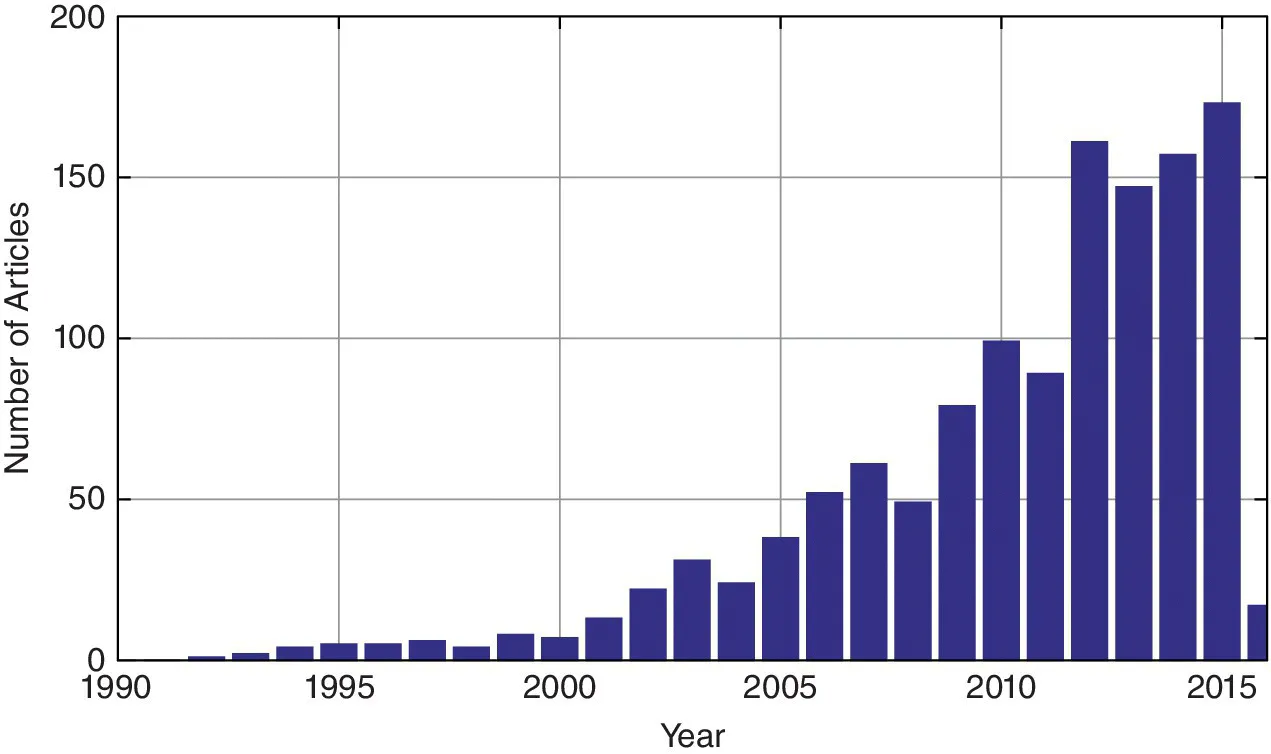
Since 2006, the IEEE Antennas and Propagation International Symposium (APS) has included sessions dedicated to reflectarray antennas in the general conference proceedings, and several sessions and special sessions have been held since then. Most notably a full‐day special session on reflectarray antennas was held at the 2011 APS. Several hundred papers have been presented in these sessions, and many researchers are now interested in joining this active research area. In 2012, the International Journal of Antennas and Propagation published a special issue on Reflectarray Antennas: Analysis and Synthesis Techniques, which further stimulated the research interest in this area. A literature search on IEEE Xplore using the keyword “reflectarray” showed more than 1200 articles have been published in IEEE in this area, as shown in Figure 1.3. The majority of the articles, however, have been published in the recent years, and in particular, there has a notable increase in the number of papers over the last 10 years.
Figure 1.3 The number of articles on reflectarray antennas published in IEEE. Data obtained from IEEE Xplore on April 1, 2016.
The reflectarray antenna offers a multitude of capabilities that has encouraged continuous development and exciting applications in recent years. The elements of the reflectarray are designed to reflect the electromagnetic wave with a certain phase to compensate for the phase delay caused by the spatial feed. The phase shift of the elements is realized using various methods such as variable size elements, phase‐delay lines, and element rotation techniques. The infinite array approach is used to calibrate the element phase versus element change [12]. Due to the very large number of elements involved in a reflectarray, full‐wave simulation of the entire reflectarray antenna is still challenging. On the other hand, different theoretical models have been developed for the analysis of reflectarrays, such as the array theory formulation and the aperture field analysis technique, which show a good agreement with measured results. Moreover, implementing the spectral transform in these calculations allows for fast calculation of the radiation characteristics of the antenna, which is a considerable advantage for synthesis design problems using iterative procedures.
Single and multilayer reflectarrays have been designed to achieve broadband and multiband performance from microwave frequencies up to the THz range [16], [17]. Considerable improvements have been made to these designs over the years, and many practical designs have been demonstrated. One of the main challenges in reflectarray designs is improving the bandwidth of the antenna, which is the major drawback of printed resonator‐type structures [18]. Different bandwidth improvement techniques such as ...
Table of contents
Cover
Title Page
Table of Contents
Foreword
Preface
Acknowledgments
1 Introduction to Reflectarray Antennas
2 Analysis and Design of Reflectarray Elements
3 System Design and Aperture Efficiency Analysis
4 Radiation Analysis Techniques
5 Bandwidth of Reflectarray Antennas
6 Reflectarray Design Examples
7 Broadband and Multiband Reflectarray Antennas
8 Terahertz, Infrared, and Optical Reflectarray Antennas
9 Multi‐Beam and Shaped‐Beam Reflectarray Antennas
10 Beam‐Scanning Reflectarray Antennas
11 Reflectarray Engineering and Emerging Applications
Index
End User License Agreement
Frequently asked questions
Yes, you can cancel anytime from the Subscription tab in your account settings on the Perlego website. Your subscription will stay active until the end of your current billing period. Learn how to cancel your subscription
No, books cannot be downloaded as external files, such as PDFs, for use outside of Perlego. However, you can download books within the Perlego app for offline reading on mobile or tablet. Learn how to download books offline
Perlego offers two plans: Essential and Complete
Essential is ideal for learners and professionals who enjoy exploring a wide range of subjects. Access the Essential Library with 800,000+ trusted titles and best-sellers across business, personal growth, and the humanities. Includes unlimited reading time and Standard Read Aloud voice.
Complete: Perfect for advanced learners and researchers needing full, unrestricted access. Unlock 1.4M+ books across hundreds of subjects, including academic and specialized titles. The Complete Plan also includes advanced features like Premium Read Aloud and Research Assistant.
Both plans are available with monthly, semester, or annual billing cycles.
We are an online textbook subscription service, where you can get access to an entire online library for less than the price of a single book per month. With over 1 million books across 990+ topics, we’ve got you covered! Learn about our mission
Look out for the read-aloud symbol on your next book to see if you can listen to it. The read-aloud tool reads text aloud for you, highlighting the text as it is being read. You can pause it, speed it up and slow it down. Learn more about Read Aloud
Yes! You can use the Perlego app on both iOS and Android devices to read anytime, anywhere — even offline. Perfect for commutes or when you’re on the go. Please note we cannot support devices running on iOS 13 and Android 7 or earlier. Learn more about using the app
Yes, you can access Reflectarray Antennas by Payam Nayeri,Fan Yang,Atef Z. Elsherbeni in PDF and/or ePUB format, as well as other popular books in Technology & Engineering & Electrical Engineering & Telecommunications. We have over one million books available in our catalogue for you to explore.