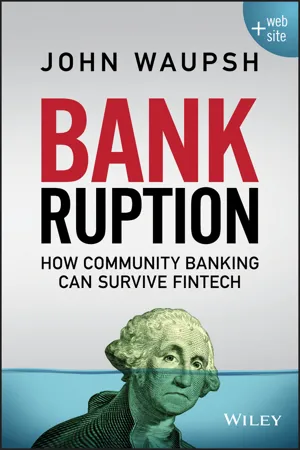
Community banking can flourish in the face of fintech and global competition with a fresh approach to strategy
Bankruption + Website offers a survival guide for community banks and credit unions searching for relevance amidst immense global competition and fintech startups. Author John Waupsh is the Chief Innovation Officer at Kasasa, where he helps spearhead financial product development and implementation across hundreds of institutions. In this guide, he draws on more than a decade in the industry to offer clear, practical advice for competing with the megabanks, direct banks, non-banks, and financial technology companies.
The discussion separates futurist thinking from today's realities, and dispels common myths surrounding the U.S. community banking model in order to shed light on the real challenges facing community banking institutions. It follows with clear solutions, proven strategies, and insight from experts across banking and fintech. All arguments are backed by massive amounts of data, and the companion website provides presentation-ready visualizations to help you kickstart change within your team.
In the U.S. and around the globe, fintech companies and non-banks alike are creating streams of banking services that are interesting, elegant, and refreshing—and they're winning the hearts and minds of early adopters. Not a one-size-fits-all approach, this book offers many different tactics for community banks and credit unions to compete and flourish in the new world.
Analyze fintech's threat to the community banking model
Learn where community banking must improve to compete
Disprove the myths to uncover the real challenges banks face
Adopt proven strategies to bring your organization into the future
Community banks and credit unions were once the go-to institutions for local relationship banking, but their asset share has been on the decline for three decades as the big banks just got bigger. Now, fintech companies are exploiting inefficiencies in the traditional banking model to streamline service and draw even more market share, as community banking executives are left at a loss for fresh tactics and forward-looking strategy. Bankruption + Website shows how community banks can be saved, and provides a proven path to success.
Community banks overdosed on arrogance and comfort in the status quo. The vice of Pride plays the long game. She starts harmless enough—young and reckless. Discerning and punctual. But Pride, a generation or three down the line, quite deeply cataracts and sloths. Bankers' kids become loan officers become CEOs become chairmen become barnacle board members of their grandkids' banks.
By and large, community banks are family‐begun businesses that have only lasted this long because banking competition was light, with controlled access points. The ultimate problem with family businesses, perhaps, is not pride—it's that blood overrules brains.
Credit unions, you're not off the hook, either.
Quite a bit of legacy thinking going on there, too, with far too many inefficiencies, a model the average consumer doesn't know or care about, and a belief system that outstrips capability. Oh and your boards are typically full of people who have no experience in banking or technology, and zero financial interest in the health or future of the credit union.
If any of that cut a bit too close to home, pay attention, it gets worse.
Because despite the tireless work of many thousands of passionate employees who sought to advance their community institutions from the inside, community banks and credit unions are bloated, outdated, human‐powered, ego‐driven, know‐it‐all, do‐it‐all, whiny, tired, overregulated, underappreciated customer experience nightmares.
Of course, that's the easy part to fix. Community institutions still have to thrive within the ever‐changing banking landscape. And with pole shifts occurring to every foregone conclusion in their business models, top financial institutions today are defining winning strategies that acknowledge and respect these transformative forces.
Although there are a few community banks and credit unions committing to the difficult process of re‐examining and changing their business based upon the realities of today, there's not enough to make a difference. Not enough to save the industry from its own damned self.
This is where my brain sat for about a year. My heart crushed; my soul smashed, until I became absolutely obsessed with finding any possible cure to the terminal illness. It only makes sense that incumbents should have one or more advantages. We just need to find them, exploit them, and shore up the weaknesses.
Community Banking Relies Too Heavily on Physical Proximity
Years ago, people in towns across America needed access to capital and a safer place to store their money. Customers lacked the capability to travel too far from home, and bankers didn't want the money they lent to go too far from the safe, so they established a nearby physical location to perform these services. This nearness worked both ways, positioned around the ideal of convenience.
Proximity manufactured a false sense of trust between the two parties. Either side trusting the other not to take its money and run—because they have a big, heavy, unmovable structure with columns, or because they live nearby.
And the mutual lie worked pretty well.
This falsehood of belief became further twisted when people learned that the attire they wore to the bank directly impacted how they were treated (e.g., more favorable loan rates). In perhaps an early form of identity fraud, customers would don their Sunday best to get the banker's best.
Somehow, this lie of convenience between the two parties became known as a relationship, and mistaken for intimacy—a word that connotes personal and honest, shared knowledge—even though the association was, and has remained for decades, anything but intimate.
And over the years, with few exceptions, regulation has reinforced the false benefits of human touch–powered banking by, among other things, raising insurance rates on deposits originated in areas beyond an FI's local branch network. Their assumption: Deposits and accounts sourced digitally (or otherwise outside physical branches) are more inclined to travel to other FIs at a whim.
Today, Data Proximity Yields Intimacy
In 2015, we left behind five exabytes of data exhaust every two minutes: from Periscoped hip‐hop concerts to Snapchatted high school homecomings to YouTubed cat videos to less important things like emojiied business emails (see Figure 1.1).
Figure 1.1 Creating Five Exabytes of Data
SOURCE: Berkeley School of Information, 2015 The time, in minutes, it takes humans to create the amount of data from the dawn of time to 2003. Another way to look at it is if you wanted to watch a video of everything that was sent across our global networks in one second of 2015, it would take you about five years of 24×7 screen time.
Not only does each of us leave behind gigabytes‐thick data residue daily, but we also have become—consciously and subconsciously—comfortable, and nearly dependent, on our data streams.
These days, well‐timed, well‐placed, well‐modeled informed digital interactions build relationships, trust, and understanding. This all but ensures that any strategy relying solely on physical proximity is a liability.
Data Proximity Has Cast a Very Bright Light on the Cracks of Banking
As Americans begin to taste and feel the ease and fluidity of omni‐channel in retail, theme parks, and so on, they learn that innocuous data, like that which sat in ink on paper shopping lists, can greatly enhance their lives. They see how we can talk to devices, and they will do things for us (“Alexa, play some Violent Femmes”). They see how devices can talk to other devices (via Internet of Things) and turn on lamps or adjust the temperature for us (see Figure 1.2). Consumers see all of t...
Table of contents
Cover
Title Page
Copyright
Table of Contents
Dedication
Preface
Introduction
Additional Thanks
Chapter 1: An Overview of the Bankruption
Chapter 2: Community Banking Is Broken
Chapter 3: The Opportunity for Community Financial Institutions
Chapter 4: Advice from Others
Chapter 5: Finishing Move
About the Author
About the Companion Website
Index
End User License Agreement
Trusted by 375,005 students
Access to over 1.5 million titles for a fair monthly price.
Study more efficiently using our study tools.
Frequently asked questions
Yes, you can cancel anytime from the Subscription tab in your account settings on the Perlego website. Your subscription will stay active until the end of your current billing period. Learn how to cancel your subscription
No, books cannot be downloaded as external files, such as PDFs, for use outside of Perlego. However, you can download books within the Perlego app for offline reading on mobile or tablet. Learn how to download books offline
Perlego offers two plans: Essential and Complete
Essential is ideal for learners and professionals who enjoy exploring a wide range of subjects. Access the Essential Library with 800,000+ trusted titles and best-sellers across business, personal growth, and the humanities. Includes unlimited reading time and Standard Read Aloud voice.
Complete: Perfect for advanced learners and researchers needing full, unrestricted access. Unlock 1.5M+ books across hundreds of subjects, including academic and specialized titles. The Complete Plan also includes advanced features like Premium Read Aloud and Research Assistant.
Both plans are available with monthly, semester, or annual billing cycles.
We are an online textbook subscription service, where you can get access to an entire online library for less than the price of a single book per month. With over 1.5 million books across 990+ topics, we’ve got you covered! Learn about our mission
Look out for the read-aloud symbol on your next book to see if you can listen to it. The read-aloud tool reads text aloud for you, highlighting the text as it is being read. You can pause it, speed it up and slow it down. Learn more about Read Aloud
Yes! You can use the Perlego app on both iOS and Android devices to read anytime, anywhere — even offline. Perfect for commutes or when you’re on the go. Please note we cannot support devices running on iOS 13 and Android 7 or earlier. Learn more about using the app
Yes, you can access Bankruption by John Waupsh in PDF and/or ePUB format, as well as other popular books in Economics & Banks & Banking. We have over 1.5 million books available in our catalogue for you to explore.