BIM for Design Firms
eBook - ePub

BIM for Design Firms

Data Rich Architecture at Small and Medium Scales

  1. English
  2. ePUB (mobile friendly)
  3. Available on iOS & Android
eBook - ePub

BIM for Design Firms

Data Rich Architecture at Small and Medium Scales

About this book

Paves the path for the adoption and effective implementation of BIM by design firms, emphasizing the design opportunities that this workflow affords

This book expands on BIM (Building Information Modeling), showing its applicability to a range of design-oriented projects. It emphasizes the full impact that a data modeling tool has on design processes, systems, and the high level of collaboration required across the design team. It also explains the quantitative analysis opportunities that BIM affords for sustainable design and for balancing competing design agendas, while highlighting the benefits BIM offers to designing in 3D for construction. The book concludes with a deep look at the possible future of BIM and digitally-enhanced design.

Through clear explanation of the processes involved and compelling case studies of design-oriented projects presented with full-color illustrations, BIM for Design Firms: Data Rich Architecture at Small and Medium Scales proves that the power of BIM is far more than an improved documentation and sharing environment. It offers chapters that discuss a broad range of digital design, including problems with BIM, how readers can leverage BIM workflows for complex projects, the way BIM is taught, and more.

  • Helps architects in small and medium design studios realize the cost and efficiency benefits of using BIM
  • Demonstrates how the use of BIM is as relevant and beneficial for a range of projects, from small buildings to large and complex commercial developments
  • Highlights the quantitative analysis opportunities of data-rich BIM models across design disciplines for climate responsiveness, design exploration, visualization, documentation, and error detection
  • Includes full-color case studies of small to medium projects, so that examples are applicable to a range of practice types
  • Features projects by Arca Architects, ARX Protugal Arquitectos, Bearth & Deplazes, Durbach Block Jaggers, Flansburgh Architects, and LEVER Architecture

BIM for Design Firms is an excellent book for architects in small and medium-sized studios (including design departments within large firms) as well as for architecture students.

Frequently asked questions

Yes, you can cancel anytime from the Subscription tab in your account settings on the Perlego website. Your subscription will stay active until the end of your current billing period. Learn how to cancel your subscription.
No, books cannot be downloaded as external files, such as PDFs, for use outside of Perlego. However, you can download books within the Perlego app for offline reading on mobile or tablet. Learn more here.
Perlego offers two plans: Essential and Complete
  • Essential is ideal for learners and professionals who enjoy exploring a wide range of subjects. Access the Essential Library with 800,000+ trusted titles and best-sellers across business, personal growth, and the humanities. Includes unlimited reading time and Standard Read Aloud voice.
  • Complete: Perfect for advanced learners and researchers needing full, unrestricted access. Unlock 1.4M+ books across hundreds of subjects, including academic and specialized titles. The Complete Plan also includes advanced features like Premium Read Aloud and Research Assistant.
Both plans are available with monthly, semester, or annual billing cycles.
We are an online textbook subscription service, where you can get access to an entire online library for less than the price of a single book per month. With over 1 million books across 1000+ topics, we’ve got you covered! Learn more here.
Look out for the read-aloud symbol on your next book to see if you can listen to it. The read-aloud tool reads text aloud for you, highlighting the text as it is being read. You can pause it, speed it up and slow it down. Learn more here.
Yes! You can use the Perlego app on both iOS or Android devices to read anytime, anywhere — even offline. Perfect for commutes or when you’re on the go.
Please note we cannot support devices running on iOS 13 and Android 7 or earlier. Learn more about using the app.
Yes, you can access BIM for Design Firms by François Lévy,Jeffrey W. Ouellette in PDF and/or ePUB format, as well as other popular books in Architecture & Professional Practice in Architecture. We have over one million books available in our catalogue for you to explore.

Information

Chapter 1
Digital Design

What is design? Is there a particular quality to digital design processes?
A question asked with the objective of obtaining a definitive answer is not a very interesting question. A question asked in an open‐ended, indeterminate process of perpetual inquiry becomes a way of being. So when one thoughtfully asks “What is design?” what is really meant is, “How can I keep testing my assumptions about architecture and what it means to design?” Or, “How shall I keep questioning how and why I design what I design?”
Swimming in the waters of this type of inquiry will always be hard. For the young designer—looking for his voice, unsure about how to proceed, feeling the pressure of solving a design problem, and wandering away from a theory of design process—inexperience clouds the question. For the experienced designer—confident in her abilities, mature in her practice, technically knowledgeable, and sure‐footed—the quick and possibly glib solution arises so quickly, seemingly magical in its effortlessness, that there's no time and certainly no incentive to question it.
Then there's the question of the cognitive quality of designing “by hand” as distinct from designing “digitally” (“computationally” would be more apt, as “digital design” has little to do with fingers). How does the modality of design affect the design outcome? Is an architect exploring a design solution by sketching with pencil and paper favoring a different design outcome than one immersed in a BIM workflow, by virtue of the haptic or cognitive nature of the design process? Does BIM lead to a particular architectural outcome?

Introduction

As a fruitful premise for inquiry (what Socrates in Plato's dialogues calls εικωσ μγθοσ—a “likely story”), let's consider that architecture (as a profession, though perhaps too as a human artifact) has been experiencing an evolving crisis for well over a century. And while we're in Greece, let's also ponder that “architect” is from άρχι and τέκτων: “master builder,” or chief craftsman. While some architects may be capable builders, for a very long time the process of design has been divorced from the direct process of making. To be sure, in Europe some architects serve as maître d'ouvrage (master of the work), and their professional function is distinct from design architects. Even in the United States, many architects function as project managers. And as with maîtres d'ouvrage, their bailiwick encompasses project objectives, scheduling, sequencing, and budgets; they are not builders or craftsmen per se. Perhaps not coincidentally, very few architects come up through the profession with a background in building. For better or worse, ours is a profession rooted in the academy.
Arguably, the Viennese Secession, Franco‐Belgian Art Nouveau, the British and American Arts and Crafts Movement, and their contemporary localized counterparts were a reformation against mechanized and industrialized fabrication methods coming online over a century ago. (Ironically, nowadays of course one can order Arts and Crafts furniture online, made in a factory overseas and delivered with two‐day free shipping. I have no objections to such a convenience, but it does reduce an architectural and artistic movement to a mere style or fetish.) Mechanization has so pervaded our social expression of work that the handcrafted has lost the moral superiority assigned to it by the Arts and Crafts Movement, and is now commodified or fetishized. A century ago windows were produced by hand like custom millwork; now they are mass produced—and with good reason, too, as modern windows assembled with modern materials and manufacturing vastly outperform their historical counterparts.
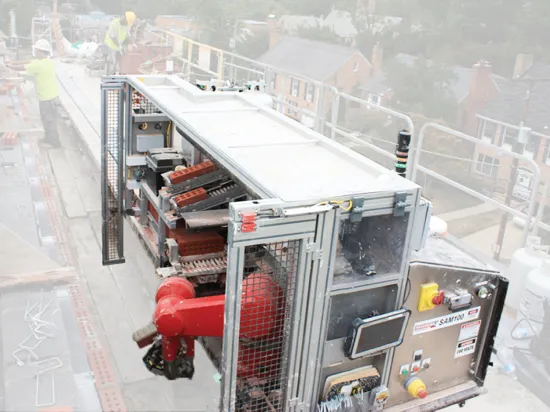
So on the one hand we have master builders who do not build, and on the other we have building processes that are farther and farther removed from craft (Figure 1.1). In a philosophical context, it may not be a problem that architects do not build anything; it may merely be a needless obsession with an archaic etymology that would suggest that as a profession we should be builders. I for one am not trained in the act of building, nor do I have the urge to exercise it. Except that as the distance from design to execution lengthens, the constructibility of the design may suffer. Moreover, design can be instructed by construction. An architectural detail may be intricately drawn, but what if it cannot be achieved due to the dimensional tolerances required, or if the sequencing of its components would be impossible?
Illustration of automated construction of an architectural wall
FIGURE 1.1 Automated construction of an architectural wall. If the craft isn't in the assembly in the field, where does it lie? In the programming of the automation?
Image courtesy Construction Robotics.
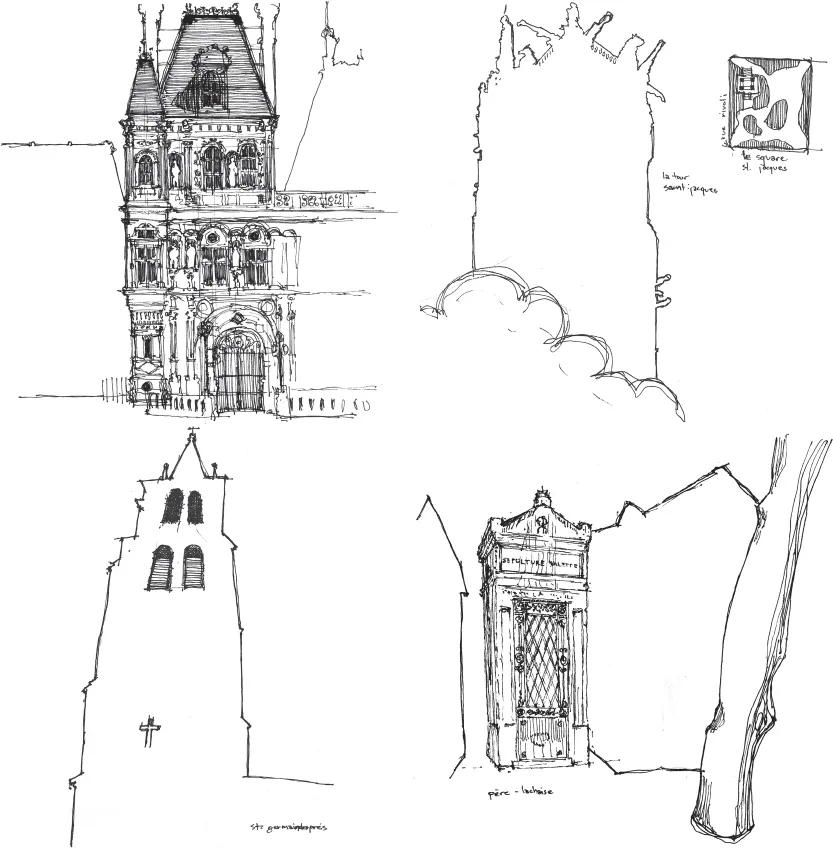
If anything, the abstract nature of architectural design processes only contributes to this gap between the design idea and its physical manifestation. The more abstract the design artifact, the greater the gap. The architect loves the hand‐drawn line in part because it is so abstract: bearing almost no intrinsic information, an entire story may be inferred from a few accidental details. Is it perfectly straight (a firm decision has been made) or wavering (it describes a vague impulse, or perhaps a natural feature)? Is it ink (confident, authoritative), or soft pencil (tentative, or evocative)? Is it drawn on vellum (final) or trace (exploratory), or on a scrap of napkin (extemporaneous)? Note that all these meanings are subjective: they are supplied by the observer, using certain cultural visual cues as a context for assembling a narrative out of a mere line drawn between two points. In other words, the observer infers the meaning (Figure 1.2).
Sketches of the architectural elements by traveler
FIGURE 1.2 These travel sketches communicate as much with what they omit as by what is explicit. Moreover, the architectural elements of the drawing require that the user interpret the intended representation.
By training moreover, for many architects and designers drawing is much more than merely a means of clearly communicating a comprehensive idea. The act of drawing itself is a cognitive process, an act of uncovering, an exploration. Just as the traveler may not fully see the building he is drawing until he actually draws it, so the architect may not fully realize a design idea except by drawing it.
Now consider a BIM assembly. With contemporary BIM‐authoring software, it can of course readily be rendered in a hard line; in a sketch style with variable parameters to control wobble, overstrike, and so on; as a cartoon color rendering with graphic qualities reminiscent of Francis D.K. Ching; as a white rendering almost indistinguishable from a museum‐board model; as a photo‐realistic rendering with depth of field, blur, and complex lighting; and so on (Figure 1.3).
Illustration of a series of renderings of the same building information model assembly
FIGURE 1.3 A series of renderings of the same BIM assembly, illustrating just some of the variety of rendering styles available when rendering in BIM.
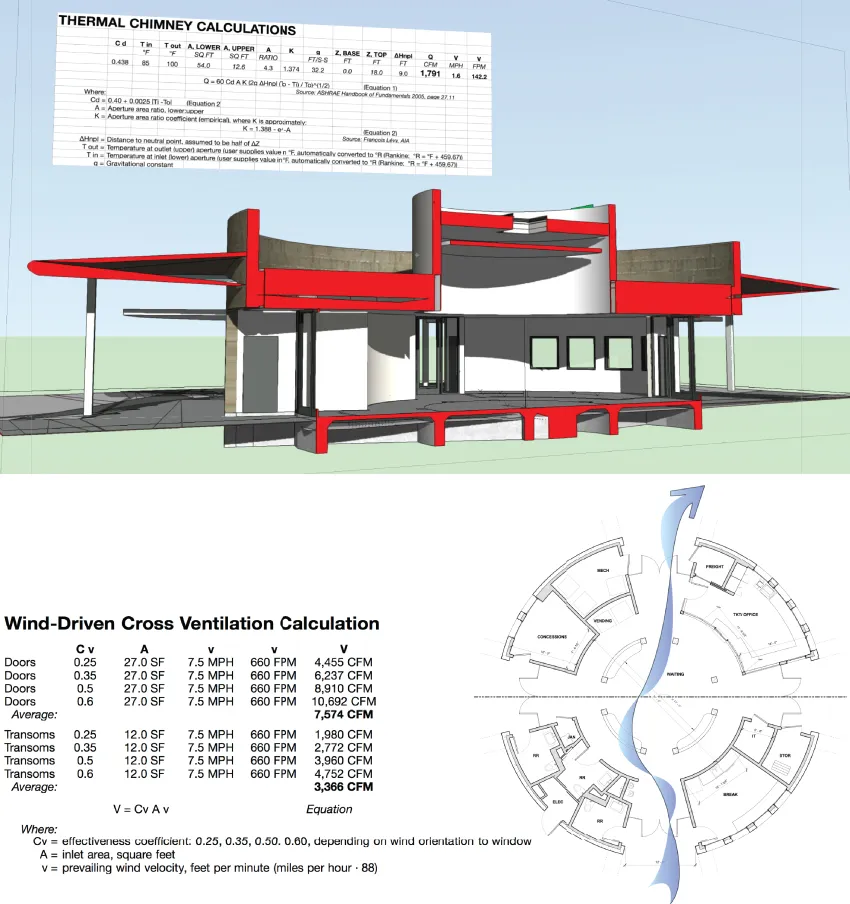
I assert that the modality of a BIM rendering, unlike that of the hand drawing, is a function of the communication of the completed design thought. As typically used, BIM is not as a rule an exploratory device. It may be that this fact contributes to experienced designers' contending that BIM is not a design tool, but only suitable to the refinement, coordination, or documentation of a design derived by other means (Figure 1.4). This is a serious error, due perhaps to judging digital processes by analog standards and analog experiences. For the paradigm of the line is not the appropriate one for BIM. Rather, BIM inhabits the world of data, whether abstract or geometric, and should therefore be evaluated performatively and formally, rather than graphically.
Illustration of design investigation in building information model.
FIGURE 1.4 Design investigation in BIM. A single BIM model is used to evaluate a host of performance‐based design decisions. Capital Area Rural Transportation System (CARTS) Eastside Bus Plaza project design by McCann Adams Studio and Jackson McElhaney Architects; energy and sustainability analysis by the author.

What's Wrong with BIM?

The infamous 2004 NIST study, which “conservatively” identified an estimated $5.3 billion cost to designers and builders in the capital facilities industry in the United States for 2002 alone, helped set the stage for adoption of BIM in constructi...

Table of contents

  1. Cover
  2. Table of Contents
  3. Acknowledgments
  4. Introduction
  5. Chapter 1: Digital Design
  6. Chapter 2: BIM Past and Present
  7. Chapter 3: What Tools Mean
  8. Chapter 4: Appropriate Technology
  9. Chapter 5: Case Studies in Form Making
  10. Chapter 6: Case Studies in Digital Fabrication
  11. Chapter 7: BIM Tomorrow: Trends in Technology
  12. Afterword
  13. Index
  14. End User License Agreement