Building 21st Century Entrepreneurship
eBook - ePub

Building 21st Century Entrepreneurship

  1. English
  2. ePUB (mobile friendly)
  3. Available on iOS & Android
eBook - ePub

Building 21st Century Entrepreneurship

About this book

Entrepreneurship develops around the world in accordance to the different cultural, political, economic and social contexts. Governments promote entrepreneurship as a way to improve economic growth. As capitalism changes, entrepreneurship also changes. This book describes some of the new profiles of entrepreneurs that are creating the entrepreneurial economy of the 21st Century. It presents entrepreneurship in a theoretical and pragmatic way in order to help readers to understand what entrepreneurship means today. Illustrated by socio-economic information and case studies of an international scope, two main questions are explicitly studied in this book: who are the new figures of entrepreneurs and how are they creating the companies of the future?

The book is based on academic literature and serves as a reference to researchers interested in the evolution of entrepreneurship.

Frequently asked questions

Yes, you can cancel anytime from the Subscription tab in your account settings on the Perlego website. Your subscription will stay active until the end of your current billing period. Learn how to cancel your subscription.
At the moment all of our mobile-responsive ePub books are available to download via the app. Most of our PDFs are also available to download and we're working on making the final remaining ones downloadable now. Learn more here.
Perlego offers two plans: Essential and Complete
  • Essential is ideal for learners and professionals who enjoy exploring a wide range of subjects. Access the Essential Library with 800,000+ trusted titles and best-sellers across business, personal growth, and the humanities. Includes unlimited reading time and Standard Read Aloud voice.
  • Complete: Perfect for advanced learners and researchers needing full, unrestricted access. Unlock 1.4M+ books across hundreds of subjects, including academic and specialized titles. The Complete Plan also includes advanced features like Premium Read Aloud and Research Assistant.
Both plans are available with monthly, semester, or annual billing cycles.
We are an online textbook subscription service, where you can get access to an entire online library for less than the price of a single book per month. With over 1 million books across 1000+ topics, we’ve got you covered! Learn more here.
Look out for the read-aloud symbol on your next book to see if you can listen to it. The read-aloud tool reads text aloud for you, highlighting the text as it is being read. You can pause it, speed it up and slow it down. Learn more here.
Yes! You can use the Perlego app on both iOS or Android devices to read anytime, anywhere — even offline. Perfect for commutes or when you’re on the go.
Please note we cannot support devices running on iOS 13 and Android 7 or earlier. Learn more about using the app.
Yes, you can access Building 21st Century Entrepreneurship by Aude d'Andria,Inès Gabarret in PDF and/or ePUB format, as well as other popular books in Business & Human Resource Management. We have over one million books available in our catalogue for you to explore.

Information

Publisher
Wiley-ISTE
Year
2017
Print ISBN
9781786300768
eBook ISBN
9781119419730

1
Entrepreneurship and High Heels

Entrepreneurship by women is a major question. It helps to understand not only the place of women in business but also in society.
The changes in society during the last century have allowed significant participation of women in the work market. In parallel, women started creating new companies in every country.
Although women constitute a critical part of the group of self-employed workers, their work is often recognized as secondary and subordinate to men’s work. It is possibly a result of the pressure of domestic logics that pushes the devaluation of women’s productive activities.
Female entrepreneurship is now recognized worldwide as a leading global trend with significant economic, social and political consequences.
The increasing number of female entrepreneurs is contributing to a major dynamism in all economies worldwide. However, the level of female creation continues to be significantly lower than that of men.
image001.webp
We Can Do It! [MIL 43]
Objectives of this chapter:
  • – Understand the main characteristics of female entrepreneurs.
  • – Analyze the different types of female entrepreneurs.
  • – Raise awareness of the need to study female entrepreneurship in relation to the lifecycle of the woman and their family.

1.1. Entrepreneurship by women

1.1.1. Definition

Any woman who initiates, organizes and runs a business enterprise is a female entrepreneur.
The Global Entrepreneurship Monitor (GEM) is the world’s leading study of entrepreneurship. Since 1999, it has provided information and comprehensive reports from international data collection to understand the entrepreneurial phenomenon.
It provides information to better understand for each economy:
  • – the entrepreneurial behavior and attitudes of individuals;
  • – the national context and how that impacts entrepreneurship.
The last GEM Report (2015/2016) covers results based on 60 economies. According to the GEM [GEM 16]:
  • – More than 126 million female entrepreneurs are starting or running new businesses in 67 economies;
  • – An estimated 48 million female entrepreneurs and 64 million female established business owners currently employ one or more people in their businesses;
  • In 5 years, 7 million female entrepreneurs and 5 million female established business owners are expected to grow their ventures by at least six employees.
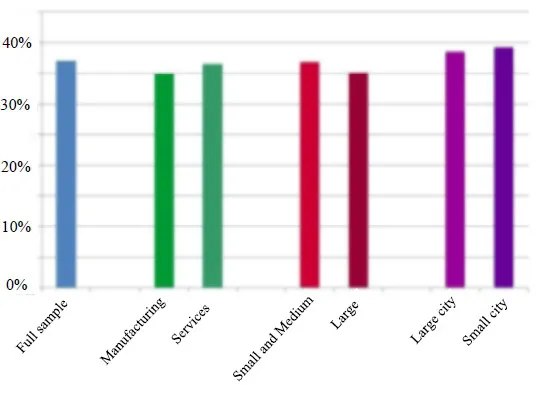
image003.webp
Figure 1.1. Percentage of firms with a female owner
Adapted from ICF – Banking on women 2013

1.1.2. The GEM Special Report: Women’s Entrepreneurship

The GEM Special Report Women’s Entrepreneurship facilitates understanding of female entrepreneurship by researchers, policy-makers, educators and practitioners. It offers an in-depth view of women who start and run businesses around the world.
The report provides information on female entrepreneurship rates and gender gaps in the following key areas:
  • – participation in multiple phases of activity;
  • – characteristics and motivations of female entrepreneurs;
  • – societal attitudes about entrepreneurship;
  • impact of indicators among entrepreneurs.
The ultimate aim is to foster an environment that encourages women to see entrepreneurship as a viable career option; equips them with the tools to create the type and quality of business each wishes to build; and creates awareness among stakeholders who will support their efforts.
The last GEM Special Report Women’s Entrepreneurship (2015) examines 83 economies and helps to understand the substantial differences in women’s TEA rates (total early-stage entrepreneurship activity).
Table 1.1. TEA rates (average) by region and gender
GEM Special Report Women’s Entrepreneurship [GEM 15:17]
Regions Female TEA Male TEA Ratio female/male
Africa 25 26 0.96
Latin America and Caribbean 15 19 0.79
Asia and Oceania (efficiency-driven) 14 15 0.93
North America 11 16 0.69
Middle East (innovation-driven) 8 14 0.57
Europe (efficiency-driven) 6 13 0.46
Asia and Oceania (innovation-driven) 6 11 0.54
Europe (innovation-driven) 5 9 0.55
GEM average 11 16 0.69
The TEA rate is a central indicator of GEM. It measures the percentage of the adult population (18–64 years) in the process of starting a new business: nascent entrepreneurs and new business owners (fewer than 42 months).

1.1.3. Portraits of three famous female entrepreneurs

image005.webp
Rosalía Mera Goyenechea (1944–2013) was a Spani...

Table of contents

  1. Cover
  2. Table of Contents
  3. Title
  4. Copyright
  5. Introduction
  6. 1 Entrepreneurship and High Heels
  7. 2 Entrepreneurship for All Ages
  8. 3 Entrepreneurship Without Limits
  9. 4 The Entrepreneurial Connection
  10. 5 Improving the Expansion of Business Creation
  11. 6 Building New Theories to Understand Entrepreneurship
  12. Conclusion
  13. Bibliography
  14. Index
  15. End User License Agreement