A comprehensive and versatile treatment of an important and complex topic in vehicle design
Written by an expert in the field with over 30 years of NVH experience, Noise and Vibration Control of Automotive Body offers nine informative chapters on all of the core knowledge required for noise, vibration, and harshness engineers to do their job properly. It starts with an introduction to noise and vibration problems; transfer of structural-borne noise and airborne noise to interior body; key techniques for body noise and vibration control; and noise and vibration control during vehicle development. The book then goes on to cover all the noise and vibration issues relating to the automotive body, including: overall body structure; local body structure; sound package; excitations exerted on the body and transfer functions; wind noise; body sound quality; body squeak and rattle; and the vehicle development process for an automotive body.
Vehicle noise and vibration is one of the most important attributes for modern vehicles, and it is extremely important to understand and solve NVH problems. Noise and Vibration Control of Automotive Body offers comprehensive coverage of automotive body noise and vibration analysis and control, making it an excellent guide for body design engineers and testing engineers.
Covers all the noise and vibration issues relating to the automotive body
Features a thorough set of tables, illustrations, photographs, and examples
Introduces automotive body structure and noise and vibration problems
Pulls together the diverse topics of body structure, sound package, sound quality, squeak and rattle, and target setting
Noise and Vibration Control of Automotive Body is a valuable reference for engineers, designers, researchers, and graduate students in the fields of automotive body design and NVH.
1.1 Automotive Body Structure and Noise and Vibration Problems
1.1.1 Automotive Body Structure
An automotive structure, including the body, power train, suspension, and so on, is very complex. The main systems of the vehicle are “hung” on the body – for example, the power plant is connected with the body by mountings, the suspension is connected with the body by bushings or directly connected with the body, and the exhaust system is connected with the body by hangers – so the body is a core of the vehicle and determines the vehicle’s performance. However, the body is also a place for carrying passengers, so its structural characteristics directly influence the perception of the vehicle’s users.
1.1.1.1 Unitized Body and Body‐on‐Frame
There are two major forms of automotive structure: the unitized body and the body‐on‐frame. When the body and the chassis frame are integrated as a whole structure, as shown in Figure 1.1, this is known as a unitized body, also called an integrated body or integral body. The unitized body itself takes the load of vehicle, rather than the load being taken by an independent frame. The advantages of a unitized body include its simple structure, small size, light weight, and low cost, but its disadvantage is that the body’s loading capacity is limited. Most passenger vehicles have a unitized body.
Figure 1.1 Structure of a united body.
Body‐on‐frame, also called a separate frame structure, non‐integrated body, monocoque, or body chassis frame construction, is a body structure in which the chassis frame is separated from the body. The chassis frame, which has high structural strength, is arranged below the body. This structure has the advantages of high stiffness, high strength, strong loading capacity, and strong capacity to resist bending deformation and torsion deformation, but the disadvantages are that the structure is complex, heavy, and expensive. Trucks, buses, off‐road vehicles, large sport‐utility vehicles (SUVs), and a small number of passenger sedans use a body‐on‐frame structure.
The noise and vibration problems and control methods described in this book are based on the unitized body structure, so throughout, “body” refers to the unitized body. In automotive engineering, vehicle noise and vibration is usually denoted by “NVH”, for noise, vibration, and harshness. Harshness represents the subjective sensation on the human body of vehicle noise and vibration.
1.1.1.2 Body‐in‐White, Trimmed Body, and Whole Vehicle Body
The stages of construction of a vehicle body are divided into the body‐in‐white (BIW), the trimmed body, and the whole vehicle body. The BIW refers to a body consisting of frames and panels, including front and rear side frames, rocker frames, cross members, dash panel, floors, roof, and front and rear windshields. Sometimes the BIW is further divided into a BIW without windshields and a BIW with windshields. The BIW without windshields refers to the welded body structure, as shown in Figure 1.1.
The doors, trimmed parts, and seats are installed on the BIW to form the trimmed body, as shown in Figure 1.2. The trimmed body includes the BIW, doors, engine hood, trunk lid, seats, steering system, sound absorptive materials, and insulators.
Figure 1.2 Structure of a trimmed body.
After the trimmed body and other systems, such as the power plant, exhaust, and suspension, are integrated into the vehicle, the body is called the whole vehicle body. The structures of the whole vehicle body and the trimmed body are the same, but their boundary conditions are different. The body in a whole vehicle is connected with other systems, so it is subjected to constraints from these systems.
1.1.1.3 Classification of Body Structure
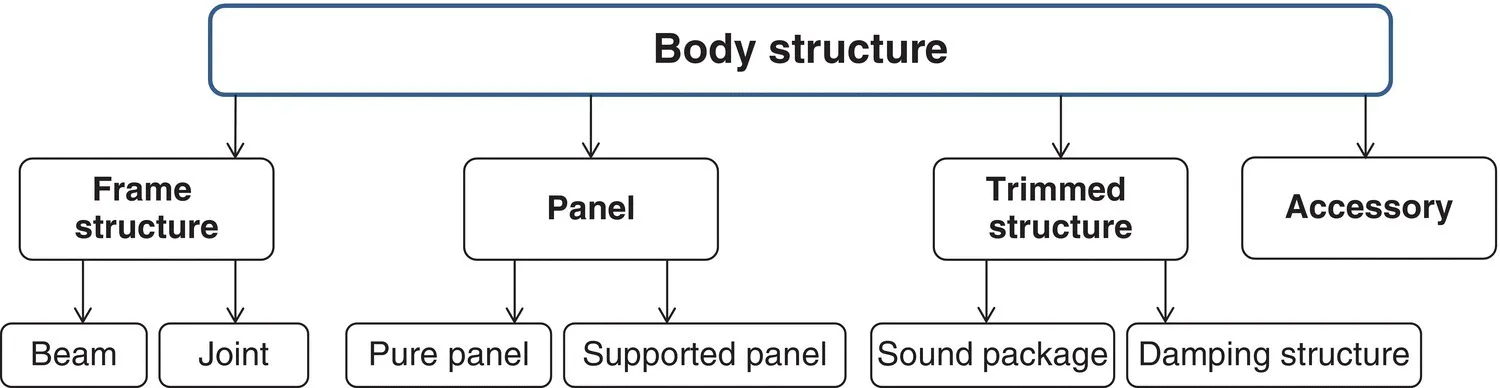
Body design involves many performance attributes, such as NVH, crash safety, fatigue and reliability, fuel economy, and handling. The body can be classified by each attribute according its characteristics. In this book, the body is classified from the perspective of NVH. The body is divided into four categories of structure according to its NVH functions, namely the frame structure, panel structure, trimmed structure, and accessory structure, as shown in Figure 1.3. The frame structure refers to a body frame comprising side frames, cross members, and pillars that are connected by the joints. The panel structure refers to the metal plates that cover the body frame, such as the dash panel, roof, floor, side panels, and door panels. The trimmed structure refers to the parts that reduce noise and vibration, such as the dash insulator and damping structure. The accessory structure refers to the accessory parts installed on the body, such as the steering shaft, mirrors, and seats. The make‐up and functions of these four structures are briefly described below.
Figure 1.3 Classification of body structure.
The frame structure, as shown in Figure 1.4, is the foundation of the body. The frame is composed of front and rear side frames, cross members, pillars, and so on. Several side frames, cross members, and pillars intersect, forming a joint. The cross section, size, and span of a beam determine its stiffness. The joint has significant influence on the body frame stiffness. The frames can only be tightly intersected if the joints have sufficient stiffness. If the frames are stiff enough, but the joint is weak, the stiffness of the body frame is still weak. Therefore, the stiffness of the body frame is determined by both the frame stiffness and the joint stiffness, while the body frame stiffness determines the modal shapes and frequencies of the vehicle body.
Figure 1.4 Body frame structure.
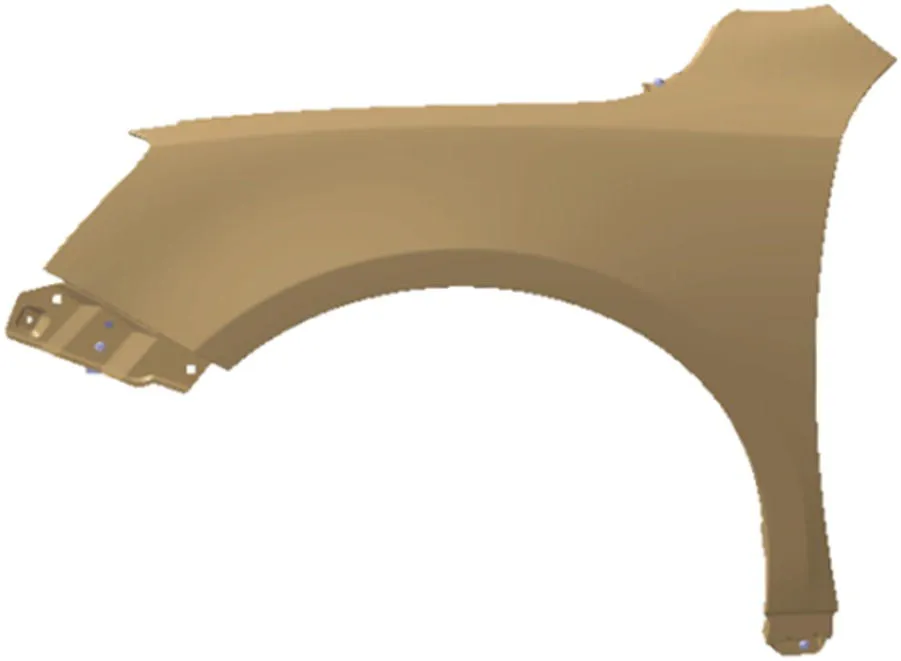
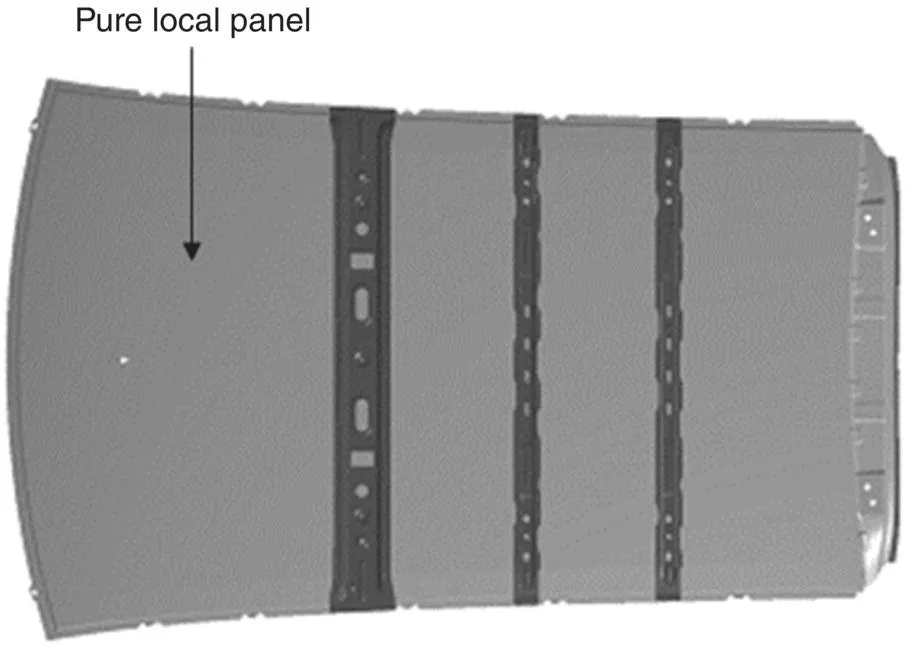
The panels are mounted on the frames to form an enclosed body space. The panels are divided into pure panels (or local pure panels) and supported panels. A pure panel is one without support, such as the fender shown in Figure 1.5. Most body panels are supported by metal beams or reinforcement adhesives, or have beaded surfaces, so this kind of panel is called supported panel. Examples of supported panels include the outer door panel (Figure 1.6), where the internal side is supported by the side‐impact beam or reinforcement adhesives, and the beaded floor (Figure 1.7), which is supported by the cross members. Sometimes, it is difficult to distinguish between a pure panel and a supported panel, as in the case of the roof shown in Figure 1.8. The roof is a big panel supported by several cross rails, but some area of the roof between two rails is so large that it can be regarded as a pure panel.
Figure 1.5 Fender.
Figure 1.6 A door panel. (a) Outside. (b) Internal side.
Figure 1.7 A floor.
Figure 1.8 A roof.
The trimmed structure bonded to the panels and frames includes decoration parts that also function to absorb and insulate sound and non‐metallic parts that suppress the transmission of noise and vibration. From the NVH perspective, the trimmed structure can be divided into four categories: sound insulation structure, sound absorption structure, damping structure, and barrier structure. The sound insulation structure includes the dash insulator and carpets. The sound absorption structure includes the headliner and the sound absorption layer of the dash insulator. In most cases, the sound insulation structure and the sound absorption structure are integrated...
Table of contents
Cover
Table of Contents
Preface
1 Introduction
2 Vibration Control of Overall Body Structure
3 Noise and Vibration Control for Local Body Structures
4 Sound Package
5 Vehicle Body Sensitivity Analysis and Control
6 Wind Noise
7 Door Closing Sound Quality
8 Squeak and Rattle Control in Vehicle Body
9 Targets for Body Noise and Vibration
Index
End User License Agreement
Frequently asked questions
Yes, you can cancel anytime from the Subscription tab in your account settings on the Perlego website. Your subscription will stay active until the end of your current billing period. Learn how to cancel your subscription
No, books cannot be downloaded as external files, such as PDFs, for use outside of Perlego. However, you can download books within the Perlego app for offline reading on mobile or tablet. Learn how to download books offline
Perlego offers two plans: Essential and Complete
Essential is ideal for learners and professionals who enjoy exploring a wide range of subjects. Access the Essential Library with 800,000+ trusted titles and best-sellers across business, personal growth, and the humanities. Includes unlimited reading time and Standard Read Aloud voice.
Complete: Perfect for advanced learners and researchers needing full, unrestricted access. Unlock 1.4M+ books across hundreds of subjects, including academic and specialized titles. The Complete Plan also includes advanced features like Premium Read Aloud and Research Assistant.
Both plans are available with monthly, semester, or annual billing cycles.
We are an online textbook subscription service, where you can get access to an entire online library for less than the price of a single book per month. With over 1 million books across 990+ topics, we’ve got you covered! Learn about our mission
Look out for the read-aloud symbol on your next book to see if you can listen to it. The read-aloud tool reads text aloud for you, highlighting the text as it is being read. You can pause it, speed it up and slow it down. Learn more about Read Aloud
Yes! You can use the Perlego app on both iOS and Android devices to read anytime, anywhere — even offline. Perfect for commutes or when you’re on the go. Please note we cannot support devices running on iOS 13 and Android 7 or earlier. Learn more about using the app
Yes, you can access Noise and Vibration Control in Automotive Bodies by Jian Pang in PDF and/or ePUB format, as well as other popular books in Technology & Engineering & Mechanical Engineering. We have over one million books available in our catalogue for you to explore.