Transplant Immunology
  1. English
  2. ePUB (mobile friendly)
  3. Available on iOS & Android
eBook - ePub

About this book

With all the complex issues of acceptance or rejection of a transplanted organ, immunology is a key subject for all transplantation clinicians. During recent years, there has been an explosion of research and knowledge in this area.

Produced in association with the American Society of Transplantation, and written by experts within the field, Transplant Immunology provides a comprehensive overview of the topic in relation to clinical transplantation.

Starting with the basic functionality of the immune system, it then moves on to cover the very latest developments in immunosuppressive drugs and protocols, as well as a look at all emerging technologies in the field.

Key chapters include:

  • Transplant-related complications
  • Immune responses to transplants
  • Emerging issues in transplantation
  • Biomarkers of Allograft rejection and tolerance
  • T cells and the principles of immune responses

In full colour throughout, over 100 outstanding diagrams support the text, all figures being fully downloadable via the book's companion website. The result is an essential tool for all those responsible for managing patients awaiting and undergoing organ transplantation, including transplant surgeons and clinicians, immunologists and researchers.

Frequently asked questions

Yes, you can cancel anytime from the Subscription tab in your account settings on the Perlego website. Your subscription will stay active until the end of your current billing period. Learn how to cancel your subscription.
No, books cannot be downloaded as external files, such as PDFs, for use outside of Perlego. However, you can download books within the Perlego app for offline reading on mobile or tablet. Learn more here.
Perlego offers two plans: Essential and Complete
  • Essential is ideal for learners and professionals who enjoy exploring a wide range of subjects. Access the Essential Library with 800,000+ trusted titles and best-sellers across business, personal growth, and the humanities. Includes unlimited reading time and Standard Read Aloud voice.
  • Complete: Perfect for advanced learners and researchers needing full, unrestricted access. Unlock 1.4M+ books across hundreds of subjects, including academic and specialized titles. The Complete Plan also includes advanced features like Premium Read Aloud and Research Assistant.
Both plans are available with monthly, semester, or annual billing cycles.
We are an online textbook subscription service, where you can get access to an entire online library for less than the price of a single book per month. With over 1 million books across 1000+ topics, we’ve got you covered! Learn more here.
Look out for the read-aloud symbol on your next book to see if you can listen to it. The read-aloud tool reads text aloud for you, highlighting the text as it is being read. You can pause it, speed it up and slow it down. Learn more here.
Yes! You can use the Perlego app on both iOS or Android devices to read anytime, anywhere — even offline. Perfect for commutes or when you’re on the go.
Please note we cannot support devices running on iOS 13 and Android 7 or earlier. Learn more about using the app.
Yes, you can access Transplant Immunology by Xian C. Li, Anthony M. Jevnikar, Xian C. Li,Anthony M. Jevnikar in PDF and/or ePUB format, as well as other popular books in Medicine & Surgery & Surgical Medicine. We have over one million books available in our catalogue for you to explore.

Information

CHAPTER 1
Tissues and organs of the immune system

Isam W. Nasr, Qiang Zeng, and Fadi G. Lakkis
Thomas E. Starzl Transplantation Institute, Departments of Surgery, Immunology, and Medicine, University of Pittsburgh, Pittsburgh, USA

CHAPTER OVERVIEW

  • Lymphoid organs or tissues are specialized anatomic compartments where lymphocytes develop, reside, and function.
  • Primary lymphoid tissues are the sites where lymphocytes undergo development, education, and maturation.
  • Secondary lymphoid tissues are the main sites where naĂŻve lymphocytes engage foreign antigens to mount a primary immune response.
  • Tertiary lymphoid tissues are secondary lymphoid tissue-like structures that are induced at sites of chronic inflammation, and the function of such structures is not fully defined.
  • Memory immune responses can occur outside secondary lymphoid tissues. Memory T cells can also be maintained without secondary lymphoid tissues.
  • Primary and secondary lymphoid tissues are also necessary for tolerance induction and maintenance.

Introduction
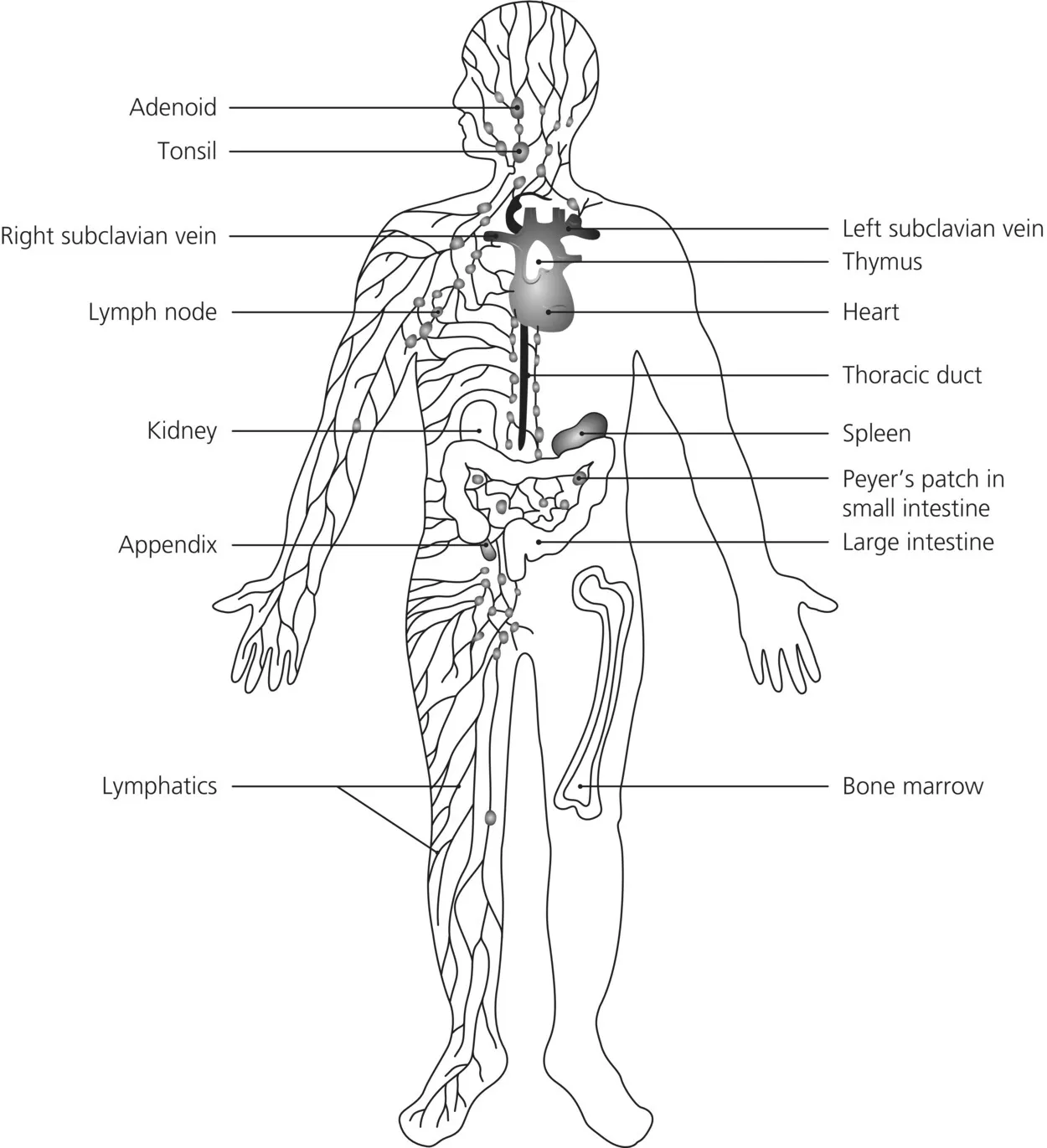
It is the nature of scientists to be perpetually occupied with questions like “where,” “how,” and “why” things happen the way they do. Immunologists, in particular, are keen on answering the “where” question as it is central to understanding how immune cells are generated, what is required for their maturation, and whether they might mount productive responses against foreign antigens or not. The immune system is a bona fide organ system comprising primary and secondary lymphoid tissues (Figure 1.1). Primary lymphoid tissues (the bone marrow and thymus) specialize in generating immune cells from hematopoietic progenitors and transforming immature cells into mature lymphocytes with high specificity to foreign antigens (non-self) but not “self antigens.” Secondary lymphoid tissues, namely the spleen, lymph nodes, and mucosa-associated lymphoid tissues (MALTs) on the other hand are organized structures that are strategically located throughout the body to trap foreign antigens and ensure that they are best presented to T and B lymphocytes. The ability of an animal to mount a productive immune response is therefore critically dependent on the presence of the primary and secondary lymphoid tissues as well as the coordinated migration of immune cells into and out of these tissues.
c1-fig-0001
Figure 1.1 Lymphoid tissues of the human body. The primary lymphoid tissues are the bone marrow and thymus. The secondary lymphoid tissues consist of lymph nodes, the spleen, and MALTs. Lymph nodes are arranged in strings along lymphatic vessels where they trap antigens and cells traveling in the lymph. The spleen intercepts antigens and cells circulating in the bloodstream. MALT includes the Peyer’s patches, adenoids, tonsils, and appendix. Cells traveling in the lymphatic system re-enter the blood circulation via the thoracic duct.
Source: Redrawn from Murphy (2011). Reproduced by permission of Garland Science/Taylor & Francis LLC.
This chapter will provide a comprehensive overview of the anatomy and function of primary and secondary lymphoid tissues and consider their roles in both transplant rejection and tolerance. Tertiary lymphoid tissues, which are secondary lymphoid tissue-like structures that are induced at sites of chronic inflammation, will also be discussed as they are thought to influence allograft outcomes. Controversies and unresolved questions will be highlighted where appropriate to encourage future investigations.

Primary lymphoid tissues

Primary lymphoid tissues are sites where T cells and B cells develop and mature, and mainly include the bone marrow and the thymus in mammals.

Bone marrow

The bone marrow is the site where both red and white blood cells are generated, by a process known as hematopoiesis. The adult human has two types of bone marrow: the red marrow, in which hematopoiesis is actively taking place, and the yellow marrow, consisting mainly of fat cells and lacking hematopoietic activity. At birth, all marrow is red but it is slowly replaced by yellow marrow over time. By adulthood, red marrow is restricted to flat bones (cranium, sternum, vertebrae, pelvis, and scapulae) and the epiphyseal ends of long bones (e.g., the femur and humerus), while the remaining marrow cavities are being occupied by fat cells. The bone marrow also provides a place where subsets of lymphocytes (both T cells and B cells), especially those with memory phenotypes reside.

Structure

Histologically, the red marrow consists of hematopoietic islands; such islands are mixed with fat cells, surrounded by vascular sinusoids, and interspersed throughout a meshwork of trabecular bone (Figure 1.2). The hematopoietic islands are organized into three-dimensional structures that provide optimal microenvironment for hematopoiesis. They contain blood cell precursors at different stages of maturation, stromal reticular cells, endothelial cells, macrophages, osteoblasts, osteoclasts, and the extracellular matrix. Both hematopoietic and nonhematopoietic cells in the islands orchestrate blood cell maturation through cell–cell contacts as well as production of growth factors, cytokines, and chemokines. Mature blood cells enter the circulation by migrating through the discontinuous basement membrane and between the endothelial cells of the vascular sinusoids.
c1-fig-0002
Figure 1.2 Structure of the bone marrow. Example of red bone marrow (vertebra). Arrow points to a hematopoietic tissue island. Note fat cells (white globules) admixed with hematopoietic cells. Trabecular bone fills the space between islands.
Source: Reprinted from Travlos (2006). Reproduced by permission of SAGE publications.

Function

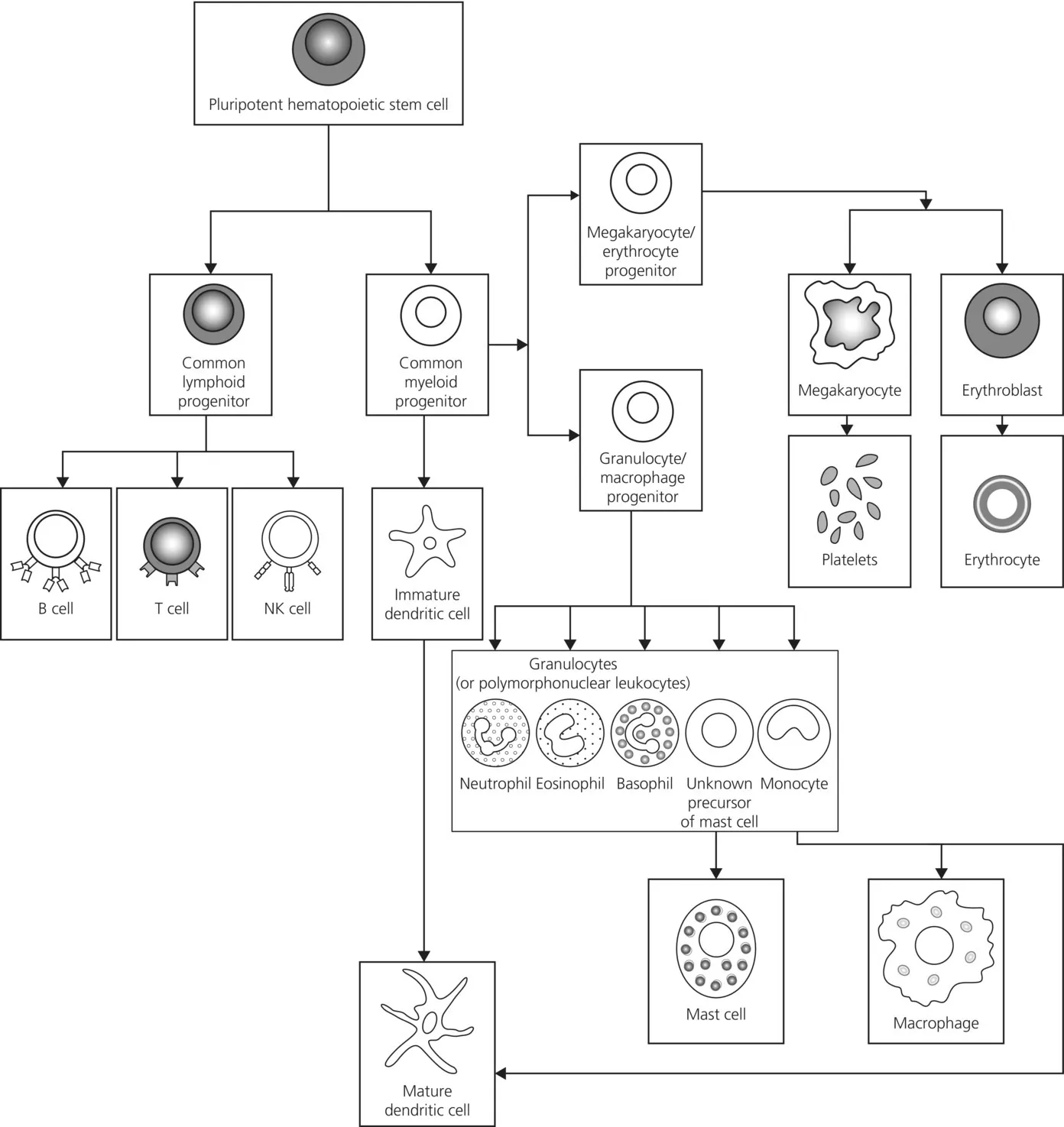
Hematopoietic stem cells (HSCs) are a pluripotent self-renewing cell type in the bone marrow that give rise to progenitor cells. These progenitor cells in turn generate all cells of the megakaryocytic (platelet), erythroid (RBC), myeloid, and lymphoid lineages (Figure 1.3). Myeloid cells (monocytes, dendritic cells or DCs, neutrophils, basophils, and eosinophils), natural killer (NK) cells, and B lymphocytes develop in the bone marrow, whereas T cell progenitors (pre-thymocytes) migrate to the thymus where they undergo further maturation (see section “Thymus”). The bone marrow also contains mesenchymal stem cells that give rise to nonhematopoietic tissues such as adipocytes, chondrocytes, osteocytes, and myoblasts. Mesenchymal stem cells have attracted considerable interest among transplant immunologists because of their immunosuppressive properties and prolonged survival features when adoptively transferred in select models.
c1-fig-0003
Figure 1.3 Ontogeny of immune cells. Cells of the immune system arise from pluripotent HSCs in the bone marrow. The common lymphoid progenitor gives rise to B cells, T cells, and NK cells. The common myeloid progenitor gives rise to dendritic cells (DCs), monocytes, neutrophils, eosinophils, and basophils.
The bone marrow is the site where most stages of B cell maturation occur in mammals. B cell development in the bone marrow proceeds in a stepwise fashion from pro-B cells to pre-B cells, and lastly to immature B cells. During maturation in the bone marrow, B cells rearrange their immunoglobulin genes and express cell-surface IgM (the B cell receptor for antigen). These steps require close interactions with bone marrow stromal cells, which provide critical adhesion molecules, growth factors, chemokines, and cytokines (e.g., Flt3 ligand, thrombopoietin, CXCL12, and IL-7). Finally, autoreactive immature B cells are “weeded out” in the bone marrow through either clonal deletion or receptor editing before they are allowed into the circulation and complete their maturation in secondary lymphoid tissues.
In addition to serving as a primary lymphoid organ, the bone marrow is also a reservoir for mature myeloid and lymphoid cells. The bone marrow contains large numbers of neutrophils and monocytes that are mobilized into the circulation when needed (e.g., after infection). It is also the homing site for mature plasma cells, which are maintained in the bone marrow through the action of IL-6. Plasma cells are the principal source of antibodies in sensitized transplant recipients; therefore, investigators addressing the pathogenesis of antibody (historically referred to as “humoral”) rejection are increasingly interested in these bone marrow-resident plasma cells. There is also strong evidence that memory T cells home to or reside in the bone marrow where they can be activated by antigens. Other experiments have suggested that activation of naïve T cells could occur in the bone marrow under certain circumstances, raising the possibility that the bone marrow may additionally serve as a secondary lymphoid tissue (see section “Secondary lymphoid tissues”).

Cell trafficking

Cell trafficking is a dynamic process underlying allorecognition and transplantation responses, and remains a potential target in therapeutic strategies. Mature myeloid cells and certain precursor lymphoid cells (pre-thymocytes, immature B cells) migrate out of the bone marrow and enter the circulation. Conversely, mature lymphocytes (e.g., plasma cells) migrate into the bone marrow. The HSCs are also known to exit and re-enter the bone marrow. These trafficking events are primarily regulated by adhesion molecules and guided by chemokines. The integrin VLA-4, for example, maintains the developing B cells in tight contact with stromal cells by binding to VCAM-1. The chemokine CXCL12, which is produced by stromal reticular cells and osteoblasts, is responsible for retaining HSCs as well as myeloid and lymphoid cells in the bone marrow by binding to its receptor CXCR4. Some individuals with “gain of function” mutations in CXCR4 (e.g., WHIM syndrome) have pan-leukopenia because of increased retention of leukocytes in the bon...

Table of contents

  1. Cover
  2. Title page
  3. Table of Contents
  4. Contributors
  5. Foreword
  6. Preface
  7. About the companion website
  8. CHAPTER 1: Tissues and organs of the immune system
  9. CHAPTER 2: Cells of the immune system
  10. CHAPTER 3: Soluble mediators in the immune system
  11. CHAPTER 4: Costimulatory molecules
  12. CHAPTER 5: Major histocompatibility complex
  13. CHAPTER 6: T cells and the principles of immune responses
  14. CHAPTER 7: Ischemia and reperfusion injury
  15. CHAPTER 8: Immune responses to transplants
  16. CHAPTER 9: Principles of hematopoietic cell transplantation
  17. CHAPTER 10: Therapeutic approaches to organ transplantation
  18. CHAPTER 11: Organ-specific features in clinical transplantation
  19. CHAPTER 12: Transplant-related complications
  20. CHAPTER 13: Biomarkers of allograft rejection and tolerance
  21. CHAPTER 14: Emerging issues in transplantation
  22. CHAPTER 15: New frontiers and new technologies
  23. CHAPTER 16: Experimental models in discovery and translational studies
  24. Index
  25. End User License Agreement