
eBook - ePub
Hyperbolic Structures
Shukhov's Lattice Towers - Forerunners of Modern Lightweight Construction
- English
- ePUB (mobile friendly)
- Available on iOS & Android
eBook - ePub
Hyperbolic Structures
Shukhov's Lattice Towers - Forerunners of Modern Lightweight Construction
About this book
Hyperbolic structures analyses the interactions of form with the structural behaviour of hyperbolic lattice towers, and the effects of the various influencing factors were determined with the help of parametric studies and load capacity analyses. This evaluation of Shukhov's historical calculations and the reconstruction of the design and development process of his water towers shows why the Russian engineer is considered not only a pathfinder for lightweight structures but also a pioneer of parametrised design processes.
Tools to learn more effectively

Saving Books

Keyword Search

Annotating Text

Listen to it instead
Information
Design and analysis of Shukhov’s towers
To gain a deeper insight into Shukhov’s methods of design and the underlying theory, the calculations for his hyperbolic lattice towers and their static models are analysed and evaluated in the following sections. The basic information was obtained from the archives of the Russian Academy of Sciences in Moscow, the city archives at Nizhny Novgorod, the private archives of Elena Shukhov and the Stuttgart University library catalogue.
The design process for his water towers is also reconstructed, the development of the tower design over time investigated and some details of construction briefly explained. To obtain a better understanding and set the historic context, the following section presents a general picture of the development of steel water towers and the state of structural engineering knowledge at the time of Shukhov.
The development of steel water tanks and water towers
It is helpful in establishing the historical context and the significance of Shukhov’s water towers to examine the development of steel water tanks, because the different forms of construction of these containers always have their own characteristic requirements and consequences on the supporting structure. Extensive consideration of the architectural history and technical development of these structures can be found, for example, in contemporary papers on steel construction (various authors including Eduard Kottenmeier [1]) and in the publication “Ursachen und technische Voraussetzungen für die Entwicklung der Wasserhochbehälter” [2].
The development of water towers, which have their predecessors in the hydraulic structures of the Middle Ages and early water supply systems for towns and villages, started in the middle of the 19th century. The same era also saw the construction of mostly cast iron flat-bottomed tanks, which often took the rectangular box shape of their wooden predecessors (Fig. 2 a). One of the first cylindrical flat-bottomed tanks in Germany to be built completely out of wrought iron was the 1868 water tower in Halle an der Saale (464 m3 capacity, Fig. 2 b). This tank is made out of singly curved plates riveted together at their overlapping edges, which are then sealed with spun yarn and red lead. The crucial disadvantage of the flat-bottomed tank is its supporting grillage beam system, which is loaded in bending, therefore material-intensive and costly, and also makes maintenance of the underside of the tank difficult. In 1855, Frenchman Jules Dupuit was the first to design the tank bottom as a suspended calotte and therefore make the cylinder walls and the bottom into predominantly tensile members. The first water tanks with a suspended bottom were built from the end of the 1860s for French railway companies and had medium storage capacities. One example is the elevated tank with a 150 m3 capacity built for the Midi-Ouest railway (Fig. 2 c). [3] The bottom plates are typically fastened with an angle profile (120°) to the cylindrical tank wall and connected by another angle profile – in this case cast iron – to a support ring, which distributes the vertical forces into the substructure (Fig. 4).

1 Water tower, Lugovaya near Moscow (RUS), condition in 2008
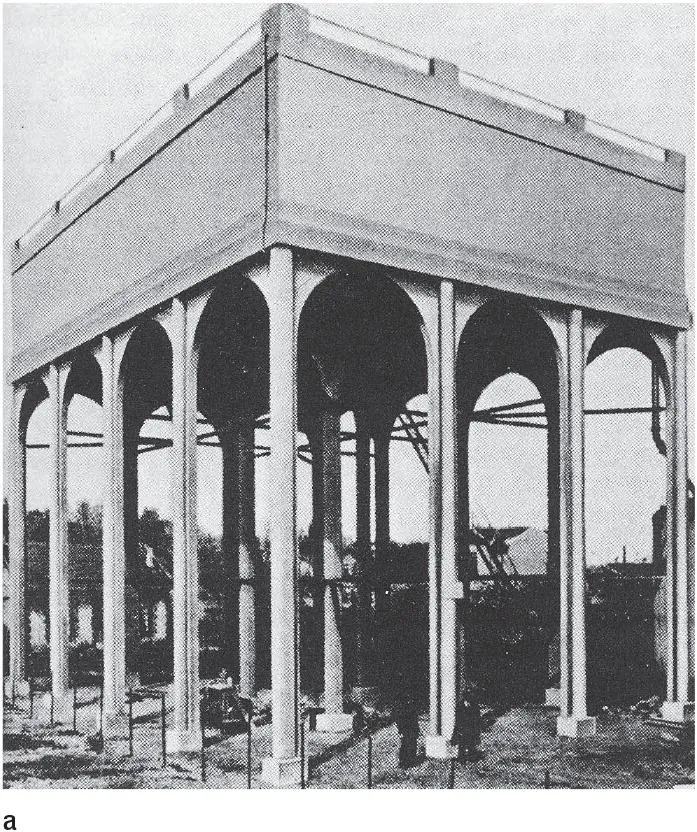
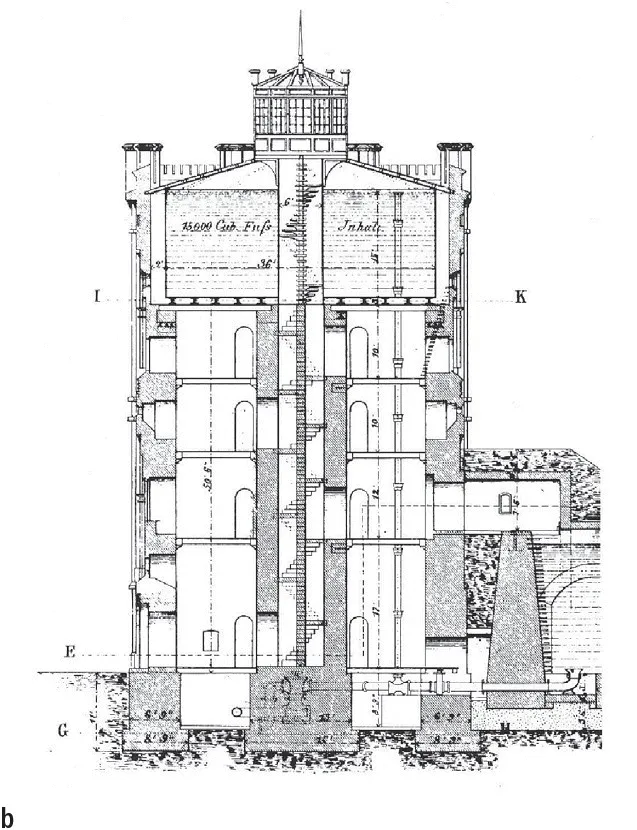
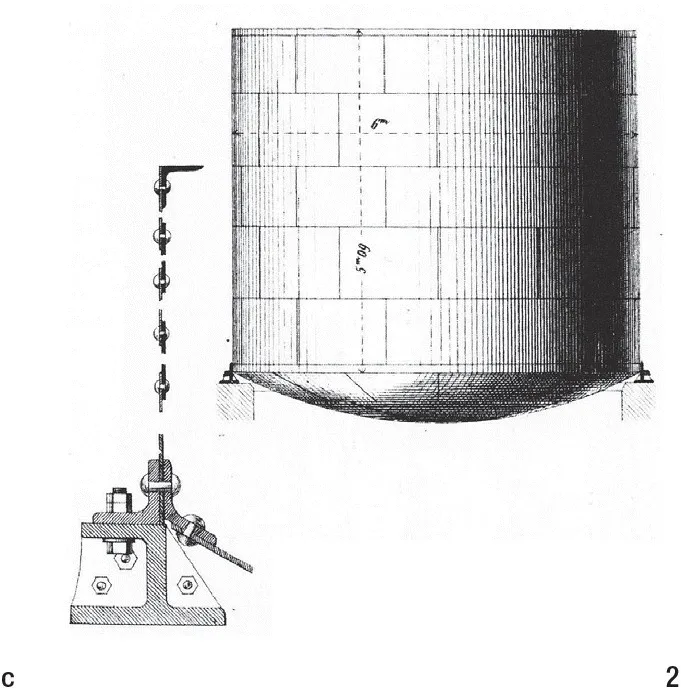
2 Elevated water tanks
- Maisons-Lafitte near Paris (F) 1850
- Halle an der Saale (D) 1868
- For the French Midi-Ouest railway (F) ca. 1865
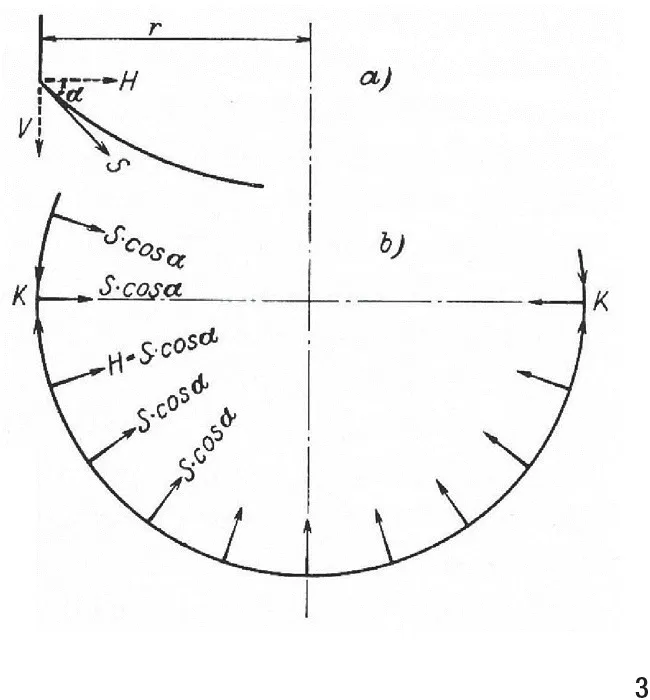
3 Horizontal forces acting on the support ring for suspended bottom tanks
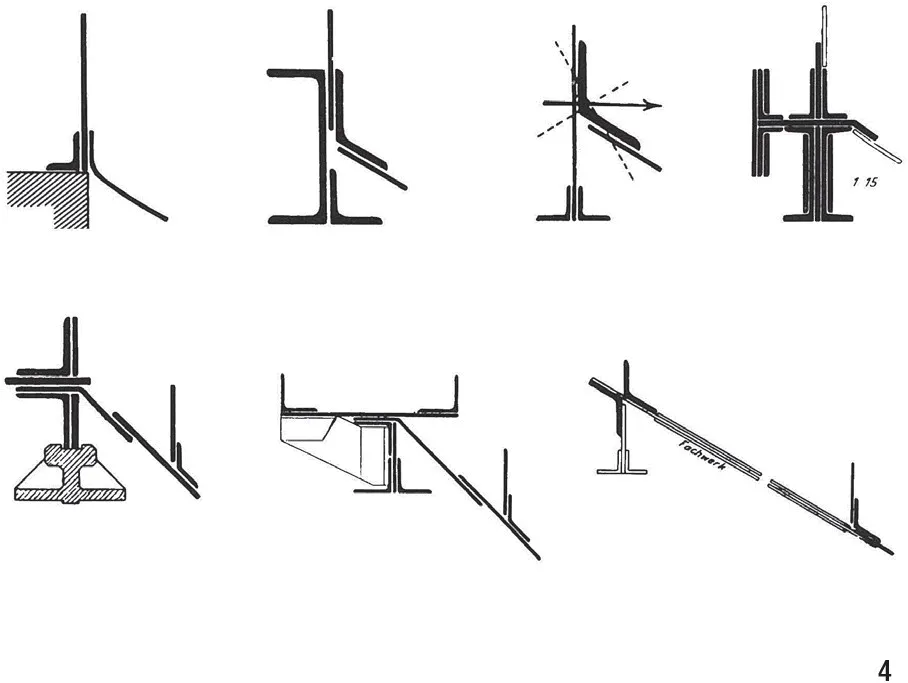
4 Different methods of fastening the suspended bottom to the support ring
The shallow inclination of the calotte bottom places the support ring for the suspended tanks under considerable compressive stress. In tanks with larger volumes, the rise and fall of the water level causes the support ring to deflect, exhibiting a wide range of movement, which generally leads to the tanks leaking. [4] Over the years, engineers sought by various design measures to eliminate this construction problem without ever finding a fully satisfactory solution.
A substantial improvement was brought about only by a later invention patented by the Aachen engineer Otto Intze. For a water tower built in 1883 in Remscheid, he incorporated a conical area into the tank cross section from the bottom edge of the cylinder wall to an inner support ring. By inverting the then conventional suspended bottom to form a supporting bottom, he creates a compression-loaded domed calotte (with stiffening ribs): in geometrical terms a spherical cap, with the horizontal bearing force components acting outwards on the support ring. The horizontal forces are cancelled out if the angles of the conical section are appropriately chosen to suit the tangent angle of the domed calotte. In this case, the support ring has to be designed only for the vertical loads and therefore the task is much simpler. For tank volumes of over 1000 m3, this leads to material savings of around 10 % and for smaller capacity tanks around 25 %. [5] Intze improved his tank shape in 1885 by replacing the supporting bottom with a second upstand to his cone in combination with a suspended bottom (Intze type II, Fig. 6 b). This did away with the large construction depth of the supporting bottom and resulted in a considerable increase in tank capacity. Moreover, it dispensed with the need to fabricate the complex buckling stiffeners required for the supporting bottom. The new form of construction proved very successful for the Aachen company F. A. Neumann, who acquired the patents from Intze. Between 1891 and 1902, the company manufactured 85 series-produced railway water towers to the Intze type I design alone, with standardised tank sizes of between 15 and 1000 m3. [6]
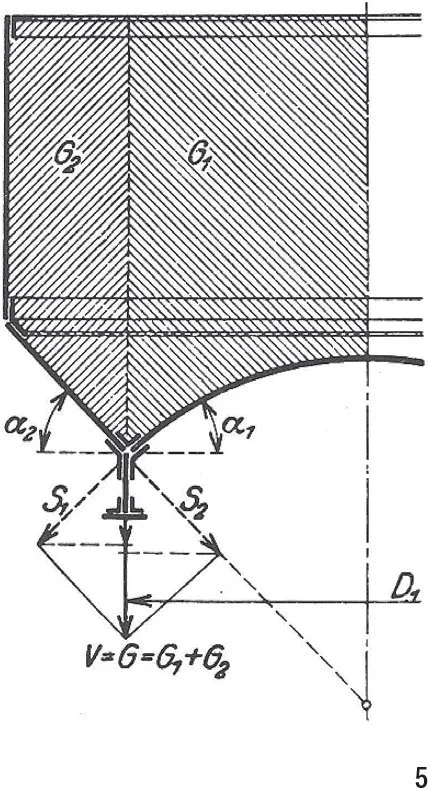
5 Cancelling out of the horizontal force component with Intze tanks (type I)
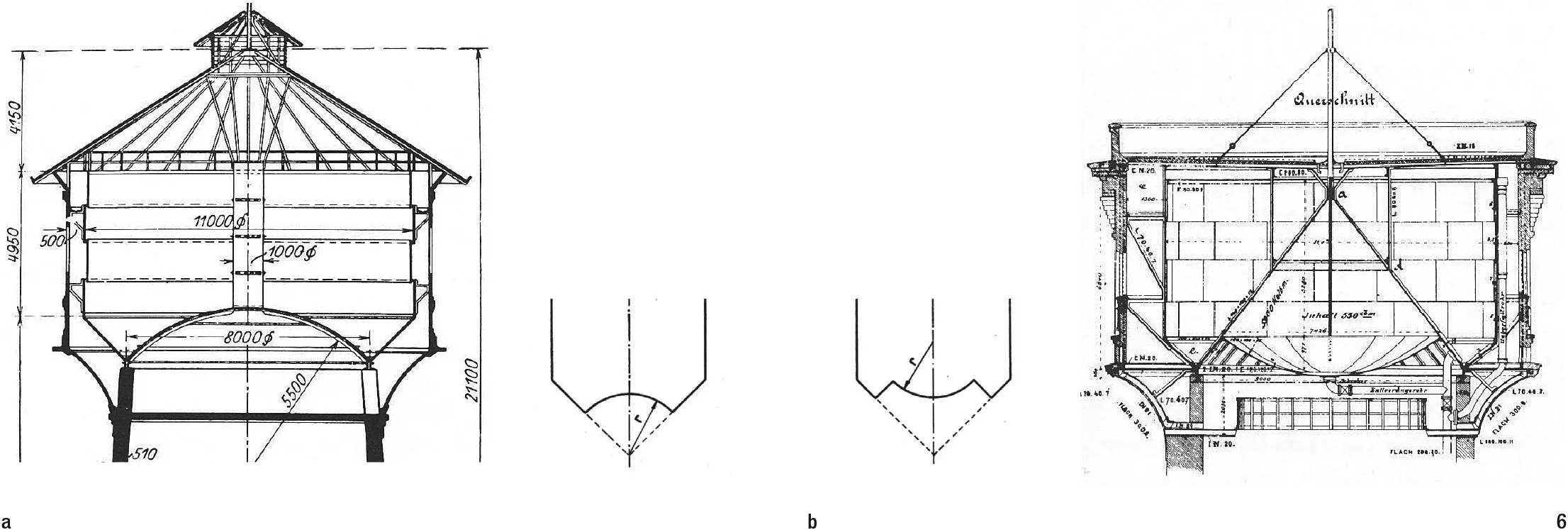
6 Water tanks to the Otto Intze design: type I with a supporting bottom (a) and type II incorporating a suspended bottom (b)
The Intze tanks continued to be the dominant construction type for water tanks in Germany until the start of the 20th century. In 1898, Georg Barkhausen developed a new type of tank, which was a further development of the earlier suspended bottom type. It became known as the Barkh...
Table of contents
- Cover
- Title page
- Copyright page
- Foreword
- Introduction
- Building with hyperbolic lattice structures
- Geometry and form of hyperbolic lattice structures
- Structural analysis and calculation methods
- Relationships between form and structural behaviour
- Design and analysis of Shukhov’s towers
- NiGRES tower on the Oka
- Résumé
- Towers in comparison
- Notes
- Literature
- Picture credits
- About the author
- Notation
- Index
- Acknowledgement
- End User License Agreement
Frequently asked questions
Yes, you can cancel anytime from the Subscription tab in your account settings on the Perlego website. Your subscription will stay active until the end of your current billing period. Learn how to cancel your subscription
No, books cannot be downloaded as external files, such as PDFs, for use outside of Perlego. However, you can download books within the Perlego app for offline reading on mobile or tablet. Learn how to download books offline
Perlego offers two plans: Essential and Complete
- Essential is ideal for learners and professionals who enjoy exploring a wide range of subjects. Access the Essential Library with 800,000+ trusted titles and best-sellers across business, personal growth, and the humanities. Includes unlimited reading time and Standard Read Aloud voice.
- Complete: Perfect for advanced learners and researchers needing full, unrestricted access. Unlock 1.4M+ books across hundreds of subjects, including academic and specialized titles. The Complete Plan also includes advanced features like Premium Read Aloud and Research Assistant.
We are an online textbook subscription service, where you can get access to an entire online library for less than the price of a single book per month. With over 1 million books across 990+ topics, we’ve got you covered! Learn about our mission
Look out for the read-aloud symbol on your next book to see if you can listen to it. The read-aloud tool reads text aloud for you, highlighting the text as it is being read. You can pause it, speed it up and slow it down. Learn more about Read Aloud
Yes! You can use the Perlego app on both iOS and Android devices to read anytime, anywhere — even offline. Perfect for commutes or when you’re on the go.
Please note we cannot support devices running on iOS 13 and Android 7 or earlier. Learn more about using the app
Please note we cannot support devices running on iOS 13 and Android 7 or earlier. Learn more about using the app
Yes, you can access Hyperbolic Structures by Matthias Beckh in PDF and/or ePUB format, as well as other popular books in Technology & Engineering & Civil Engineering. We have over one million books available in our catalogue for you to explore.