Introduction to Applied Colloid and Surface Chemistry
eBook - ePub

Introduction to Applied Colloid and Surface Chemistry

  1. English
  2. ePUB (mobile friendly)
  3. Available on iOS & Android
eBook - ePub

Introduction to Applied Colloid and Surface Chemistry

About this book

Colloid and Surface Chemistry is a subject of immense importance and implications both to our everyday life and numerous industrial sectors, ranging from coatings and materials to medicine and biotechnology.

How do detergents really clean? (Why can't we just use water?) Why is milk "milky"? Why do we use eggs so often for making sauces? Can we deliver drugs in better and controlled ways? Coating industries wish to manufacture improved coatings e.g. for providing corrosion resistance, which are also environmentally friendly i.e. less based on organic solvents and if possible exclusively on water. Food companies want to develop healthy, tasty but also long-lasting food products which appeal to the environmental authorities and the consumer. Detergent and enzyme companies are working to develop improved formulations which clean more persistent stains, at lower temperatures and amounts, to the benefit of both the environment and our pocket. Cosmetics is also big business! Creams, lotions and other personal care products are really just complex emulsions.

All of the above can be explained by the principles and methods of colloid and surface chemistry. A course on this topic is truly valuable to chemists, chemical engineers, biologists, material and food scientists and many more.

Frequently asked questions

Yes, you can cancel anytime from the Subscription tab in your account settings on the Perlego website. Your subscription will stay active until the end of your current billing period. Learn how to cancel your subscription.
At the moment all of our mobile-responsive ePub books are available to download via the app. Most of our PDFs are also available to download and we're working on making the final remaining ones downloadable now. Learn more here.
Perlego offers two plans: Essential and Complete
  • Essential is ideal for learners and professionals who enjoy exploring a wide range of subjects. Access the Essential Library with 800,000+ trusted titles and best-sellers across business, personal growth, and the humanities. Includes unlimited reading time and Standard Read Aloud voice.
  • Complete: Perfect for advanced learners and researchers needing full, unrestricted access. Unlock 1.4M+ books across hundreds of subjects, including academic and specialized titles. The Complete Plan also includes advanced features like Premium Read Aloud and Research Assistant.
Both plans are available with monthly, semester, or annual billing cycles.
We are an online textbook subscription service, where you can get access to an entire online library for less than the price of a single book per month. With over 1 million books across 1000+ topics, we’ve got you covered! Learn more here.
Look out for the read-aloud symbol on your next book to see if you can listen to it. The read-aloud tool reads text aloud for you, highlighting the text as it is being read. You can pause it, speed it up and slow it down. Learn more here.
Yes! You can use the Perlego app on both iOS or Android devices to read anytime, anywhere — even offline. Perfect for commutes or when you’re on the go.
Please note we cannot support devices running on iOS 13 and Android 7 or earlier. Learn more about using the app.
Yes, you can access Introduction to Applied Colloid and Surface Chemistry by Georgios M. Kontogeorgis,Soren Kiil in PDF and/or ePUB format, as well as other popular books in Physical Sciences & Physical & Theoretical Chemistry. We have over one million books available in our catalogue for you to explore.

Information

1
Introduction to Colloid and Surface Chemistry

1.1 What are the colloids and interfaces? Why are they important? Why do we study them together?
Colloid and surface chemistry is a core subject of physical chemistry. It is a highly interdisciplinary subject, of interest to diverse fields of science and engineering (pharmaceuticals, food, cosmetics, detergents, medicine and biology, up to materials and microelectronics, just to mention a few). Being challenging to teach, it is often either incorporated or presented very briefly in general physical chemistry courses or, even worse, completely neglected (Panayiotou, 1998).
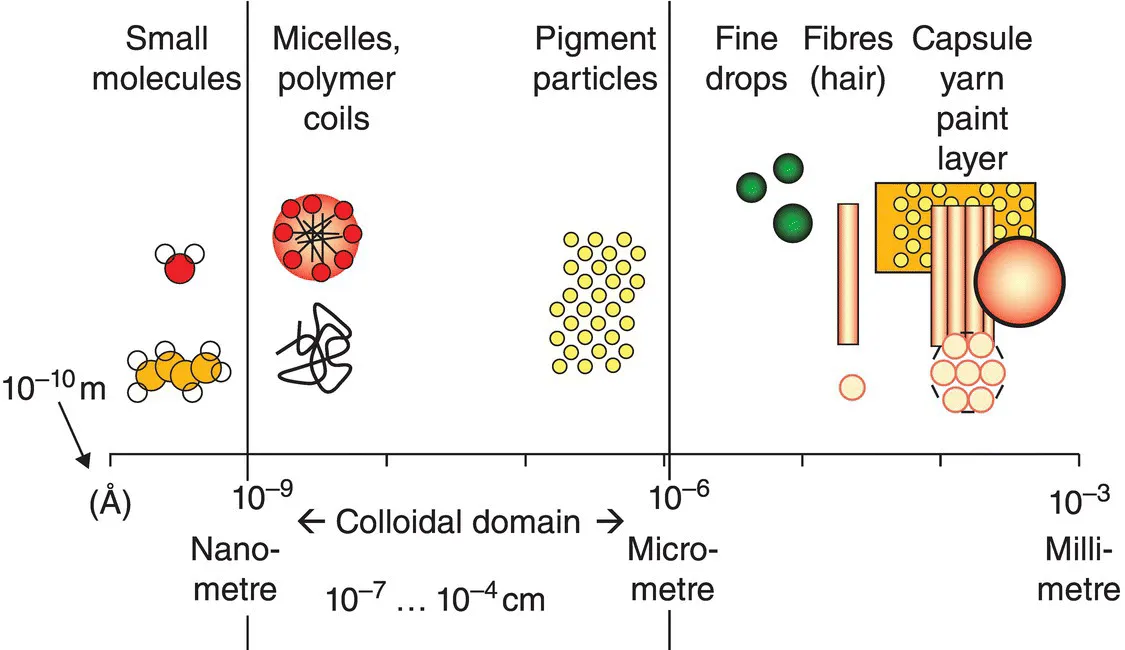
Colloidal systems have a minimum of two components. Colloidal dispersions are systems of particles or droplets with the “right dimensions” (the dispersed phase), which are dispersed in a medium (gas, liquid or solid). The medium is called the continuous phase, which is usually in excess. But which are the “right dimensions”? The particles or droplets have dimensions (or one key dimension) between (typically) 1 nm and 1 μm and their special properties arise from the large surfaces due to precisely these dimensions (Figure 1.1).
Schematic illustrating scales in colloid and surface science displaying the small molecules, micelles polymer coils, pigment particles, fine drops, fibers (hair), capsule yarn paint layer
Figure 1.1 Scales in colloid and surface science. Typically, colloidal particles have one key dimension between 1 nm and 1 μm (micrometre).
Adapted from Wesselingh et al. (2007), with permission from John Wiley & Sons, Ltd
However, sometimes even larger particles, with diameters up to 10 or even up to 50 micrometre (μm), e.g. in emulsions, or very small particles as small as 5 × 10⁻¹⁰ m can present colloidal character. Thus, despite the above definition, it is sometimes stated that “If it looks like and if it acts like a colloid, it is a colloid”.
Colloids are characterized by their many interesting properties (e.g. kinetic or optical) as well as by observing their stability over time.
The characteristic properties of colloidal systems are due to the size of the particles or droplets (i.e. the dispersed phase), and not to any special nature of the particles. However, their name is attributed to Thomas Graham (Figure 1.2), who was studying glue-like (gelatinous or gum-like polymeric) solutions (from the Greek word for glue which is “colla”).
Photo of a glue (left) and a portrait of Thomas Graham (right).
Figure 1.2 Thomas Graham (1805–1869), the pioneer in the study of colloidal systems, used the term “colloids” derived from the Greek word for glue (“colla”). He thought that their special properties were due to the nature of the compounds involved. Later, it was realized that the size of particles (of the “dispersed phase”, as we call it) is solely responsible for the special properties of colloidal systems. (Right) T. Graham, H407/0106.
Courtesy of Science Photo Libraryx
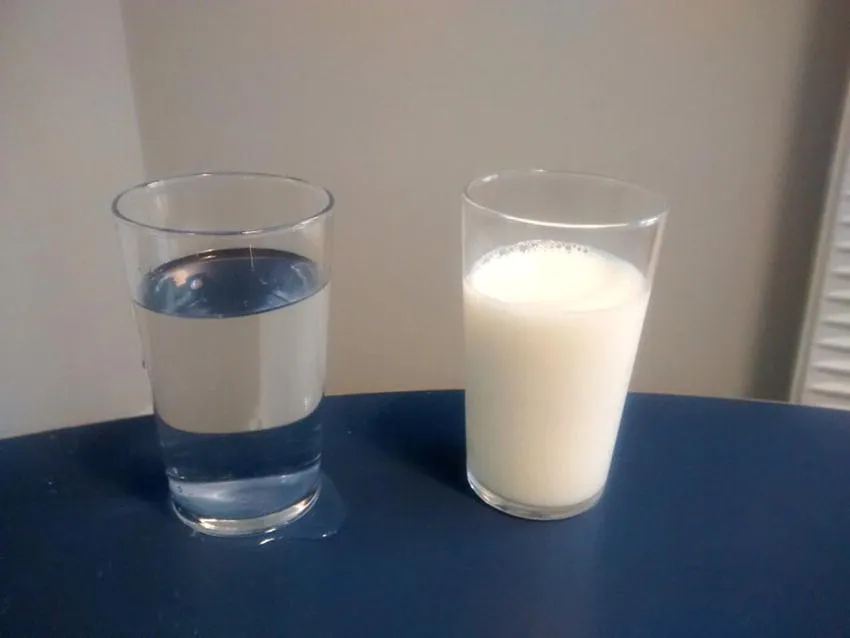
Many colloidal systems like milk are easily identified by their colour, or more precisely their non-transparent appearance (Figure 1.3). The optical properties of colloids are very important, also in their characterization and study of their stability – as discussed in later chapters.
Photo displaying a non-colloidal (water; left) and a colloidal liquid system (milk; right).
Figure 1.3 A non-colloidal (water) and a colloidal liquid system (milk)
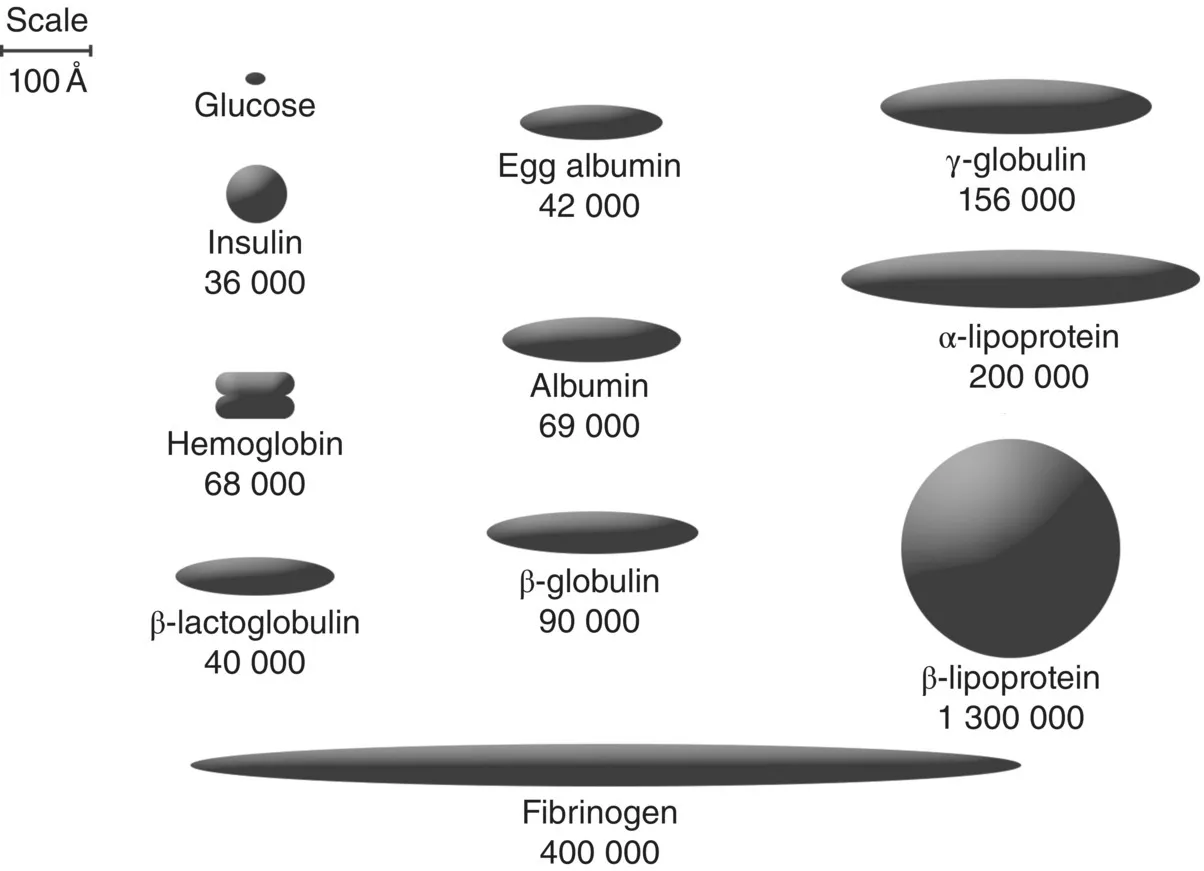
Colloidal particles (or droplets) are not always spherical. They can have various shapes (e.g. spherical and rod- or disk-like), as shown in Figure 1.4. Proteinic and polymeric molecules are usually large enough to be defined as colloid particles. Moreover, their shape may be somewhat affected by solvation (hydration) phenomena, where solvent molecules become “attached” to them and influence their final properties. Solutions of proteins and polymers may be stable and they are classified as lyophilic colloids. Many colloidal particles (e.g. Au or AgI) are (near)spherical, but others are not. For example, proteins are often ellipsoids, while many polymers are random coils.
Image described by caption.
Figure 1.4 Different shapes of colloid particles with molecular weights provided in g mol–1. Pr J. L. Onclev. Harvard Medical School

1.1.1 Colloids and interfaces

What about surfaces and interfaces? Colloidal systems are composed of small particles dispersed in a medium. The fact that these particles have such small dimensions is the reason that a huge surface (interfac...

Table of contents

  1. Cover
  2. Title Page
  3. Table of Contents
  4. Preface
  5. Useful Constants
  6. Symbols and Some Basic Abbreviations
  7. About the Companion Web Site
  8. 1 Introduction to Colloid and Surface Chemistry
  9. 2 Intermolecular and Interparticle Forces
  10. 3 Surface and Interfacial Tensions – Principles and Estimation Methods
  11. 4 Fundamental Equations in Colloid and Surface Science
  12. 5 Surfactants and Self-assembly. Detergents and Cleaning
  13. 6 Wetting and Adhesion
  14. 7 Adsorption in Colloid and Surface Science – A Universal Concept
  15. 8 Characterization Methods of Colloids – Part I
  16. 9 Characterization Methods of Colloids – Part II
  17. 10 Colloid Stability – Part I
  18. 11 Colloid Stability – Part II
  19. 12 Emulsions
  20. 13 Foams
  21. 14 Multicomponent Adsorption
  22. 15 Sixty Years with Theories for Interfacial Tension – Quo Vadis?
  23. 16 Epilogue and Review Problems
  24. Index
  25. End User License Agreement