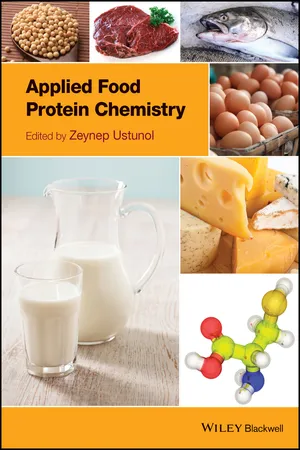
Applied Food Protein Chemistry
eBook - ePub

Applied Food Protein Chemistry

  1. English
  2. ePUB (mobile friendly)
  3. Available on iOS & Android
eBook - ePub

Applied Food Protein Chemistry

About this book

Food proteins are of great interest, not only because of their nutritional importance and their functionality in foods, but also for their detrimental effects. Although proteins from milk, meats (including fish and poultry), eggs, cereals, legumes, and oilseeds have been the traditional sources of protein in the human diet, potentially any proteins from a biological source could serve as a food protein. The primary role of protein in the diet is to provide the building materials for the synthesis of muscle and other tissues, and they play a critical role in many biological processes. They are also responsible for food texture, color, and flavor. Today, food proteins are extracted, modified, and incorporated into processed foods to impart specific functional properties. They can also have adverse effects in the diet: proteins, such as walnuts, pecans, almonds, and cashews, soybean, wheat, milk, egg, crustacean, and fish proteins can be powerful allergens for some people.

Applied Food Protein Chemistry is an applied reference which reviews the properties of food proteins and provides in-depth information on important plant and animal proteins consumed around the world. The book is grouped into three sections: (1) overview of food proteins, (2) plant proteins, and (3) animal proteins. Each chapter discusses world production, distribution, utilization, physicochemical properties, and the functional properties of each protein, as well as its food applications. The authors for each of the chapters are carefully selected experts in the field. This book will be a valuable reference tool for those who work on food proteins. It will also be an important text on applied food protein chemistry for upper-level students and graduate students of food science programs.

Trusted by 375,005 students

Access to over 1.5 million titles for a fair monthly price.

Study more efficiently using our study tools.

Information

Publisher
Wiley
Year
2014
Print ISBN
9781119944492
eBook ISBN
9781118860618

I
Protein Properties

1
Introduction to Food Proteins

Zeynep Ustunol
Department of Food Science and Human Nutrition, Michigan State University, East Lansing, MI, USA
The word protein was coined by Jons J. Berzelius in 1838, and is derived from the Greek word proteios which refers to being “of the first rank.” Over the past 100 years proteins were studied extensively and food proteins have been of much interest not only because of their importance nutritionally and for their functionality in foods, but also for their detrimental effects. Food proteins include proteins from milk, meats (including fish and poultry), eggs, cereals, legumes, and oilseeds. Although these have been the traditional sources of protein in the human diet, potentially any proteins from a biological source could serve as a food protein. However, a food protein must be nontoxic, nutritionally adequate, digestible, have functionality desirable in foods, be readily available, and agriculturally sustainable.
The primary role of proteins in the diet is to provide the building materials for synthesis of muscle and other tissues. Proteins play a critical role in many biological processes. For example, proteins such as myoglobin and ferritin are involved in the transport of important biological molecules; oxygen and iron, respectively. Proteins are also major components of muscle and skin, and are essential for providing mechanical support in the body. Antibodies are highly specific proteins, important in immune defenses. Nerve cell responses to specific stimuli are mediated by protein receptors. Growth and differentiation of cells are also controlled by growth factors that are often proteins. Enzymes are proteins with catalytic activity which stimulate many chemical reactions in biological systems. Recently, there has been much interest in proteins due to the satiety they provide, as well as the bioactive peptides derived from them because of their potential as neutraceuticals. Proteins and bioactive peptides have the potential to improve health and reduce risk of various diseases.
The nutritional value of a protein is determined by its amino acid composition. A protein containing all of the essential amino acids in life and growth sustaining proportions is considered a complete protein and will have a high biological value. Many animal proteins generally have high biological value, whereas plant proteins generally are not as high in biological value due to their deficiency in some of the essential amino acids. However, incomplete proteins can be supplemented with the missing essential amino acids. This has been an important practice in improving world's food sources. The body's daily protein requirements vary by person, with typical demand being greatest during growth, pregnancy, and lactation. Protein malnutrition can be reversed by proper diet. However, when protein intake is inadequate for too long the recovery may not be complete and the damage is irreversible, possibly leading to mental retardation.
Food proteins are responsible for texture, color, and flavor. Today they are extracted, modified, and incorporated into processed foods to impart specific functional properties. For example, proteins can function as buffering agents, emulsifiers, and fat mimetics in foods. Certain proteins can also form gels and foams. Because proteins contain both hydrophilic and hydrophobic characteristics they can orient themselves at the oil–water interface and can stabilize emulsions, which is important for the stability of foods such as salad dressings, sauces and mayonnaise. Foams are colloidal dispersion of gas in liquid. The protein orients itself at the air–water interface to trap air, similarly as emulsions. Foams are important in foods such as dessert toppings and ice creams. Egg and milk proteins are good foaming agents. Proteins can also form a well-ordered protein matrix or a gel which then traps water, fat, and other food components. Food products like yogurt, tofu, and gelatin dessert rely on the gelation properties of proteins.
Enzymes in food can be desirable or undesirable. Enzymes may serve as processing aids in food processing. For example, lactose-free (or lactose-reduced) milk and lactose-free dairy products are produced from milk where lactose has been hydrolyzed through a controlled enzymatic process. Enzymes also ha...

Table of contents

  1. Cover
  2. Titlepage
  3. Copyright
  4. About the Editor
  5. List of Contributors
  6. Scientific Review Panel
  7. Preface
  8. Acknowledgments
  9. Part I Protein Properties
  10. Part II Plant Proteins
  11. Part III Animal Proteins
  12. Index
  13. Advert
  14. End User License Agreement

Frequently asked questions

Yes, you can cancel anytime from the Subscription tab in your account settings on the Perlego website. Your subscription will stay active until the end of your current billing period. Learn how to cancel your subscription
No, books cannot be downloaded as external files, such as PDFs, for use outside of Perlego. However, you can download books within the Perlego app for offline reading on mobile or tablet. Learn how to download books offline
Perlego offers two plans: Essential and Complete
  • Essential is ideal for learners and professionals who enjoy exploring a wide range of subjects. Access the Essential Library with 800,000+ trusted titles and best-sellers across business, personal growth, and the humanities. Includes unlimited reading time and Standard Read Aloud voice.
  • Complete: Perfect for advanced learners and researchers needing full, unrestricted access. Unlock 1.5M+ books across hundreds of subjects, including academic and specialized titles. The Complete Plan also includes advanced features like Premium Read Aloud and Research Assistant.
Both plans are available with monthly, semester, or annual billing cycles.
We are an online textbook subscription service, where you can get access to an entire online library for less than the price of a single book per month. With over 1.5 million books across 990+ topics, we’ve got you covered! Learn about our mission
Look out for the read-aloud symbol on your next book to see if you can listen to it. The read-aloud tool reads text aloud for you, highlighting the text as it is being read. You can pause it, speed it up and slow it down. Learn more about Read Aloud
Yes! You can use the Perlego app on both iOS and Android devices to read anytime, anywhere — even offline. Perfect for commutes or when you’re on the go.
Please note we cannot support devices running on iOS 13 and Android 7 or earlier. Learn more about using the app
Yes, you can access Applied Food Protein Chemistry by Zeynep Ustunol in PDF and/or ePUB format, as well as other popular books in Technologie et ingénierie & Sciences de l'alimentation. We have over 1.5 million books available in our catalogue for you to explore.