Designed for practitioners of organic synthesis, this book helps chemists understand and take advantage of rearrangement reactions to enhance the synthesis of useful chemical compounds.
Provides ready access to the genesis, mechanisms, and synthetic utility of rearrangement reactions
Emphasizes strategic synthetic planning and implementation
Covers 20 different rearrangement reactions
Includes applications for synthesizing compounds useful as natural products, medicinal compounds, functional materials, and physical organic chemistry
CHAPTER 1 PINACOL AND SEMIPINACOL REARRANGEMENTS IN TOTAL SYNTHESIS
Alison Xiang Gao
Department of Chemistry, The Scripps Research Institute, Jupiter, FL, USA
Stephen B. Thomas
Department of Chemistry, Columbia University, NY, USA
Scott A. Snyder
Department of Chemistry, The Scripps Research Institute, Jupiter, FL, USA; Department of Chemistry, Columbia University, NY, USA
1.1 INTRODUCTION
Among the array of reactions available to alter molecular complexity, pinacol and semipinacol rearrangements have a particularly long history, constituting among the very first (if not the first) rearrangement reactions discovered by synthetic chemists.1 However, despite being known for over a century and a half, their use in complex natural product synthesis has only recently come of age. Indeed, with a clearer understanding of the factors governing their regio- and stereoselectivity, as well as more powerful variants (including asymmetric) that can induce the rearrangement under mild conditions, these processes have a number of specific, but highly valuable, applications whose wealth is beginning to be tapped with ever greater frequency. This chapter seeks to provide a sense of the current state of the art of both pinacol and semipinacol processes, discussing each separately under the rubric of recent applications.
1.2 PINACOL REACTION
1.2.1 Background and Introduction
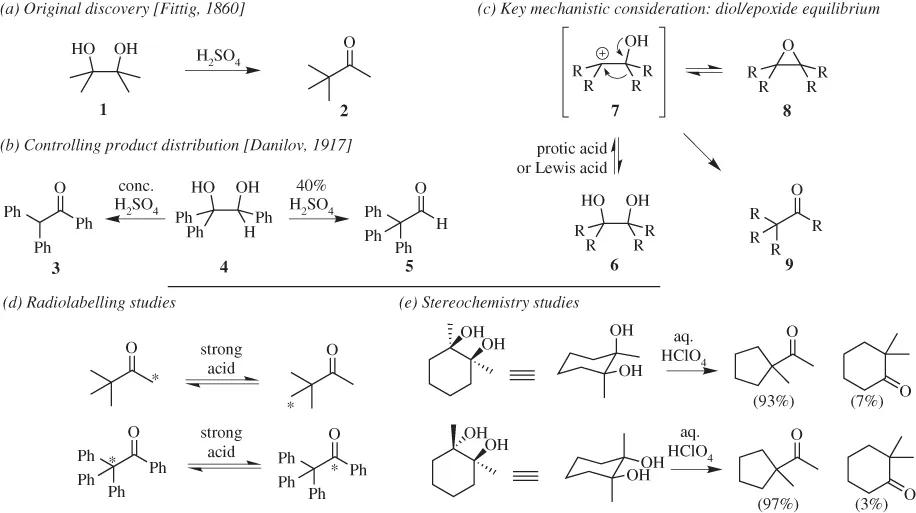
We begin with the pinacol rearrangement, a reaction process whose name derives from the starting material used in the earliest known example of the transformation. That event, the exposure of pinacol (1, 2,3-dimethylbutane-2,3-diol; Scheme 1.1) to sulfuric acid, produced pinacolone (2, 3,3-dimethylbutane-2-one). Although this reaction was first performed by Fittig in 1860,2 it was not until the early 1870s that the actual structure of the product was confirmed by Butlerov3; this lapse not only reflects the challenges of determining structure in that era but also the fact that rearrangements were effectively unknown. In fact, a contemporary publication by Kekulé (his seminal paper on representing organic structures) included rules which suggested that carbon skeletal rearrangements could not occur.4 In any event, by the end of the 19th century, the overall process depicted for the conversion of 1 to 2 was clear in terms of starting material and product. As additional substrates proved amenable to the process, the term pinacol rearrangement has since been used more broadly to define the conversion of any acyclic or cyclic vicinal diol into an aldehyde or ketone under acidic (proton or Lewis) conditions.5
Scheme 1.1 The pinacol rearrangement: discovery and key considerations.
Critically, as with many other skeletal rearrangements, there are subtleties that define both its mechanism as well as the products that can be generated from a given substrate under a specific set of reaction conditions. One early clue to that complexity derived from the observation by Danilov in 1917 that a single diol substrate (4) could yield different carbonyl-containing products (3 or 5) based solely on the strength of the acid deployed (Scheme 1.1b).6 Although these outcomes reflect kinetic control, that analysis, in and of itself, is insufficient given that separate study has shown that both 4 and 5 can interconvert, suggesting the prospect of reversibility as part of the pinacol rearrangement process itself. Indeed, that concept was beautifully illustrated by Fry in a subsequent series of elegant 14C-labeling studies which showed the transposition of carbon atoms of an array of pinacol “products” exposed to strongly acidic conditions (Scheme 1.1d).7 A second critical observation resides in the fact that a number of pinacol rearrangements produce epoxides in addition to the standard carbonyl-containing adduct. In some cases, these materials can be induced to rearrange to standard pinacol products, while in others, they are inert to the reaction conditions. Finally, there is a wide range of contexts, employing both protic acids and Lewis acids under varying reaction conditions, that can induce the rearrangement to occur for most individual substrates (with expected variations in yield).
Collectively, these findings indicate that very few mechanistic conclu...
Table of contents
Cover
Title Page
Copyright
Table of Contents
LIST OF CONTRIBUTORS
PREFACE
PART I: 1,2-MIGRATIONS
PART II: 1,2-MIGRATIONS VIA THREE-MEMBERED RINGS
PART III: 1,3-TRANSPOSITIONS
Part IV: [3,3]- AND [2,3]-SIGMATROPIC REARRANGEMENTS
PART V: IPSO REARRANGEMENTS
INDEX
End User License Agreement
Trusted by 375,005 students
Access to over 1.5 million titles for a fair monthly price.
Study more efficiently using our study tools.
Frequently asked questions
Yes, you can cancel anytime from the Subscription tab in your account settings on the Perlego website. Your subscription will stay active until the end of your current billing period. Learn how to cancel your subscription
No, books cannot be downloaded as external files, such as PDFs, for use outside of Perlego. However, you can download books within the Perlego app for offline reading on mobile or tablet. Learn how to download books offline
Perlego offers two plans: Essential and Complete
Essential is ideal for learners and professionals who enjoy exploring a wide range of subjects. Access the Essential Library with 800,000+ trusted titles and best-sellers across business, personal growth, and the humanities. Includes unlimited reading time and Standard Read Aloud voice.
Complete: Perfect for advanced learners and researchers needing full, unrestricted access. Unlock 1.5M+ books across hundreds of subjects, including academic and specialized titles. The Complete Plan also includes advanced features like Premium Read Aloud and Research Assistant.
Both plans are available with monthly, semester, or annual billing cycles.
We are an online textbook subscription service, where you can get access to an entire online library for less than the price of a single book per month. With over 1.5 million books across 990+ topics, we’ve got you covered! Learn about our mission
Look out for the read-aloud symbol on your next book to see if you can listen to it. The read-aloud tool reads text aloud for you, highlighting the text as it is being read. You can pause it, speed it up and slow it down. Learn more about Read Aloud
Yes! You can use the Perlego app on both iOS and Android devices to read anytime, anywhere — even offline. Perfect for commutes or when you’re on the go. Please note we cannot support devices running on iOS 13 and Android 7 or earlier. Learn more about using the app
Yes, you can access Molecular Rearrangements in Organic Synthesis by Christian M. Rojas in PDF and/or ePUB format, as well as other popular books in Physical Sciences & Chemistry. We have over 1.5 million books available in our catalogue for you to explore.