- English
- ePUB (mobile friendly)
- Available on iOS & Android
eBook - ePub
Animal Biology and Care
About this book
The perfect study companion, Animal Biology and Care, 3rd Edition is specifically designed for students on animal care, animal nursing assistant and veterinary care assistant courses. This edition is fully updated with new course content, a refreshed design and colour illustrations throughout. Basic biological theory is introduced with diagrams for visual learners while photographs demonstrate the common practical procedures carried out by animal care assistants.
Key features include:
- New content on exotic species, recognising the increasing number of these animals kept as pets.
- Extensive coverage of the Animal Welfare Act 2006 and recent advances in animal welfare.
- Written in line with course curricula, chapter summaries help you to remember key points and learning objectives.
- A companion website has interactive MCQs to help you test your knowledge.
Divided into three main sections covering animal science and genetics, health and husbandry and nursing procedures, this book will help lay the foundations for a successful career in animal care and management!
Frequently asked questions
Yes, you can cancel anytime from the Subscription tab in your account settings on the Perlego website. Your subscription will stay active until the end of your current billing period. Learn how to cancel your subscription.
No, books cannot be downloaded as external files, such as PDFs, for use outside of Perlego. However, you can download books within the Perlego app for offline reading on mobile or tablet. Learn more here.
Perlego offers two plans: Essential and Complete
- Essential is ideal for learners and professionals who enjoy exploring a wide range of subjects. Access the Essential Library with 800,000+ trusted titles and best-sellers across business, personal growth, and the humanities. Includes unlimited reading time and Standard Read Aloud voice.
- Complete: Perfect for advanced learners and researchers needing full, unrestricted access. Unlock 1.4M+ books across hundreds of subjects, including academic and specialized titles. The Complete Plan also includes advanced features like Premium Read Aloud and Research Assistant.
We are an online textbook subscription service, where you can get access to an entire online library for less than the price of a single book per month. With over 1 million books across 1000+ topics, we’ve got you covered! Learn more here.
Look out for the read-aloud symbol on your next book to see if you can listen to it. The read-aloud tool reads text aloud for you, highlighting the text as it is being read. You can pause it, speed it up and slow it down. Learn more here.
Yes! You can use the Perlego app on both iOS or Android devices to read anytime, anywhere — even offline. Perfect for commutes or when you’re on the go.
Please note we cannot support devices running on iOS 13 and Android 7 or earlier. Learn more about using the app.
Yes, you can access Animal Biology and Care by Sue Dallas,Emily Jewell in PDF and/or ePUB format, as well as other popular books in Medicine & Veterinary Medicine. We have over one million books available in our catalogue for you to explore.
Information
Section 1
Animal Biology
Chapter 1
Cells and Basic Tissues
Summary
In this chapter, the learning outcomes are:
- To understand the essential functions required to sustain life – MRS GREN
- To be able to identify the structure and function of animal cells and tissues
- To be able to recognize the diversity of animal cells and tissues in existence
What is biology?
Biology is the study of life and living organisms
What is life?
In order to be considered as a living organism, an organism must be able to perform all the following essential functions of life:
- Movement – the organism is capable of moving itself or a part of itself.
- Reproduction – the organism is capable of reproducing itself so that the species doesn’t die out.
- Sensitivity – to stimuli in its surroundings in order to avoid life-threatening occurrences in the environment.
- Growth – sustained growth from within by a process which involves the intake of new materials from the outside and their incorporation into the internal structure of the organism.
- Release of energy from respiration – in a controlled manner and in a form usable by the organism. The process of respiration releases energy from food to sustain life.
- Excretion – the removal of the waste products of metabolism from the organism.
- Nutrition – taking in food materials which provide energy to maintain life and growth.
The cell is the simplest functional unit of all tissues and has the ability to perform individually all the essential life functions. Organisms may be single-celled or multi-celled. Within the multicellular organisms, the constituent cells show a wide range of specialisations. Cells can be viewed as the building blocks of the body, and so the following can be said:
- Cells form…
- Tissues, and tissues form…
- Organs, and organs… join together to form systems within the body.
- Systems have a specific function to perform in the living organism.
The diversity of cells
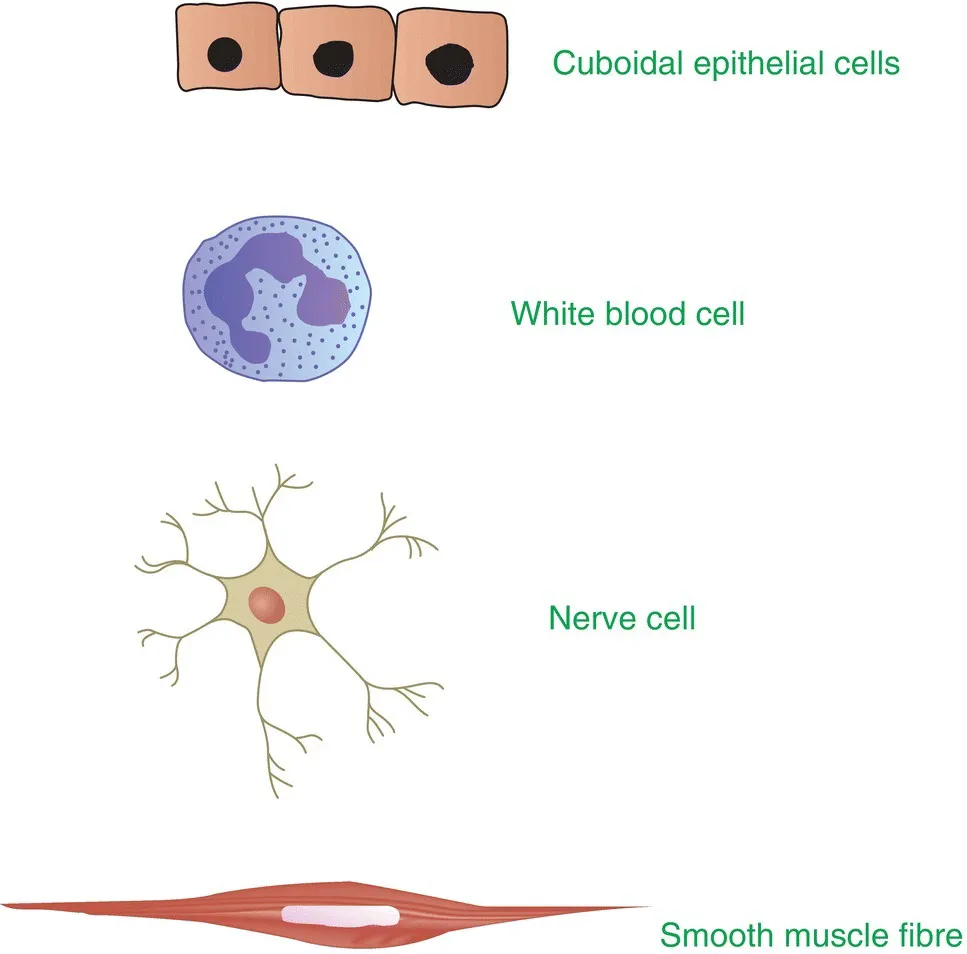
Cells are not all identical (Fig. 1.1) but all have the same basic structure. Each component of a cell is known as an organelle:

Fig. 1.1 Diversity of cells from their basic form.
- Cell membrane – the surrounding membrane of the cell which encloses the cytoplasm and is only 0.00001 mm in thickness. The cell membrane is the outer boundary that controls all exchanges between the cell and its surrounding environment. The cell membrane allows certain chemicals to pass in and out of the cell either by diffusion, osmosis or active transport. The cell membrane is described as being selectively permeable.
- Nucleus – acts as the cell’s brain and controls the cell’s activities and there is usually only one nucleus in the cell. The nucleus also contains the chromosomes.
- Cytoplasm – a jelly-like material that supports the organelles within the cell. It contains enzymes and many other chemicals that aid cell metabolism.
- Chromosomes – rod-shaped components that contain the hereditary information of the organism. Chromosomes contain deoxyribonucleic acid (DNA) which controls the characteristics that an organism inherits from its parents.
- Mitochondria – the energy-producing organelles where cell respiration takes place.
- Endoplasmic reticulum (ER) – is a series of tubules acting as a transport and packaging system. ER may be rough ER or smooth ER. Rough...
Table of contents
- Cover
- Title page
- Copyright page
- Preface
- Acknowledgments
- Section 1: Animal Biology
- Section 2: Animal Health and Husbandry
- Section 3: Nursing
- Further Reading
- Appendix: Anatomy and Physiology Terminology
- Index
- Access to Companion Site
- End User License Agreement