- Presents the first complete mindfulness program designed to improve the personal and professional well-being and effectiveness of therapists themselves
- Features an 8-week introduction to mindfulness in the form of exercises designed to help therapists develop their own meditation practice and apply it to their lives
- Integrates key research that includes the Five Facets of Mindfulness, the Three-Person-Perspectives approach, and the neurobiological foundations of mindfulness training
- Supported by online meditations and exercises for therapists
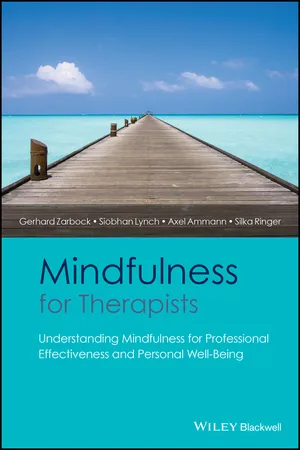
eBook - ePub
Mindfulness for Therapists
Understanding Mindfulness for Professional Effectiveness and Personal Well-Being
- English
- ePUB (mobile friendly)
- Available on iOS & Android
eBook - ePub
Mindfulness for Therapists
Understanding Mindfulness for Professional Effectiveness and Personal Well-Being
About this book
Mindfulness for Therapists presents an innovative eight-week mindfulness protocol designed to aid therapists—which may be worked through alone or in small groups
Trusted by 375,005 students
Access to over 1.5 million titles for a fair monthly price.
Study more efficiently using our study tools.
Information

1
Welcome
Before we begin you might like to pause for a moment and consider what ‘mindfulness’ means to you. What thoughts or images pop up? Perhaps you already know about mindfulness and have your own personal practice? Or maybe this is all quite new for you?
There is no single ‘right’ answer or absolute definition of mindfulness, not least because the term is used in many different ways in the literature (Hayes & Wilson, 2003). However, perhaps the most useful starting point is the ever-popular definition given by Jon Kabat-Zinn, who developed mindfulness-based stress reduction (MBSR) with colleagues back in the late 1970s. Kabat-Zinn describes mindfulness as: “paying attention in a particular way, on purpose, in the present moment, and non-judgmentally” (1994, p. 4).
While the modern Western psychological understanding of mindfulness does not simply adopt Buddhist notions, and although mindfulness is generally considered to be a natural human quality which can be cultivated with regular practice, it is important to acknowledge that secular mindfulness-based approaches have a strong grounding in Buddhist meditation. Within a Buddhist context, mindfulness has been described as:
characterized by dispassionate, non-evaluative, and sustained moment-to-moment awareness of perceptible mental states and processes. This denotes continuous, immediate awareness of physical sensations, perceptions, affective states, thoughts and imagery”(Grossman, 2010, p. 88).
While these definitions emphasise that mindfulness encompasses more than ‘just’ attention, it is clear that attention plays a central role (Chiesa & Malinowski, 2011). How do these definitions fit in with your initial reflections?
We will touch on the scientific literature surrounding the nature of mindfulness and the established benefits of mindfulness training in Chapter 2, for those of you who are not overly familiar with the field. However, the purpose of this book isn’t to tell you what mindfulness is, but rather to serve as an invitation to explore it for yourself. The material is aimed at those who provide some form of psychological therapy or support, but may be equally useful for those in a variety of helping professions, such as social workers, mental health project workers or medical practitioners. Equally, the material may also be useful for those who work in other capacities, such as educators.
Being a therapist is mentally and emotionally draining, regardless of whether you are ‘freshly minted’ or an ‘old hand’. Research suggests that mindfulness training is beneficial for those in the helping professions and may serve as a useful self-care practice (Irving, Dobkin, & Park, 2009). There is some evidence that suggests that therapists who have trained in mindfulness may actually have better client outcomes, although the “jury is still out on this question” (Labbé, 2011, p. 30). The mindfulness for therapists programme presented in Chapter 3 includes a series of meditations and exercises to help you discover new ways of bringing your practice into your therapy room. Regular mindfulness practice supports the development of a decentred perspective, allowing you to step back and observe your attitudes, feelings and approaches to yourself and your client. Regular practice is absolutely essential and lies at the heart of all modern mindfulness training (Malinowski, 2008). Of course this is common sense – if you wanted to learn to play the piano you wouldn’t expect to be able to play after only a couple of lessons! This fits in with the research, where there appears to be a relationship between the time individuals spent practising formal meditation and the levels of change observed in measures of mindfulness and well-being (Carmody & Baer, 2008). It might be useful to take a moment to reflect on whether you’re really prepared to incorporate some regular practice into your life.
For those who use mindfulness therapeutically, this book offers a way to incorporate mindfulness practice into your working day. Several years ago, some of us offered training in MBSR for therapists. The participants were fascinated by the idea of mindfulness and MBSR, but they were really looking for the most useful exercises and approaches they could use with their clients immediately. While this may be appropriate in many therapeutic approaches, mindfulness is different in that it is not possible to apply the ‘see one, do one’ approach. It takes time and practice to develop a personal experience and understanding of mindfulness, which is necessary before one can instruct others in an authentic way. If the support you provide for your clients as they begin to develop their own mindfulness practice is based on your own practice you are able to give a different quality of support and encouragement, rooted in a deep understanding of the difficulties encountered in mindfulness meditation.
Of course, we do not want to judge those of you who may have tried mindfulness exercises with your clients without practising yourself! Instead we would like to emphasise our view that in order to support your clients with their mindfulness practice credibly and successfully in the long term, it is essential that your guidance is rooted in your own practice.
As you work your way through this book you will be introduced to different practices which we hope will help you to develop and embed your personal mindfulness practice into your daily life. Recordings of all of the exercises are available online (see www.wiley.com/go/zarbock/mindfulnessfortherapists). Please see About the Companion Website at the back of the book for more details. The key types of practices are presented below.
Formal Mindfulness Exercises
These include meditations that focus on the breath, the body and mindful movement. Such formal exercises are usually practised regularly throughout the week. It is helpful to practise at least five times per week for a minimum of 20 minutes. It can be helpful to have an established place to practise, perhaps a corner of your study or bedroom. It is also useful to think ahead and plan a regular time to practise (e.g. in the morning before work, during lunch, etc.). Many people choose to attend some sort of group to support their practice and provide inspiration. Depending on your own preferences, you may find that attending a weekly yoga or Tai Chi class may suit you better than attending a meditation group.
Informal Mindfulness Exercises (Personal and Professional Lives)
These exercises help you to create moments of mindfulness in your everyday life. The book provides many suggestions as to how you can create such mini oases of mindfulness in your day. For example, you may choose to make the first few sips of your morning tea or coffee a mindfulness practice, or perhaps you could use the walk from your desk to the door as an opportunity to notice the pressure and weight of your feet on the floor, the changing pressure as you pick up your foot and the motion as you move your leg forward, ready to take your next step.
Therapist Role Mindfulness Exercises
These exercises centre on you and your role as a therapist. They aim to help you embed your mindfulness practice in your therapeutic work. For example, you may ‘check in’ with yourself before your client arrives, noticing bodily sensations or any thoughts or feelings which surface. During the session you may take a moment to check in with yourself again, noticing how you are sitting in your chair or the tone of your voice. There are many such examples throughout the book.
Joint Mindfulness Exercises
These joint mindfulness exercises have been designed to be done together with your client. The book includes several examples, such as the use of a joint breathing space or of short joint meditations as a way of closing a therapeutic session.
Intensive Exercises
Regular periods of intensive practice are a mainstay of most mindfulness training. If you are serious about your personal practice and bringing mindfulness into your lives, an intensive period of practice is highly recommended. Such periods can range from a single day to seven or ten days (or more). There are a variety of accessible retreats, from different traditions, which you might like to attend as you develop and expand your practice. For example, you might like to try a Vipassana, Zen or Yoga retreat. As the evidence mounts that mindfulness training is beneficial for therapists, it seems likely that there will be an increase in the support available specifically for therapists and those in the helping professions. We hope that this book will contribute to the ongoing growth and development of this field.
Client Exercises
We have also included a number of exercises which you can use with your clients. It is important that the decision to embark on these exercises is made jointly, as of course the client actually...
Table of contents
- Cover
- Title page
- Copyright page
- Acknowledgments
- 1 Welcome
- 2 Mindfulness
- 3 Bringing Mindfulness Into Your Life
- 4 Extending Your Practice
- 5 Short Manual for Running a Group Based on the Presented Material
- 6 Frequently Asked Questions (FAQ)
- Further Reading
- Index
- Access the Companion Website
- End User License Agreement
Frequently asked questions
Yes, you can cancel anytime from the Subscription tab in your account settings on the Perlego website. Your subscription will stay active until the end of your current billing period. Learn how to cancel your subscription
No, books cannot be downloaded as external files, such as PDFs, for use outside of Perlego. However, you can download books within the Perlego app for offline reading on mobile or tablet. Learn how to download books offline
Perlego offers two plans: Essential and Complete
- Essential is ideal for learners and professionals who enjoy exploring a wide range of subjects. Access the Essential Library with 800,000+ trusted titles and best-sellers across business, personal growth, and the humanities. Includes unlimited reading time and Standard Read Aloud voice.
- Complete: Perfect for advanced learners and researchers needing full, unrestricted access. Unlock 1.5M+ books across hundreds of subjects, including academic and specialized titles. The Complete Plan also includes advanced features like Premium Read Aloud and Research Assistant.
We are an online textbook subscription service, where you can get access to an entire online library for less than the price of a single book per month. With over 1.5 million books across 990+ topics, we’ve got you covered! Learn about our mission
Look out for the read-aloud symbol on your next book to see if you can listen to it. The read-aloud tool reads text aloud for you, highlighting the text as it is being read. You can pause it, speed it up and slow it down. Learn more about Read Aloud
Yes! You can use the Perlego app on both iOS and Android devices to read anytime, anywhere — even offline. Perfect for commutes or when you’re on the go.
Please note we cannot support devices running on iOS 13 and Android 7 or earlier. Learn more about using the app
Please note we cannot support devices running on iOS 13 and Android 7 or earlier. Learn more about using the app
Yes, you can access Mindfulness for Therapists by Gerhard Zarbock,Siobhan Lynch,Axel Ammann,Silka Ringer in PDF and/or ePUB format, as well as other popular books in Psychology & Psychotherapy. We have over 1.5 million books available in our catalogue for you to explore.