- English
- ePUB (mobile friendly)
- Available on iOS & Android
eBook - ePub
About this book
Substation Automation Systems: Design and Implementation aims to close the gap created by fast changing technologies impacting on a series of legacy principles related to how substation secondary systems are conceived and implemented. It is intended to help those who have to define and implement SAS, whilst also conforming to the current industry best practice standards.
Key features:
- Project-oriented approach to all practical aspects of SAS design and project development.
- Uniquely focusses on the rapidly changing control aspect of substation design, using novel communication technologies and IEDs (Intelligent Electronic Devices).
- Covers the complete chain of SAS components and related equipment instead of purely concentrating on intelligent electronic devices and communication networks.
- Discusses control and monitoring facilities for auxiliary power systems.
- Contributes significantly to the understanding of the standard IEC 61850, which is viewed as a "black box" for a significant number of professionals around the world.
- Explains standard IEC 61850 – Communication networks and systems for power utility automation – to support all new systems networked to perform control, monitoring, automation, metering and protection functions.
Written for practical application, this book is a valuable resource for professionals operating within different SAS project stages including the: specification process; contracting process; design and engineering process; integration process; testing process and the operation and maintenance process.
Frequently asked questions
Yes, you can cancel anytime from the Subscription tab in your account settings on the Perlego website. Your subscription will stay active until the end of your current billing period. Learn how to cancel your subscription.
No, books cannot be downloaded as external files, such as PDFs, for use outside of Perlego. However, you can download books within the Perlego app for offline reading on mobile or tablet. Learn more here.
Perlego offers two plans: Essential and Complete
- Essential is ideal for learners and professionals who enjoy exploring a wide range of subjects. Access the Essential Library with 800,000+ trusted titles and best-sellers across business, personal growth, and the humanities. Includes unlimited reading time and Standard Read Aloud voice.
- Complete: Perfect for advanced learners and researchers needing full, unrestricted access. Unlock 1.4M+ books across hundreds of subjects, including academic and specialized titles. The Complete Plan also includes advanced features like Premium Read Aloud and Research Assistant.
We are an online textbook subscription service, where you can get access to an entire online library for less than the price of a single book per month. With over 1 million books across 1000+ topics, we’ve got you covered! Learn more here.
Look out for the read-aloud symbol on your next book to see if you can listen to it. The read-aloud tool reads text aloud for you, highlighting the text as it is being read. You can pause it, speed it up and slow it down. Learn more here.
Yes! You can use the Perlego app on both iOS or Android devices to read anytime, anywhere — even offline. Perfect for commutes or when you’re on the go.
Please note we cannot support devices running on iOS 13 and Android 7 or earlier. Learn more about using the app.
Yes, you can access Substation Automation Systems by Evelio Padilla in PDF and/or ePUB format, as well as other popular books in Physical Sciences & Energy. We have over one million books available in our catalogue for you to explore.
Information
1
Historical Evolution of Substation Automation Systems (SASs)
The key goal in the operation of electrical power systems is to maintain the energy balance between generation and demand in an economic manner. This often requires changes in system configuration to keep voltage and frequency parameters at acceptable pre-specified ranges; furthermore, configuration changes are needed for maintenance work at utility installations or for clearing faults due to short-circuit currents. Typical changes in system configurations include connection and disconnection of generators, power transformers, transmission lines, shunt reactors and static reactive power compensators. Therefore, such changes in system configuration are made through control facilities available in both generation stations and substations located along transmission and distribution systems (see a view of a substation in Figure 1.1).

Figure 1.1 View of a 765 kV electric substation.
Source: © Corpoelec. Reproduced with permission of Corpoelec
Until a few decades ago, the control of electric substations was based on systems consisting of discrete electronic or electromechanical elements, where several functions were carried out separately by specific subsystems. Although those arrangements were reliable because the failure of a subsystem does not affect the performance of the rest of control facilities, it was also quite expensive, as they require a large investment in wiring, cubicles and civil engineering work. Back then, stations were controlled through a large mimic control board located in the main control house, as shown in Figure 1.2.

Figure 1.2 Old mimic control board.
Source: © Corpoelec. Reproduced with permission of Corpoelec
Sometimes, primary arrangements of substations were placed outside control cubicles lodged in dedicated relay rooms (Figure 1.3).

Figure 1.3 Substation primary arrangement shown outside control cubicles.
Source: © Corpoelec. Reproduced with permission of Corpoelec
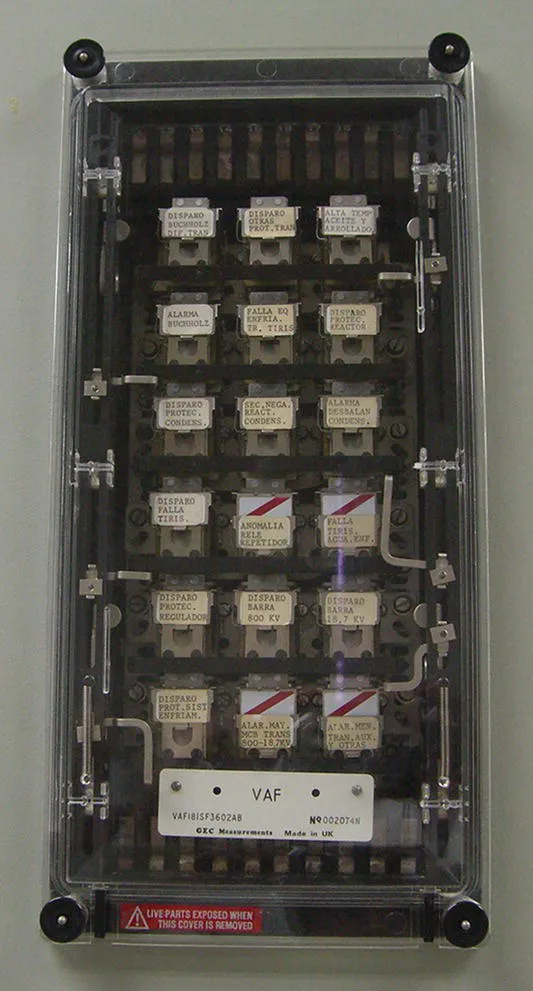
One of the most emblematic components of that age was the flag relay shown in Figure 1.4, which was the main way to display alarms for the attention of the substation operator.

Figure 1.4 Flag relay.
Source: © Corpoelec. Reproduced with permission of Corpoelec
In terms of civil engineering work, some substations were provided with large concrete channels where several kilometers of copper cables were run, as shown in Figure 1.5.

Figure 1.5 Old cabling channels.
Source: © Corpoelec. Reproduced with permission of Corpoelec
When microprocessor based substation control systems were originally developed, they were conceived as RTU-centric architecture, and later a distributed LAN architecture became the predominant technology. In more recent years, when control systems and other secondary systems began to incorporate new communication technologies and Intelligent Electronic Devices (IEDs), the complete set of secondary facilities and functionalities was referred to as “Substation Automation Systems” (SASs).
1.1 Emerging Communication Technologies
Development of communication technologies represents an important step allowing SASs to be more and more versatile and increase functionality. The most influential new technologies applied in substations are described in the following sections.
1.1.1 Serial Communication
Serial communication is the process of sending data one bit at a time, over a single communication line. In contrast, parallel communication requires at least as many lines as there are bits in a word being transmitted. This kind of communication was widely used at the beginning of the digital technology incursion in substations; in particular for relay to relay connections through a RS-232 interface. In recent years, instead of serial communication, Ethernet connectivity is gaining a place.
1.1.2 Local Area Network
As a group of computers/devices connected together locally to communicate with one another and share resources, this solution was early dedicated to office environments and later introduced to industrial applications, including substations. The use of LANs in a substation is increasing, in particular the Ethernet LAN specified in Standard IEEE 802.3.
1.2 Intelligent Electronic Devices (IEDs)
Generally, this refers to any device provided with one or several microprocessors able to receive/send data to or from another element. The most common IEDs used in substations are the following types:
1.2.1 Functional Relays
Digital relays (sometimes called computer relays, numerical relays or microprocessor-based relays) are devices that accept inputs and process them using logical algorithms to develop outputs addressed to make decisions resulting in trip commands or alarm signals. Early on, this kind of relay was designed to replace existing electrome...
Table of contents
- Cover
- Title Page
- Table of Contents
- Preface
- Acknowledgments
- List of Abbreviations
- 1 Historical Evolution of Substation Automation Systems (SASs)
- 2 Main Functions of Substation Automation Systems
- 3 Impact of the IEC 61850 Standard on SAS Projects
- 4 Switchyard Level, Equipment and Interfaces
- 5 Bay Level: Components and Incident Factors
- 6 Station Level: Facilities and Functions
- 7 System Functionalities
- 8 System Inputs and Outputs
- 9 System Engineering
- 10 Communication with the Remote Control Center
- 11 System Attributes
- 12 Tests on SAS Components
- 13 Factory Acceptance Tests
- 14 Commissioning Process
- 15 Training Strategies for Power Utilities
- 16 Planning and Development of SAS Projects
- 17 Quality Managementfor SAS Projects
- 18 SAS Engineering Process According to Standard IEC 61850
- 19 Future Technological Trends
- Appendix A Samples of Equipment and System Signal Lists
- Appendix B Project Drawing List: Titles and Contents
- Appendix C Essential Tips Related to Networking Technology
- Index
- End User License Agreement