Illustrated Guide to Door Hardware: Design, Specification, Selection
eBook - ePub

Illustrated Guide to Door Hardware: Design, Specification, Selection

  1. English
  2. ePUB (mobile friendly)
  3. Available on iOS & Android
eBook - ePub

Illustrated Guide to Door Hardware: Design, Specification, Selection

About this book

Your one-stop, comprehensive guide to commercial doors and door hardware—from the brand you trust

Illustrated Guide to Door Hardware: Design, Specification, Selection is the only book of its kind to compile all the relevant information regarding design, specifications, crafting, and reviewing shop drawings for door openings in one easy-to-access place. Content is presented consistently across chapters so professionals can find what they need quickly and reliably, and the book is illustrated with charts, photographs, and architectural details to more easily and meaningfully convey key information. Organized according to industry standards, each chapter focuses on a component of the door opening or door hardware and provides all options available, complete with everything professionals need to know about that component.

When designing, specifying, creating, and reviewing shop drawings for door openings, there are many elements to consider: physical items, such as the door, frame, and hanging devices; the opening's function; local codes and standards related to fire, life safety, and accessibility; aesthetics; quality and longevity versus cost; hardware cycle tests; security considerations; and electrified hardware requirements, to name a few. Until now, there hasn't been a single resource for this information.

  • The only resource available that consolidates all the door and hardware standards and guidelines into one comprehensive publication
  • Consistently formatted across chapters and topics for ease of use
  • Packed with drawings and photographs
  • Serves as a valuable study aid for DHI's certification exams

If you're a professional tired of referring to numerous product magazines or endless online searches only to find short, out-of-date material, Illustrated Guide to Door Hardware: Design, Specification, Selection gives you everything you need in one convenient, comprehensive resource.
Frequently asked questions

Yes, you can cancel anytime from the Subscription tab in your account settings on the Perlego website. Your subscription will stay active until the end of your current billing period. Learn how to cancel your subscription.
No, books cannot be downloaded as external files, such as PDFs, for use outside of Perlego. However, you can download books within the Perlego app for offline reading on mobile or tablet. Learn more here.
Perlego offers two plans: Essential and Complete
  • Essential is ideal for learners and professionals who enjoy exploring a wide range of subjects. Access the Essential Library with 800,000+ trusted titles and best-sellers across business, personal growth, and the humanities. Includes unlimited reading time and Standard Read Aloud voice.
  • Complete: Perfect for advanced learners and researchers needing full, unrestricted access. Unlock 1.4M+ books across hundreds of subjects, including academic and specialized titles. The Complete Plan also includes advanced features like Premium Read Aloud and Research Assistant.
Both plans are available with monthly, semester, or annual billing cycles.
We are an online textbook subscription service, where you can get access to an entire online library for less than the price of a single book per month. With over 1 million books across 1000+ topics, we’ve got you covered! Learn more here.
Look out for the read-aloud symbol on your next book to see if you can listen to it. The read-aloud tool reads text aloud for you, highlighting the text as it is being read. You can pause it, speed it up and slow it down. Learn more here.
Yes! You can use the Perlego app on both iOS or Android devices to read anytime, anywhere — even offline. Perfect for commutes or when you’re on the go.
Please note we cannot support devices running on iOS 13 and Android 7 or earlier. Learn more about using the app.
Yes, you can access Illustrated Guide to Door Hardware: Design, Specification, Selection by Scott Tobias in PDF and/or ePUB format, as well as other popular books in Architecture & Architecture General. We have over one million books available in our catalogue for you to explore.

Information

Publisher
Wiley
Year
2015
Print ISBN
9781118112618
eBook ISBN
9781118330272

Chapter 1
Hanging Devices

As discussed in the Introduction, the first type of device addressed in the Door and Hardware Institute's Sequence and Format for the Hardware Schedule is the hanging device. Although not typically a highlight of the door opening, the hanging device is one of the most important components. Supporting the entire weight of the door from the top, bottom, side, or a combination, the hanging device is relied on for its precise and consistent pivot point swing or slide, and is probably the most actively used door opening component.
Depending on the type of door, its function, and application, doors can be hung onto a door frame, onto a framed opening, or directly on a wall. A swinging door can be hung on hinges, continuous hinges, pivots, or floor closers, while a sliding door can be hung on tracks and hangers suspended from the top underneath the head of a framed opening, on the face of the wall, or supported by the floor from underneath the door. The most efficient and effective way to hang a door would be any means supported by the floor rather than the frame or wall. This creates less or no tension on the frame or wall where the door by nature is pulling away, whereas a door supported by the floor is resting on top and has no tension at all.
Although a swinging door is the most common type, sliding door options and use have increased over recent years because of their functionality, space-saving ability, and aesthetics.

HINGES

Also Known As: Butts, Butt Hinges, Standard Hinges

DESCRIPTION

Hinges are manufactured to accommodate various door sizes, thicknesses, weights, new and existing conditions, and fire ratings. Special hinge applications are available for specific situations, which include healthcare and those that have particular aesthetic needs, sound requirements, or door and frame applied materials.
image
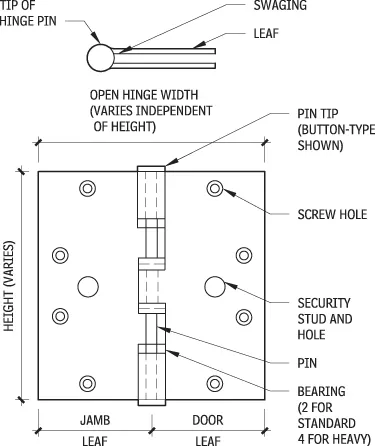
Figure 1.1 Elements of a Hinge
(Source: The Graphic Standards Guide to Architectural Finishes, John Wiley & Sons, Inc.)

PROPERTIES

Hinges are typically manufactured with two leaves that have alternating knuckles, which meet to form a barrel, and a hinge pin holds the leaves together as one. This gives a hinge the ability to rotate or swing a door into the open or closed position.
A hinge pin typically has a flat tipped end so that it rests against the top of the hinge barrel so that the pin does not fall through. With that said, although most commercial hinges are manufactured with pins that are “nonrising,” they still have the ability to rise if nothing is holding them in place as a nonremovable pin option (see Nonremovable Pin in the hinge options section of this chapter). Other pin options are what are known as fast pins, which are more difficult to remove in the field as they are either riveted or threaded into the barrel, similar to the way a screw is with threads. This type of pin might be most desirable on out-swinging, or reverse bevel, doors so that the pins cannot be easily removed, the door taken off its hinges, and the opening left unsecure.
Although the majority of barrels are round, some manufacturers offer square barrel hinges for a different aesthetic. Screw holes are typically countersunk, unless one is using a special hinge type such as the slip-in hinge (see Slip-In under Types in this section).

Bearings

Also known as anti-friction bearings, these are hinges that are manufactured with bearings separate the metal of the knuckles, keeping them from directly touching and pivoting on each other. The inserts, which can be plastic, ball bearings or oil-impregnated bearings, create a barrier between the metal parts, eliminating metal friction, which causes less wear on the knuckles than a nonbearing hinge would.
BALL BEARING
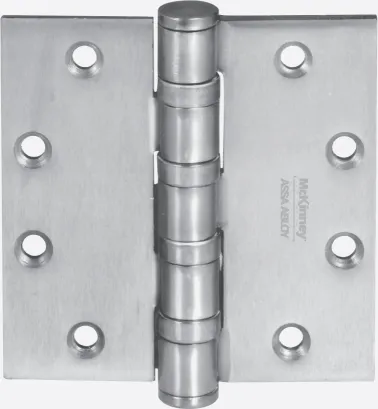
Ball bearing hinges are manufactured with a metal ring inserted in between each knuckle of the barrel with ball bearings inside each ring, very similar to the wheels of roller skates, which help them roll more smoothly and with less friction. Most commonly, the ball bearing rings are visible, creating additional shear lines in the appearance.
image
Figure 1.2 Heavyweight Ball Bearing Full Mortise Butt Hinge
(Source: Courtesy of McKinney® Products Company)
image
Figure 1.3 Nonbearing Full Mortise Butt Hinge
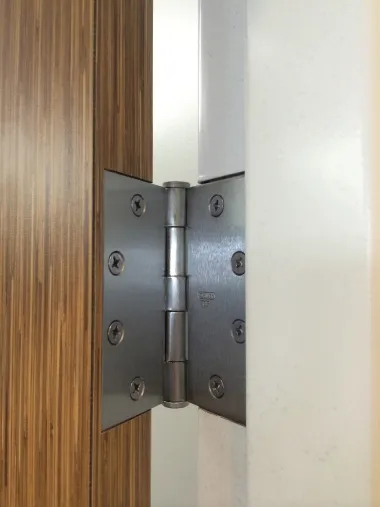
(Source: Courtesy of Scott J. Tobias)
Available as an option ...

Table of contents

  1. Cover
  2. Title Page
  3. Copyright
  4. Table of Contents
  5. Foreword
  6. Acknowledgments
  7. User Guide
  8. Introduction
  9. Chapter 1: Hanging Devices
  10. Chapter 2: Securing Devices
  11. Chapter 3: Operating Trim
  12. Chapter 4: Accessories for Pairs of Doors Only
  13. Chapter 5: Closing and Control Devices
  14. Chapter 6: Protective Plates and Trim
  15. Chapter 7: Stops and Holders
  16. Chapter 8: Accessories
  17. Chapter 9: Miscellaneous Items
  18. Chapter 10: Miscellaneous Items
  19. Index
  20. End User License Agreement