With new medications, medical therapies, and increasing numbers of older and medically complex patients seeking dental care, all dentists, hygienists, and students must understand the intersection of common diseases, medical management, and dental management to coordinate and deliver safe care.
This new second edition updates all of the protocols and guidelines for treatment and medications and adds more information to aid with patient medical assessments, and clearly organizes individual conditions under three headings: background, medical management, and dental management. Written by more than 25 expert academics and clinicians, this evidence-based guide takes a patient-focused approach to help you deliver safe, coordinated oral health care for patients with medical conditions.
Other sections contain disease descriptions, pathogenesis, coordination of care between the dentist and physician, and key questions to ask the patient and physician.
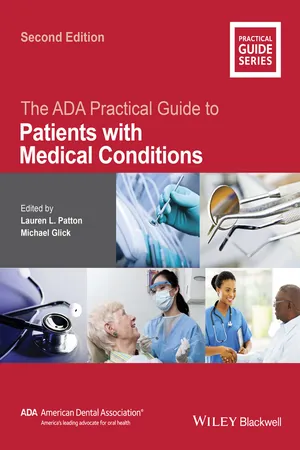
eBook - ePub
The ADA Practical Guide to Patients with Medical Conditions
- English
- ePUB (mobile friendly)
- Available on iOS & Android
eBook - ePub
The ADA Practical Guide to Patients with Medical Conditions
About this book
Information
1
Medical History, Physical Evaluation, and Risk Assessment
Lauren L. Patton, DDS
Abbreviations used in this chapter
| ADA | American Dental Association |
| ASA | American Society of Anesthesiologists |
| GERD | gastroesophageal reflux disease |
| PS | physical status |
I. Background
The US and global population demographics are constantly changing, chronic diseases are becoming more prevalent, new medications are being developed and brought to the market, and new and reemerging infectious diseases are being identified. The average life expectancy in the USA increased from 70.0 years to 76.2 years for males and from 77.4 years to 81.0 years for females in the 30 years between 1980 and 2010.1 With this increased life expectancy comes an increase in chronic medical conditions. Americans’ use of prescription drugs has grown over the past half-century due to many factors, with almost one-half of the US population taking at least one prescription drug in the preceding month and 1 in 10 taking five or more drugs.1
More patients seeking oral health care have underlying medical conditions that may alter oral health status, treatment approaches, and outcomes. The challenges of medical history information gathering and risk assessment required for safe dental treatment planning and care delivery will be discussed and presented in a practical manner applicable to day-to-day needs of the general practice dentist. There are four key considerations that serve as a framework for assessing and managing the risks of dental care used in this book, although additional considerations may be relevant for certain medical conditions. The key considerations are impaired hemostasis, susceptibility to infections, drug actions/interactions, and ability to tolerate the stress of dental care. The potential for the dental practice to encounter different types of medical emergencies is related to the patient’s medical health, adequacy of management, and stress tolerance.
Four key risks of dental care
- Impaired hemostasis
- Susceptibility to infections
- Drug actions/interactions
- Patient’s ability to tolerate dental care
II. Medical History
A medical history can be recorded by the patient in advance of the dental appointment and reviewed by providers seeking clarification of patient responses. In the national shift to electronic health records, medical history, medications, and allergies may be recorded in a number of data collection formats and in a variety of settings, including use of web-based applications. Personal information should be kept private and shared only in compliance with privacy rules.
An example is the American Dental Association (ADA) Health History Form (see Fig. 1.1; available at http://www.ada.org), which is comprised of the following:
- demographic information;
- screening questions for active tuberculosis;
- dental information;
- medical information, including physician contact information;
- hospitalizations, illnesses, and surgeri...
Table of contents
- Cover
- Titlepage
- Copyright
- Accessing Dr. Glick's Medical Support Website
- Contributors
- Preface
- Acknowledgments
- Chapter 1: Medical History, Physical Evaluation, and Risk Assessment
- Chapter 2: Cardiovascular Diseases
- Chapter 3: Pulmonary Disease
- Chapter 4: Endocrine and Metabolic Disorders
- Chapter 5: Kidney Disease
- Chapter 6: Hepatic Disease
- Chapter 7: Gastrointestinal Disease
- Chapter 8: Hematological Disease
- Chapter 9: Bleeding Disorders
- Chapter 10: Autoimmune and Connective Tissue Diseases
- Chapter 11: Human Immunodeficiency Virus/Acquired Immune Deficiency Syndrome and Related Conditions
- Chapter 12: Immunological and Mucocutaneous Disease
- Chapter 13: Head and Neck Cancer
- Chapter 14: Neurological Disorders
- Chapter 15: Neurodevelopmental and Psychiatric Disorders
- Chapter 16: Substance Use Disorders
- Chapter 17: Developmental Defects of the Craniofacial Complex and Orthopedic Disorders
- Chapter 18: Geriatric Health and Functional Issues
- Chapter 19: Women’s Health
- Chapter 20: Medical Emergencies
- Chapter 21: Medical Screening/Assessment in the Dental Office
- Appendix: List of Common Drugs
- Index
- EULA
Trusted by 375,005 students
Access to over 1.5 million titles for a fair monthly price.
Study more efficiently using our study tools.
Frequently asked questions
Yes, you can cancel anytime from the Subscription tab in your account settings on the Perlego website. Your subscription will stay active until the end of your current billing period. Learn how to cancel your subscription
No, books cannot be downloaded as external files, such as PDFs, for use outside of Perlego. However, you can download books within the Perlego app for offline reading on mobile or tablet. Learn how to download books offline
We are an online textbook subscription service, where you can get access to an entire online library for less than the price of a single book per month. With over 1.5 million books across 990+ topics, we’ve got you covered! Learn about our mission
Look out for the read-aloud symbol on your next book to see if you can listen to it. The read-aloud tool reads text aloud for you, highlighting the text as it is being read. You can pause it, speed it up and slow it down. Learn more about Read Aloud
Yes! You can use the Perlego app on both iOS and Android devices to read anytime, anywhere — even offline. Perfect for commutes or when you’re on the go.
Please note we cannot support devices running on iOS 13 and Android 7 or earlier. Learn more about using the app
Please note we cannot support devices running on iOS 13 and Android 7 or earlier. Learn more about using the app
Yes, you can access The ADA Practical Guide to Patients with Medical Conditions by Lauren L. Patton, Michael Glick in PDF and/or ePUB format, as well as other popular books in Medicine & Dentistry. We have over 1.5 million books available in our catalogue for you to explore.