Jones' Clinical Paediatric Surgery
  1. English
  2. ePUB (mobile friendly)
  3. Available on iOS & Android
eBook - ePub

About this book

JONES' CLINICAL PAEDIATRIC SURGERY

Jones' Clinical Paediatric Surgery provides clear-sighted advice on the surgical options available for young patients.

Building on the popular and successful style of previous editions, this fully revised seventh edition employs a systematic approach to the childhood diseases that need surgical treatment. It includes more case vignettes and colour photographs, expanded coverage on the use of imaging, and updated approaches to management including laparoscopic operations. Key subject areas are supported by case vignettes in a familiar format similar to what might appear in an OSCE viva.

Jones' Clinical Paediatric Surgery is the ideal guide for paeditricians, surgeons and trainees, as well as primary care physicians, junior doctors and medical students.

Frequently asked questions

Yes, you can cancel anytime from the Subscription tab in your account settings on the Perlego website. Your subscription will stay active until the end of your current billing period. Learn how to cancel your subscription.
No, books cannot be downloaded as external files, such as PDFs, for use outside of Perlego. However, you can download books within the Perlego app for offline reading on mobile or tablet. Learn more here.
Perlego offers two plans: Essential and Complete
  • Essential is ideal for learners and professionals who enjoy exploring a wide range of subjects. Access the Essential Library with 800,000+ trusted titles and best-sellers across business, personal growth, and the humanities. Includes unlimited reading time and Standard Read Aloud voice.
  • Complete: Perfect for advanced learners and researchers needing full, unrestricted access. Unlock 1.4M+ books across hundreds of subjects, including academic and specialized titles. The Complete Plan also includes advanced features like Premium Read Aloud and Research Assistant.
Both plans are available with monthly, semester, or annual billing cycles.
We are an online textbook subscription service, where you can get access to an entire online library for less than the price of a single book per month. With over 1 million books across 1000+ topics, weโ€™ve got you covered! Learn more here.
Look out for the read-aloud symbol on your next book to see if you can listen to it. The read-aloud tool reads text aloud for you, highlighting the text as it is being read. You can pause it, speed it up and slow it down. Learn more here.
Yes! You can use the Perlego app on both iOS or Android devices to read anytime, anywhere โ€” even offline. Perfect for commutes or when youโ€™re on the go.
Please note we cannot support devices running on iOS 13 and Android 7 or earlier. Learn more about using the app.
Yes, you can access Jones' Clinical Paediatric Surgery by John M. Hutson, Michael O'Brien, Spencer W. Beasley, Warwick J. Teague, Sebastian K. King, John M. Hutson,Michael O'Brien,Spencer W. Beasley,Warwick J. Teague,Sebastian K. King in PDF and/or ePUB format, as well as other popular books in Medicine & Surgery & Surgical Medicine. We have over one million books available in our catalogue for you to explore.

Information

PART I
Introduction

Chapter 1
Antenatal Diagnosis: Surgical Aspects

Case 1

At 18 weeks' gestation, right fetal hydronephrosis is diagnosed on ultrasonography.
  • Q 1.1 Discuss the further management during pregnancy.
  • Q 1.2 Does antenatal diagnosis improve the postnatal outlook for this condition?

Case 2

An exomphalos is diagnosed on the 18-week ultrasound scan.
  • Q 2.1 What further evaluation is required at this stage?
  • Q 2.2 Does this anomaly influence the timing and mode of delivery?
Antenatal diagnosis is one of the most rapidly developing fields in medical practice. While the genetic and biochemical evaluation of the developing fetus provides the key to many medical diagnoses, the development of accurate ultrasound has provided the impetus to the diagnosis of surgical fetal anomalies. At first, it was expected that antenatal diagnosis of fetal problems would lead to better treatment and an improved outcome. In some cases, this is true. Antenatally diagnosed fetuses with gastroschisis are now routinely delivered in a tertiary-level obstetric hospital with neonatal intensive care in order to prevent hypothermia and delays in surgical treatment, and the results of treatment have improved. In other cases, such as congenital diaphragmatic hernia, these expectations have not been fulfilled because antenatal diagnosis has revealed a number of complex and lethal anomalies which in the past never survived the pregnancy and were recorded in the statistics of fetal death in utero and stillbirth.

Indications and timing for antenatal ultrasound

Most pregnancies are now assessed with a mid-trimester morphology ultrasound scan, which is usually performed at 18โ€“20 weeks' gestation [Fig.1.1]. The main purpose of this examination is to assess the obstetric parameters of the pregnancy, but the increasingly important secondary role of this study is to screen the fetus for anomalies. Most fetal anomalies can be diagnosed at 18 weeks, but some only become apparent later in the pregnancy. Renal anomalies are best seen on a 30-week ultrasound scan, as urine flow is low before 24 weeks. Earlier transvaginal scanning may be performed in special circumstances, such as a previous pregnancy with neural tube defect, and increasingly to detect early signs of aneuploidy. Fetal magnetic resonance imaging is increasingly being used to assess the developing fetus in cases of suspected or confirmed fetal anomalies without exposing the fetus or mother to ionising radiation.
c1-fig-0001
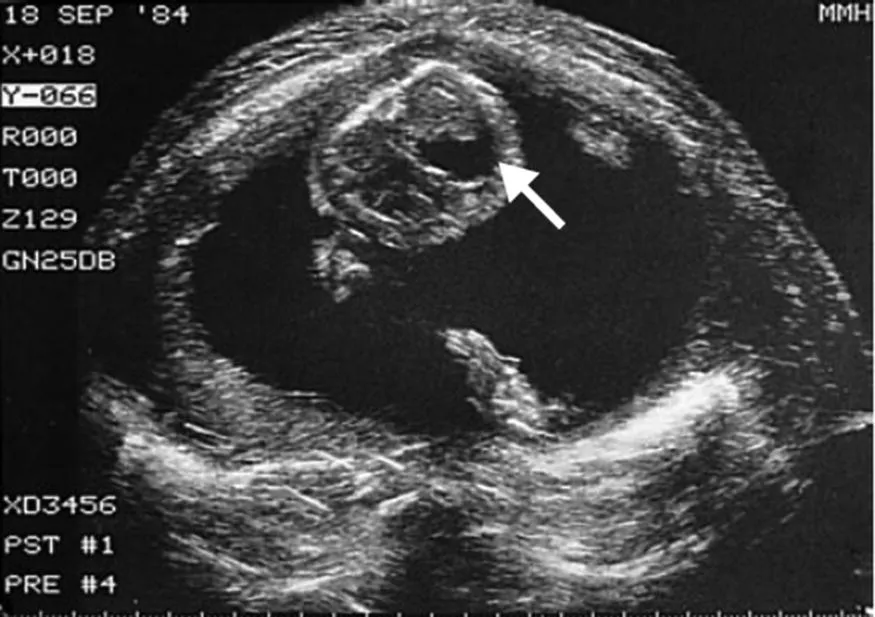
Figure 1.1 (a) Encephalocele shown in a cross section of the fetal head. The sac protruding through the posterior skull defect is arrowed. (b) Bilateral hydronephrosis shown in an upper abdominal section. The dilated renal pelvis containing clear fluid is marked. (c) The irregular outline of the free-floating bowel in the amniotic cavity of a term baby with gastroschisis. (d) A longitudinal section through a 14-week fetus showing a large exomphalos. The head is seen to the left of the picture. The large sac (marked) is seen between blurred (moving) images of the arms and legs.

Natural history of fetal anomalies

Before the advent of ultrasonography (as earlier), paediatric surgeons saw only a selected group of infants with congenital anomalies. These babies had survived the pregnancy and lived long enough after birth to reach surgical attention. Thus, the babies coming to surgical treatment were already a selected group, mostly with a good prognosis.
Antenatal diagnosis has exposed surgeons to a new group of conditions with a poor prognosis, and at last, the full spectrum of pathology is coming to surgical attention. For example, posterior urethral valve causing obstruction of the urinary tract was thought to be rare, with an incidence of 1:5000 male births; most cases did well with postnatal valve resection. It is now known that the true incidence of urethral valve is 1:2500 male births, and these additional cases did not come to surgical attention as they developed intrauterine renal failure, with either fetal death or early neonatal death from respiratory failure because of Potter syndrome. It was thought that antenatal diagnosis would improve the outcome of such congenital anomalies, but the overall results have appeared to become worse with the inclusion of these severe new cases.
In the same way, antenatal diagnosis has exposed the significant hidden mortality of congenital diaphragmatic hernia [Fig. 1.2]. Previously, congenital diaphragmatic hernia diagnosed after birth was not commonly associated with multiple congenital anomalies, but now, antenatal diagnosis has uncovered a more severe subgroup with associated chromosomal anomalies and multiple developmental defects. It is now apparent that the earlier the congenital diaphragmatic hernia is diagnosed in utero, the worse the outcome.
c1-fig-0002
Figure 1.2 Cross section of a uterus with marked polyhydramnios. The fetal chest is seen in cross section within the uterus. The fluid-filled cavity within the left side of the chest is the stomach protruding through a congenital diaphragmatic hernia (arrow).
Despite these problems, there are many advantages in antenatal diagnosis. The outcomes of many congenital anomalies are improved by prior knowledge of them before birth.

Management following antenatal diagnosis

Fetal management

Cases diagnosed antenatally may be classified into three groups:

Good prognosis

In some cases, such as a unilateral hydronephrosis, there is no role for active antenatal management, and the main task is to document the progress of the condition through pregnancy with serial ultrasound scans. The detailed diagnosis is made with the more sophisticated range of tests available after birth, and the incidence of urinary tract infections (UTIs) may be reduced with prophylactic antibiotics commenced at birth. Thus, a child with severe vesicoureteric reflux may go through the first year of life without any UTIs. If the parents receive counselling by an experienced surgeon, they have time to understand the condition, its treatment and prognosis. With such preparation, the family may cope better with the birth of a baby with a congenital anomaly.
The paediatric surgeon also has an important role to play in advising the obstetrician on the prognosis of a particular condition. Some cases of exomphalos are easy to repair, whereas in others, the defect may be so large that primary repair will be d...

Table of contents

  1. Cover
  2. Title page
  3. Copyright page
  4. Contributors
  5. Foreword to the First Edition
  6. Tribute to Mr. Peter Jones
  7. Preface to the Seventh Edition
  8. Acknowledgements
  9. PART I: Introduction
  10. PART II: Neonatal Emergencies
  11. PART III: Head and Neck
  12. PART IV: Abdomen
  13. PART V: Urinary Tract
  14. PART VI: Trauma
  15. PART VII: Orthopaedics
  16. PART VIII: Chest
  17. PART IX: Skin and Soft Tissues
  18. Index
  19. End User License Agreement