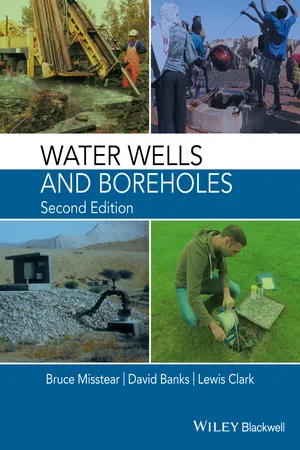
Water Wells and Boreholes
eBook - ePub

Water Wells and Boreholes

  1. English
  2. ePUB (mobile friendly)
  3. Available on iOS & Android
eBook - ePub

Water Wells and Boreholes

About this book

Water Wells and Boreholes focuses on wells that are used for drinking, industry, agriculture or other supply purposes. Other types of wells and boreholes are also covered, including boreholes for monitoring groundwater level and groundwater quality. This fully revised second edition updates and expands the content of the original book whilst maintaining its practical emphasis. The book follows a life-cycle approach to water wells, from identifying a suitable well site through to successful implementation, operation and maintenance of the well, to its eventual decommissioning.

Completely revised and updated throughout, Water Wells and Boreholes, Second edition, is the ideal reference for final-year undergraduate students in geology and civil engineering; graduate students in hydrogeology, civil engineering and environmental sciences; research students who use well data in their research; professionals in hydrogeology, water engineering, environmental engineering and geotechnical engineering; and aid workers and others involved in well projects.

Frequently asked questions

Yes, you can cancel anytime from the Subscription tab in your account settings on the Perlego website. Your subscription will stay active until the end of your current billing period. Learn how to cancel your subscription.
No, books cannot be downloaded as external files, such as PDFs, for use outside of Perlego. However, you can download books within the Perlego app for offline reading on mobile or tablet. Learn more here.
Perlego offers two plans: Essential and Complete
  • Essential is ideal for learners and professionals who enjoy exploring a wide range of subjects. Access the Essential Library with 800,000+ trusted titles and best-sellers across business, personal growth, and the humanities. Includes unlimited reading time and Standard Read Aloud voice.
  • Complete: Perfect for advanced learners and researchers needing full, unrestricted access. Unlock 1.4M+ books across hundreds of subjects, including academic and specialized titles. The Complete Plan also includes advanced features like Premium Read Aloud and Research Assistant.
Both plans are available with monthly, semester, or annual billing cycles.
We are an online textbook subscription service, where you can get access to an entire online library for less than the price of a single book per month. With over 1 million books across 1000+ topics, we’ve got you covered! Learn more here.
Look out for the read-aloud symbol on your next book to see if you can listen to it. The read-aloud tool reads text aloud for you, highlighting the text as it is being read. You can pause it, speed it up and slow it down. Learn more here.
Yes! You can use the Perlego app on both iOS or Android devices to read anytime, anywhere — even offline. Perfect for commutes or when you’re on the go.
Please note we cannot support devices running on iOS 13 and Android 7 or earlier. Learn more about using the app.
Yes, you can access Water Wells and Boreholes by Bruce Misstear,David Banks,Lewis Clark in PDF and/or ePUB format, as well as other popular books in Physical Sciences & Hydrology. We have over one million books available in our catalogue for you to explore.

Information

Year
2017
Print ISBN
9781118951705
eBook ISBN
9781118951682
Edition
2
Subtopic
Hydrology

1
Introduction

1.1 Wells and boreholes

Water wells in some form or other have existed for almost as long a time as people have occupied this planet. The earliest wells were probably simple constructions around springs and seeps, or shallow excavations in dry river beds, but such wells have not left any traces for archaeologists. One of the oldest well discoveries is in Cyprus, dating from 7000 to 9000 BC (Fagan, 2011), whilst the earliest well remains in China have been dated at around 3700 BC (Zhou et al., 2011). Since the first millennium BC, horizontal wells or qanats have been widely used for water supply and irrigation in the Middle East and western Asia, notably Iran, and continue to be used today (Figure 1.1). In Europe, the development of many towns and cities in the middle ages and on through the industrial period was aided considerably by the abstraction of relatively pure water supplies from wells and springs (Figure 1.2). In the nineteenth century, new drilling technology was used to construct deep wells to exploit artesian (flowing) aquifers (see Section 1.2 for explanations of aquifer terminology), including the Grenelle well in the Paris basin, which was drilled between 1833 and 1841, and reached a depth of 548 m (Margat et al., 2013). The first mechanically‐drilled well in the United States dates from 1823, whereas the first drilled well in the Great Artesian Basin of Australia was constructed in 1878 (Margat and van der Gun, 2013).
Photo displaying an open section of falaj (qanat) running through a town in northern Oman.
Figure 1.1 Open section of falaj (qanat) running through a town in northern Oman. Here, the channel is divided into three, with two of the channels then rejoining (at the bottom of the picture), in order to produce a two‐thirds: one third split in the flow downstream. This Falaj al Khatmeen is included on the UNESCO list of World Heritage Sites.
Photo by Bruce Misstear
Photo displaying hand‐dug well in Brittany, France.
Figure 1.2 Hand‐dug well in Brittany, France.
Photo by Bruce Misstear
Wells continue to have an important role in society today. Some 2 billion people obtain their drinking water supplies directly from drilled or hand‐dug wells (UNICEF and WHO, 2012). A further 4 billion people have access to piped water or public taps, a proportion of which will be sourced from groundwater, so it is likely that more than 3 billion people worldwide rely on water wells for their drinking water. Over half the public water supplies in European Union countries come from groundwater, ranging from between 20% and 30% of drinking water supplied in Spain and the United Kingdom, to nearly 100% in Austria, Lithuania and Denmark (Hiscock et al., 2002).
The largest use of groundwater worldwide is for irrigation (70%), with India, China and the United States the leading countries in terms of total groundwater withdrawals (Margat and van der Gun, 2013). The last 30 years have witnessed a huge increase in the use of wells for agricultural irrigation, especially in Asia (Figure 1.3): in China 54% of irrigation water is supplied from groundwater while this proportion rises to 89% in India and 94% in Pakistan. In the United States, groundwater pumping increased by 144% between 1950 and 1980, with 71% of the annual withdrawal of 111.7 km3 in 2010 being used for irrigated agriculture (Margat and van der Gun, 2013). According to the National Ground Water Association, 44...

Table of contents

  1. Cover
  2. Title Page
  3. Table of Contents
  4. Preface to Second Edition
  5. Preface to First Edition
  6. Lewis Clark (1937–2004): An Appreciation
  7. Acknowledgements
  8. 1 Introduction
  9. 2 Groundwater Investigations for Locating Well Sites
  10. 3 An Introduction to Well and Borehole Design
  11. 4 Issues in Well Design and Specialist Applications
  12. 5 Well and Borehole Construction
  13. 6 Formation Sampling and Identification
  14. 7 Well and Borehole Testing
  15. 8 Groundwater Sampling and Analysis
  16. 9 Well Monitoring and Maintenance
  17. 10 Well and Borehole Records
  18. Appendix 1: Units and Conversion Tables
  19. Appendix 2: Hydraulic Equations for Groundwater Engineers
  20. Appendix 3: Health and Safety Plans
  21. Appendix 4: World Health Organization Drinking Water Guidelines
  22. Appendix 5: FAO Irrigation Water Quality Guidelines
  23. References
  24. Index
  25. End User License Agreement