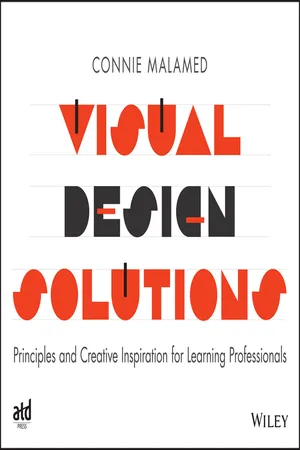
Visual Design Solutions
eBook - ePub

Visual Design Solutions

Principles and Creative Inspiration for Learning Professionals

  1. English
  2. ePUB (mobile friendly)
  3. Available on iOS & Android
eBook - ePub

Visual Design Solutions

Principles and Creative Inspiration for Learning Professionals

About this book

Enhance learners' interest and understanding with visual design for instructional and information products

No matter what medium you use to deliver content, if the visual design fails, the experience falls flat. Meaningful graphics and a compelling visual design supercharge instruction, training, and presentations, but this isn't easy to accomplish. Now you can conquer your design fears and knowledge gaps with Visual Design Solutions: a resource for learning professionals seeking to raise the bar on their graphics and visual design skills. This informal and friendly book guides you through the process and principles used by professional graphic designers. It also presents creative solutions and examples that you can start using right away. Anyone who envisions, designs, or creates instructional or informational graphics will benefit from the design strategies laid out in this comprehensive resource.

Written by Connie Malamed, an art educator and instructional designer, this book will help you tap into your creativity, design with intention, and produce polished work. Whereas most graphic design books focus on logos, packaging, and brochures, Visual Design Solutions focuses on eLearning, presentations, and performance support. Visual Design Solutions includes practical guidelines for making smart design choices, ways to create professional-looking products, and principles for successful graphics that facilitate learning. Ideal for instructional designers, trainers, presenters, and professors who want to advance from haphazard to intentional design, this book will help them realize their design potential.

  • Gain the knowledge and confidence to design impressive, effective visuals for learning
  • Increase learner comprehension and retention with visual strategies offered by an expert author
  • Serves as a reference and a resource, with a wealth of examples for inspiration and ideas
  • Addresses an intimidating topic in an informal, friendly style

In four parts, the book provides a thorough overview of the design process and design concepts; explores space, image, and typography; and presents workable solutions for your most persistent and puzzling design problems. Get started and begin creating captivating graphics for your learners.

Frequently asked questions

Yes, you can cancel anytime from the Subscription tab in your account settings on the Perlego website. Your subscription will stay active until the end of your current billing period. Learn how to cancel your subscription.
No, books cannot be downloaded as external files, such as PDFs, for use outside of Perlego. However, you can download books within the Perlego app for offline reading on mobile or tablet. Learn more here.
Perlego offers two plans: Essential and Complete
  • Essential is ideal for learners and professionals who enjoy exploring a wide range of subjects. Access the Essential Library with 800,000+ trusted titles and best-sellers across business, personal growth, and the humanities. Includes unlimited reading time and Standard Read Aloud voice.
  • Complete: Perfect for advanced learners and researchers needing full, unrestricted access. Unlock 1.4M+ books across hundreds of subjects, including academic and specialized titles. The Complete Plan also includes advanced features like Premium Read Aloud and Research Assistant.
Both plans are available with monthly, semester, or annual billing cycles.
We are an online textbook subscription service, where you can get access to an entire online library for less than the price of a single book per month. With over 1 million books across 1000+ topics, we’ve got you covered! Learn more here.
Look out for the read-aloud symbol on your next book to see if you can listen to it. The read-aloud tool reads text aloud for you, highlighting the text as it is being read. You can pause it, speed it up and slow it down. Learn more here.
Yes! You can use the Perlego app on both iOS or Android devices to read anytime, anywhere — even offline. Perfect for commutes or when you’re on the go.
Please note we cannot support devices running on iOS 13 and Android 7 or earlier. Learn more about using the app.
Yes, you can access Visual Design Solutions by Connie Malamed in PDF and/or ePUB format, as well as other popular books in Business & Human Resource Management. We have over one million books available in our catalogue for you to explore.

Information

Publisher
Wiley
Year
2015
Print ISBN
9781118863565
eBook ISBN
9781118864043

Part 1

The Big Ideas

Growing into the role of a designer means seeing, thinking, and working like one. This section describes the impact of visual design and how to embrace the role of the designer.

Chapter 1
Like a Hand in Glove

“The need for clear and imaginative communication has never been greater.”
— Phillip B. Meggs

The Framework

THIS CHAPTER answers these questions:
  • Why do visuals benefit learning?
  • How can I use visuals to improve learning?
  • What is the impact of visual design on learning?

Learning design and visual design go together like a hand in glove. They are a perfect fit for each other, yet it's rare to hear the terms spoken in the same breath. Even those who acknowledge that graphics are essential for learning may not be aware of the reverberations that visual design has throughout a learning experience. Visual design affects the quality of learning, the value of the communication, and the motivation of the audience members. It leverages the brain's innate capabilities, improves engagement, and satisfies the audience's aesthetic sensibilities.
In this chapter, you'll gain a better understanding of why graphics benefit learning and how design affects the overall user experience.
end

The Visual Brain

There's something special about vision. Together the eye and brain work in ways that are no less than wondrous. Consider this. Our eyes are in nearly constant movement, but we rarely notice it. We rapidly recognize objects in complex scenes regardless of their size, color, position, and rotation.
We perceive depth precisely because a different image is registered with each eye. In normal vision, we see six million different colors and lots of detail, both close up and at a distance. We see with different acuity levels depending on the task we are performing (Kosslyn, 1994). We adapt to a wide range of light intensities, so we can see at dusk and also in bright light. And all of this occurs with little to no conscious awareness.
Scientists estimate that over 50 percent of the brain's cortex (the outside layer) is involved in visual processing (Snowden & Thompson, 2012), whereas auditory processing uses around 10 percent and the other senses use even less. Thus, our brains devote more resources to vision than to any other sense.
The pure physiological power of our visual system is a compelling argument for ensuring that you take advantage of the audience's visual intelligence as you design learning experiences.

Benefits to Learning

What happens when you look at a picture? (See Figure 1.1.) The process starts when your eyes pick up sensory data and send signals to a sensory register (also known as sensory or iconic memory). The information lasts here for less than a second and is sent to working memory. Through perceptual processes you select what to pay attention to, based on the features that catch your eye (during pre-attentive processing) and the visual patterns that are meaningful to your goals (during attentive processing).
c01f001
Figure 1.1 How we process visual information.
As you scan the picture, visual chunks are held in working memory for a few seconds. With help from your past experience and knowledge stored in long-term memory, you decode these marks on the screen or page. If the picture is easy to understand, this process happens rapidly. Visual perception is faster than thinking.
Research shows that text accompanied by relevant visuals is better for learning than text alone in many situations and under many conditions (Mayer, 2009). Pictures can strengthen visual discrimination by emphasizing important details. Visuals improve retention and aid in problem solving. Abstract visuals help people comprehend complex information and assist in building mental models. In fact, if you break the learning process down into smaller cognitive actions, you'll see that visuals can be valuable nearly every step of the way.

Pictures Capture Attention

Pictures are magnets for attention regardless of the medium. People usually look at the graphics of a web page before they read the text (Lin, Yeh, & Wei, 2013). The same is true for newspaper advertisements. Consumer research shows that pictorial ads are better at capturing attention than text ads, and this is true regardless of picture size (Goodrich, 2010; Pieters & Wedel, 2004).
In learning and information dissemination, pictures also draw attention. For example, in a study that explored the best way to convey messages about health risks, pictures attracted and held attention for a longer period of time than the same information produced in text alone (Smerecnik, Mesters, Kessels, Ruiter, De Vries, & De Vries, 2010).
Pictures of people and particularly pictures of faces summon our visual attention. Also, certain attributes capture attention without conscious awareness. Vivid colors, striking shapes, and motion capture pre-attentive attention.

Visuals Aid Recall

Encoding information in long-term memory is an essential activity of learning, and this is one more place where visuals shine. Relevant pictures help people remember corresponding text. By relevant, psychologists mean pictures that represent the objects or concepts presented in the text (Levie, 1987).
This may be due to the fact that our memory is typically better for concrete things than for abstractions. Pictures provide a concreteness—an association with a sensory experience—that has advantages over words, which are more symbolic.

Visuals Improve Comprehension

Pictures help learners understand complex text or narration because they convey information about spatial structure. We rely on the spatial structure of visuals to provide meaning. In a diagram or chart, designers use techniques that show relationships, such as placing related elements together in a group. This quickly communicates what is associated in a way that may be more difficult through text alone. The structural organization of a picture is thought to have a scaffolding effect that helps in the construction of new mental models (Eitel, 2013).
Because graph...

Table of contents

  1. Cover
  2. Title Page
  3. Copyright
  4. Table of Contents
  5. List of Figures and Tables
  6. Dedication
  7. Preface
  8. Introduction
  9. Part 1: The Big Ideas
  10. Part 2: Building Blocks Of Design
  11. Part 3: Power Principles
  12. Part 4: Practicing Design
  13. References
  14. About the Author
  15. Index
  16. End User License Agreement