In this handbook and ready reference, editors and authors from academia and industry share their in-depth knowledge of known and novel materials, devices and technologies with the reader. The result is a comprehensive overview of electrochemical energy and conversion methods, including batteries, fuel cells, supercapacitors, hydrogen generation and storage as well as solar energy conversion. Each chapter addresses electrochemical processes, materials, components, degradation mechanisms, device assembly and manufacturing, while also discussing the challenges and perspectives for each energy storage device in question. In addition, two introductory chapters acquaint readers with the fundamentals of energy storage and conversion, and with the general engineering aspects of electrochemical devices.
With its uniformly structured, self-contained chapters, this is ideal reading for entrants to the field as well as experienced researchers.
eBook - ePub
Electrochemical Technologies for Energy Storage and Conversion
- English
- ePUB (mobile friendly)
- Available on iOS & Android
eBook - ePub
Electrochemical Technologies for Energy Storage and Conversion
About this book
Trusted by 375,005 students
Access to over 1.5 million titles for a fair monthly price.
Study more efficiently using our study tools.
Information

1
Electrochemical Technologies for Energy Storage and Conversion
1.1 Introduction
In this chapter, authors review the contemporary demand, challenges and future prospective of energy resources and discuss the relevant socioeconomical and environmental issues with their impact on global energy status. A sincere effort has been made to explore the better energy options of clean and sustainable energy sources such as hydro, biomass, wind, solar, geothermal, and biofuel as an alternative to the conventional energy sources. Electrolysis, photoelectrochemical, and photocatalytic water-splitting techniques were adopted for green and light fuel generation. Advancement in electrochemical technology for energy storage and conversion devices such as rechargeable batteries, supercapacitors, and fuel cells are also briefed.
1.2 Global Energy Status: Demands, Challenges, and Future Perspectives
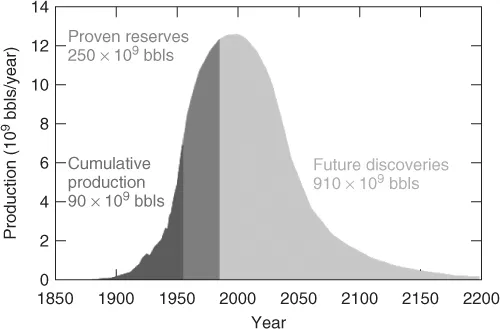
World's economy revolves around the axis of energy prices, which are primarily governed by the political consequences, environmental impact, social acceptance, availability, and demand. Nation-wise world's energy consumption plot (1980–2050) is depicted in Figure 1.1, which rated the United States, China, Russia, South Korea, and India as potential energy consumers. Energy consumption rate of our planet in 2007 was 16%, which would be accelerated to an alarming rate of 34% by 2050 (Figure 1.2) [1]. Our severe dependency on oil and electricity makes energy a vital component of our daily life [2]. Soaring prices of oil (starting from $42 per barrel in 2008 to $79 per barrel in 2010, to $108 per barrel in 2020 and $133 per barrel in 2035) as projected in Figure 1.3 [3] and other associated necessary commodities along various burning environmental issues resulted from industrial revolution compel us to give a careful thought on this serious issue. Figure 1.4 assesses the geographical region-wise oil reserve that projects the oil assets and capacities of the different regions [4]. The current global energy scenario is full of uncertainty and faces three major energy challenges in the form of energy demand/energy supply ratio and security and their impact on the environment. The present worldwide population of 6.9 billion needs 14 TW annual energy [5] to sustain the current standard of life. Of the total energy production, 45% is required for industries, 30% for transport, 20% for residential and commercial buildings, and the rest for services such as education, health, finance, government, and social services. Electricity is the world's fastest growing form of end-user energy consumption. Coal provides the largest share in the world's electricity generation, accounting for 42% in 2007, and its share will be largely unchanged through 2035. Rest share of the world's electricity generation is contributed by water, natural gas, nuclear power, hydropower, wind, and solar power. Economic trends and population growth drive the commercial sector activities and the resulting energy use. The need for services (health, educational, financial, and governmental) increases as population increases. Slower expansion of gross domestic product (GDP) and declining population growth rate in many organization for economic cooperation and development (OECD membership) nations contribute to slower anticipated rates of increase in commercial energy demand. In addition, continued efficiency improvements moderate the growth of energy demand over time, as energy-using equipment is replaced with newer and more efficient stock. World's projected population would be quadrupled by 2050, the energy use doubled and electricity consumption tripled to our present energy demand. According to Hubbert's bell-shaped curve [6] of the worldwide oil production projection, we have already attained the peak and now observe a downfall and finally, the oil will last for 200 years (Figure 1.5) [7]. Lord Ron Oxburgh, former chairman of Shell, gave the statement on oil production possibilities and price, “It is pretty clear that there is not much chance of finding any significant quantity of new cheap oil. Any new or unconventional oil is going to be expensive.” Despite the greenhouse gas concentrations approaching twice as those in the preindustrial period, coal and gasoline are still the major energy sources (34.3% oil, 25.9% coal, 20.9% gas, 13.1% renewables (10.4% combustion renewables and waste, 2.2% hydro, and 1.5% other renewables). Furthermore, alternative sustainable energy sources are still in the experimental stage; for example, some recent studies suggest that biofuels may not be as effective in reducing greenhouse gas emissions as previously thought. As a result, many countries have relaxed or postponed renewal of their mandates [8]. For example, Germany reduced its biofuel quota for 2009 from 6.25 to 5.25%. Therefore, governments, industrialists, and researchers have put their heads together on this leading energy issue with their concerns about the environmental challenges and renewed the interest in development of alternatives to fossil fuels, specifically, nuclear power, and renewable energy sources (wind, solar, biofuel, geothermal, tidal, hydro) using breakthrough concepts (catalysis by design, multielectron transfer) and accelerated application of cutting-edge scientific, engineering, and analytical tools. There are three major options of getting clean energy including carbon neutral energy (fossil fuel in conjunction with carbon sequestration), nuclear, and renewable energy. To satisfy the 10 TW no-carbon energy demands [9], a 38% conservation of energy for the next 50 years via combustion of fossil fuel is required, but the challenge of disposing 25 billion metric ton of CO2 annually needs to be conquered. The need for nuclear-powered energy required the establishment of 365 GW electric nuclear fission plants per year for 50 years. The amount of annual renewable trappable energy from resources is as follows: the most viable and abundantly sourced solar energy with a capacity of 12 000 TW; integrated overall geothermal energy, 12 TW; globally extractable wind power, 2–4 TW; tidal/ocean current, 2 TW; and hydroelectric energy, 0.5 TW. Among all sources, obviously solar energy stands out as a promising choice of renewable energy, and currently, we are exploiting it only for the satisfaction of 0.1% of the demand. Therefore, by reducing energy demand and emissions accompanied with the use of the diversifying energy sources, we should be able to meet our energy target.
Figure 1.1 Nation-wise world energy consumption in the time interval of 1980–2050.
(Energy Information Administration Annual Energy Review, 2007.)
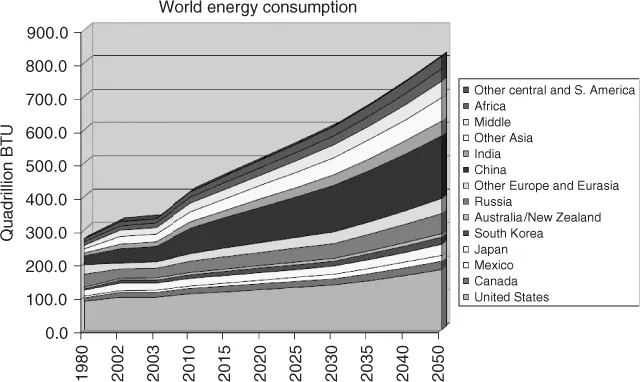
Figure 1.2 Comparative change in energy consumption rates of different zones against the world (actual reported for 2007 vs projected for 2050).
(Renewable in global energy supply: an IEA fact sheet, January 2007.)
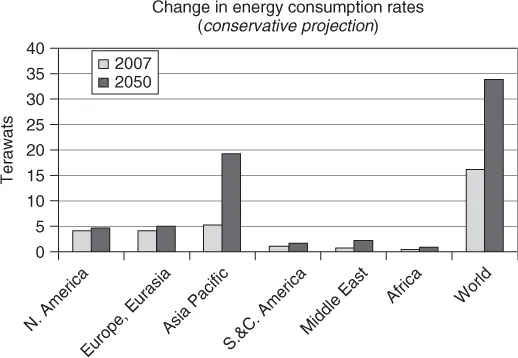
Figure 1.3 World oil prices in three oil price cases on the timescale of 1990–2035 ($2007 per barrel).
(1980–2035: EIA, Annual Energy Outlook 2010, DOE/EIA-0383(2010) (Washington, DC, April 2010), web site: www.eia.gov/oiaf/aeo.)
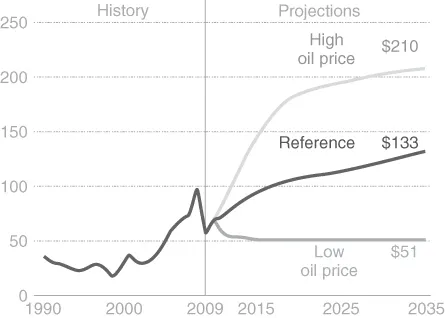
Figure 1.4 World's proved oil reserves by geographic region as of 1 January 2010 [4].
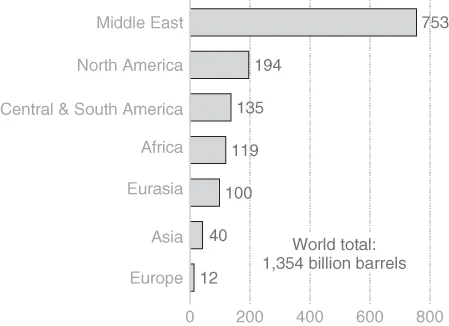
Figure 1.5 Hubbert's bell-shaped curve for time versus production of any exhaustible resources projection plot for the time interval 1850–2200 AC [7].
1.3 Driving Forces behind Clean and Sustainable Energy Sources
Our atmosphere is in a constant state of turmoil, and it is never being static. Relatively, internal and external changes in the earth's atmosphere, made by either Nature or man, bring changes in weather and climate. Scientific evidences pointed out the role of man in environmental degradation by insanely exploiting Mother Nature, which causes a disturbance in the delicate balance of Nature by accelerating global warming and associated climate changes, increasing ocean temperature, and bringing out changes in terrestrial geography, rain fall ratio, temperature, and type of soil. These changes fuel the growing consensus about the eminent need for a more pervasive action for environmental protection. Technological advancement attained during the past two decades has provided us a comfortable lifestyle full of facilities on a very high cost of resources consumption and degradation of our environment. The effect of the world's economic development on the environment was defined in the words of Elsa Reichmanis, the former president of the American Chemical Society, “We are past the days when we can trade environmental contamination for economical prosperity that is only a temporary bargain and the cost of pollution both economically and on human health is too high” [10]. However, it has ...
Table of contents
- Cover
- Related Titles
- Title Page
- Copyright
- Preface
- About the Editors
- List of Contributors
- Volume 1
- Volume 2
- Index
Frequently asked questions
Yes, you can cancel anytime from the Subscription tab in your account settings on the Perlego website. Your subscription will stay active until the end of your current billing period. Learn how to cancel your subscription
No, books cannot be downloaded as external files, such as PDFs, for use outside of Perlego. However, you can download books within the Perlego app for offline reading on mobile or tablet. Learn how to download books offline
Perlego offers two plans: Essential and Complete
- Essential is ideal for learners and professionals who enjoy exploring a wide range of subjects. Access the Essential Library with 800,000+ trusted titles and best-sellers across business, personal growth, and the humanities. Includes unlimited reading time and Standard Read Aloud voice.
- Complete: Perfect for advanced learners and researchers needing full, unrestricted access. Unlock 1.5M+ books across hundreds of subjects, including academic and specialized titles. The Complete Plan also includes advanced features like Premium Read Aloud and Research Assistant.
We are an online textbook subscription service, where you can get access to an entire online library for less than the price of a single book per month. With over 1.5 million books across 990+ topics, we’ve got you covered! Learn about our mission
Look out for the read-aloud symbol on your next book to see if you can listen to it. The read-aloud tool reads text aloud for you, highlighting the text as it is being read. You can pause it, speed it up and slow it down. Learn more about Read Aloud
Yes! You can use the Perlego app on both iOS and Android devices to read anytime, anywhere — even offline. Perfect for commutes or when you’re on the go.
Please note we cannot support devices running on iOS 13 and Android 7 or earlier. Learn more about using the app
Please note we cannot support devices running on iOS 13 and Android 7 or earlier. Learn more about using the app
Yes, you can access Electrochemical Technologies for Energy Storage and Conversion by Jiujun Zhang,Lei Zhang,Hansan Liu,Andy Sun,Ru-Shi Liu in PDF and/or ePUB format, as well as other popular books in Technology & Engineering & Electrical Engineering & Telecommunications. We have over 1.5 million books available in our catalogue for you to explore.