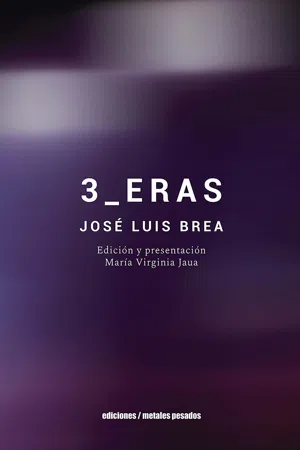
Este libro, único texto inédito —hasta ahora— de José Luis Brea, es un guion y nace a partir de la versión fílmica del libro Las tres eras de la imagen. El film de María Virginia Jaua y José Luis Brea incluye imágenes visuales y sonoras, la participación del autor y de algunos pensadores como Jean-Luc Nancy y Jacques Rancière. Hoy este film ve la vida a través de la palabra impresa.Al ser un guion se trata de un trabajo doblemente ensayístico. Por una parte, ensayo de las ideas pensadas, escritas, dichas; y, por otra, ensayo de la forma que estas adoptan en la pantalla.El resultado es un texto raro en el panorama de la producción teórica sobre la visualidad en español. Un trabajo que como señala José Luis Brea, nos invita a tomar ese cierto carácter emancipatorio que tiene el acto de conocer el trabajo histórico, para recuperar aquello que en su origen quedó como una promesa incumplida, no por utópica o intempestiva, sino por estar siempre a punto de cumplir su advenimiento, y que siempre marca el anhelado momento de un nuevo punto de partida…
- 194 páginas
- Spanish
- ePUB (apto para móviles)
- Disponible en iOS y Android
eBook - ePub
3_ERAS
Descripción del libro
Información
Categoría
ArteCategoría
Teoría y crítica del arte
text
Offscreen voice
image
Jodi, Untitled-game Spawn /
Jodi, Untitled-game Q-L
sound
Incidental
memories_of_a_never-been_future
Here the devices-memory do not look to the past: they do not want to “remember” anything, bring back to the present what has already happened. Here memories are above all generatrixes instances, devices that focus all of their energy to the production of what has never been. They are factory-memories, projections of the future and no longer memory-warehouse, remnant of a passed past.
What these images register, despite everything, is still an “already seen.” But, handled in the operators that modulate their syntactic architecture, that “already seen” that they enunciate only alludes to that which, with all of its burning heart, a time another longed to formulate, conscious of its incompleteness, in its yearning of something else…
Thus, these images are tension of utopia, memories of emancipation—and maybe remembrance of the unachieved, of the longed for in previous times.—Therefore, never simple repositories, repetition or resonance operators…
No: these images do not tell the story of what happened—that it was and always will be the overtaking that the victors make of history. But, maybe, the tenacious testimony of everything that, incorruptible, always refused to accept that the diminished life that it was allowed to live—was all that could be expected, demanded.
Perhaps, the inverted memory of the future that every past—at least as lived in its moment of maximum tension—would have desired to be.
text
Offscreen voice
image
computers
sound
IBM 7094, first computer programmed
to sing, singing Daisy Bell
ram_memories
(processing nucleus)
(processing nucleus)
So here there are no longer warehouses, but the work of tireless machines in constant activity. Here the weight and force of memory is not in any isolated object, but in the networks that bring it into play, that vague constellation in which it unfolds. Here memory is a game of interference and intercrosses, a total distribution in a flatland—absolutely no depth. Here memory is the assembly’s valence that each image in its distinctive feature has to link with so many others, in countless directions, in an unavoidable scattering…
These are memories of process, active imagination. Whose power of acting is the virtual infinity of its possible interlocking games. The swarming architecture in which it moves, the clustering in which it is embedded and lost. Thus, everything it remembers is the declension potential that the grid in which it moves holds: every image here is the incessant thought that the network challenges’with a near infinite base of other unites.
An aural sequence of dispersions, where each play increases the range of the equation a degree. In every direction, with no simultaneous order other than the asynchronousand —and atopic encounter. Here “everything that is” can be found—and in fact it does—with everything that is there too—without any order or sequencing, without invoking any common space-time coordinates.
That game of “infinite deliberation” prompts what we could call artificial intelligence, whether unique, whether possible. Only it thinks—for only in its thinking is authentic “poiesis,” a game of invention, not repetition but a powerful completion of free difference.
Yes: these images are jabs of pure activity, the dark force of a thought that no longer presupposes a soul or a conscience, nor the form of a subject—who thinks and arranges them. Not even a body of organs, nor-obviously—is there any promise of eternity, or even less so, fulfilled individuation. But rather this irrepressible movement that swarms everything with everything—sign with sign, form with form,—the deaf hardness of every place of mute matter with its elusive echoes...
text
Offscreen voice
image and sound
Ryoji Ikeda, data anatomy
anarchives
All the articulation of images with each other is played under the sign of indifference...
Índice
- PORTADA
- CRÉDITOS
- TÍTULO
- ÍNDICE
- 3_ERAS
- IMAGEN_MATERIA
- FILM
- E_IMAGE
- 3_ERAS. Translation by Armando Montesinos
- 3_ERAS
- MATTER_IMAGE
- FILM
- E_IMAGE
Cuenta con la confianza de 375,005 estudiantes
Acceso a más de 1,5 millones de títulos por un precio mensual justo.
Estudia de forma más eficiente usando nuestras herramientas de estudio.
Preguntas frecuentes
Sí, puedes cancelar tu suscripción en cualquier momento desde la pestaña Suscripción en los ajustes de tu cuenta en el sitio web de Perlego. La suscripción seguirá activa hasta que finalice el periodo de facturación actual. Descubre cómo cancelar tu suscripción
No, los libros no se pueden descargar como archivos externos, como los PDF, para usarlos fuera de Perlego. Sin embargo, puedes descargarlos en la aplicación de Perlego para leerlos sin conexión en el móvil o en una tableta. Descubre cómo descargar libros para leer sin conexión
Perlego ofrece dos planes: Esencial y Avanzado
- El plan Esencial es ideal para estudiantes y profesionales que disfrutan explorando una amplia gama de categorías. Accede a la Biblioteca Esencial con más de 800.000 títulos confiables y superventas en negocios, crecimiento personal y humanidades. Incluye tiempo de lectura ilimitado y voz estándar de Lectura en voz alta.
- Avanzado: perfecto para estudiantes avanzados e investigadores que necesitan acceso total y sin restricciones. Desbloquea más de 1,5 millones de libros en cientos de categorías, incluyendo títulos académicos y especializados. El plan Avanzado también incluye características avanzadas como Lectura en voz alta Premium y Asistente de investigación.
Somos un servicio de suscripción de libros de texto en línea, donde puedes acceder a toda una biblioteca digital por menos del precio de un solo libro al mes. Con más de 1,5 millones de libros en más de 990 categorías, ¡te tenemos cubierto! Conoce nuestra misión
Busca el símbolo de lectura en voz alta en tu próximo libro para ver si puedes escucharlo. La herramienta de lectura en voz alta lee el texto en voz alta por ti, resaltando el texto a medida que se lee. Puedes pausarla, acelerarla y ralentizarla. Obtén más información sobre la lectura en voz alta
¡Sí! Puedes usar la aplicación de Perlego en dispositivos iOS y Android para leer cuando y donde quieras, incluso sin conexión. Es ideal para cuando vas de un lado a otro o quieres acceder al contenido sobre la marcha.
Ten en cuenta que no será compatible con los dispositivos que se ejecuten en iOS 13 y Android 7 o en versiones anteriores. Obtén más información sobre cómo usar la aplicación
Ten en cuenta que no será compatible con los dispositivos que se ejecuten en iOS 13 y Android 7 o en versiones anteriores. Obtén más información sobre cómo usar la aplicación
Sí, puedes acceder a 3_ERAS de Jose Luis Brea en formato PDF o ePub, así como a otros libros populares en Arte y Teoría y crítica del arte. Tenemos más de 1,5 millones de libros disponibles en nuestro catálogo para que explores.